
Owusu on Africa
How Cheap Drones Are Reshaping Africa’s Conflicts and Diplomacy
With drones now accounting for roughly two-thirds of conflict-related deaths in Sudan this year, the continent faces a stark choice: master the governance of emerging military technologies, or watch them fragment African sovereignty from above.

By Fidel Amakye Owusu
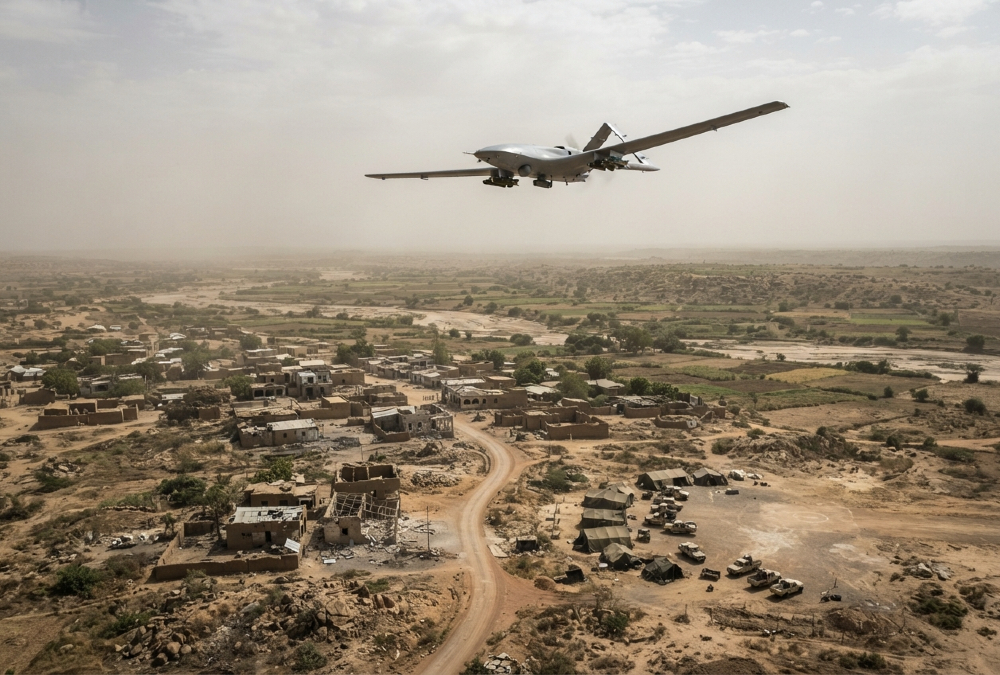
When Sudan’s generals went to war with each other in April 2023, they fought the way old armies do: with tanks, trucks and a few aging aircraft. Three years on, the conflict is being decided, and prolonged, by something far cheaper and far harder to hold to account. According to the United Nations, drones account for roughly two-thirds of the deaths recorded in Sudan so far this year. The weapon that was meant to make war precise has made it relentless.
Fighter Jets to Flying Bombs
The war began as a contest between two unequal forces. The Sudanese Armed Forces (SAF) held the sky. The Rapid Support Forces (RSF), a paramilitary force that grew out of the Janjaweed militias, held much of the ground. Early on, the SAF leaned on its air force to pound RSF positions. The paramilitaries adapted in ways that were as cynical as they were effective. They seized sensitive infrastructure and, at some sites, used civilians as human shields to deter air strikes.
It did not work for the SAF. Conventional air power proved costly, risky and unsustainable. Piloted aircraft are expensive to fly, harder to maintain under sanctions and shortages, and vulnerable to being shot down. Meanwhile, the RSF kept its grip on strategic ground, including large parts of Khartoum and its surroundings, despite the bombardment.
So the SAF turned to drones. The RSF, never keen to cede a technological edge, followed. Soon both sides were using increasingly sophisticated unmanned systems to hit each other’s positions and, with grim regularity, the infrastructure on which civilians depend.
Cheap Wars Drag On
Drones are seductive to commanders for obvious reasons. They are inexpensive relative to jets. They put no pilot at risk. They can loiter, strike and vanish, often leaving the question of who supplied or launched them conveniently murky. For a belligerent short on money, manpower or political patience, they are almost irresistible.
But the very qualities that make drones attractive on the battlefield make them corrosive to peace. A war that costs less to fight is a war that can be fought for longer. When neither side has to risk its own soldiers or pilots to inflict pain, the pressure to negotiate eases. Each army can persuade itself that one more wave of strikes will tip the balance. That is how drones have arguably become less a tool of victory than an engine of stalemate, frustrating the mediation efforts of the African Union, the Intergovernmental Authority on Development (IGAD) and Sudan’s international partners.
The human cost is stark. Rising civilian deaths are the most visible consequence. Less visible, but nearly as damaging, is the systematic destruction of power stations, fuel depots and other critical infrastructure. Sudanese displaced by the fighting are trying to return, mostly to areas under government control, and they are coming home to cities without reliable electricity, water or hospitals. Every strike on a substation lengthens the road to recovery and raises the price of rebuilding. In a country where millions have already been uprooted, a drone that darkens a city can be as devastating as one that kills.
A Continental Contagion?
Sudan is not the only place where drones are changing the calculus of conflict, and that is the larger worry. Over the past three years, drone-related incidents have strained relations between African governments from the Sahel to the Horn. Governments have accused neighbors of harboring launch sites or of supplying the weapons and expertise behind attacks. Others have protested the downing of unmanned aircraft near their frontiers. In several cases, diplomatic recalls, public denunciations and heated exchanges at international forums have followed.
The pattern should alarm anyone who cares about stability on the continent. Drones lower the threshold for using force. Because no pilot is captured and no flag-draped coffin comes home, leaders may feel freer to authorize strikes across contested borders. Attribution is slippery, which invites denial and counter-accusation. And in a region where many borders are porous, many armies are poorly integrated and many grievances are old, a single misread radar track or an ill-judged retaliation could set off something far larger than anyone intended.
The question hanging over the continent is whether this technology is becoming not merely an instrument of war but a source of division among African states. The honest answer is that it is already both. The risk of miscalculation leading to a major military confrontation is high, and it is rising.
What Africa Must Do Now
The African Union has spent two decades building the language of conflict prevention, but its toolkit was designed for coups and civil wars, not for a world in which a US$20,000 aircraft can reshape a battlefield. Three steps would be a start.
First, transparency about supply. The flow of drones and components into African conflicts, from state sponsors, brokers and commercial suppliers, must be tracked and publicized. Regional bodies and the UN Panel of Experts need the mandate and the resources to name those who arm belligerents, and the political backing to do so.
Second, rules for the air. African governments need shared protocols for airspace incidents, including hotlines, joint verification mechanisms and agreed procedures for investigating cross-border drone events before they harden into casus belli.
Third, protection for what civilians need to survive. Warring parties in Sudan and elsewhere should be pressed, loudly and repeatedly, to refrain from striking energy, water and health infrastructure. International humanitarian law already forbids it. What is missing is the cost of ignoring it.
Technology’s Easy-War Trap
Africa has long been told that technology would leapfrog its development problems. Mobile money did. Solar power may yet. But the same ingenuity applied to the instruments of killing offers no such promise. In Sudan, drones have given two armies the means to keep fighting long after any rational political purpose has faded. If the continent’s leaders do not act collectively, the lesson will not stay in Khartoum. Cheap wars are easy to start and very hard to end.
Fidel Amakye Owusu is an International Relations and Security Analyst. He is an Associate at the Conflict Research Consortium for Africa and has previously hosted an International Affairs program with the Ghana Broadcasting Corporation (GBC). He is passionate about Diplomacy and realizing Africa’s global potential and how the continent should be viewed as part of the global collective.
