
Owusu on Africa
Africa’s Resource Nationalism Hinges on an Energy Revolution
Resource nationalism is reshaping African mining. The binding constraint is not ambition but electricity, and whoever solves it stands to profit.

By Fidel Amakye Owusu
For centuries, the story of African minerals has followed a familiar script. Ore is dug from the ground, loaded onto ships, and sent abroad, where foreign factories turn it into the batteries, alloys and electronics that command the real money. The continent supplies the raw material, and others capture the value.
Africa’s governments are now rewriting that script. In recent years, a wave of resource nationalism has swept the continent, with leaders insisting that their countries’ natural wealth must deliver tangible benefits to the people who live above it. The instruments vary, from tougher royalty regimes to renegotiated licenses and outright export bans. But the most popular, and the most politically potent, is value addition: the demand that minerals be processed at home before they leave.
The logic is hard to fault. Governments are increasingly requiring mining companies to build smelters, refineries and manufacturing plants within their borders, transforming raw commodities into higher-value products before export. Done well, the payoff is considerable: skilled jobs, broader tax revenues, a deeper industrial base and the transfer of technology that no royalty cheque can buy. A country that exports lithium ore earns a fraction of what one exporting battery-grade chemicals does. Africa’s policymakers have noticed.
The Missing Ingredient
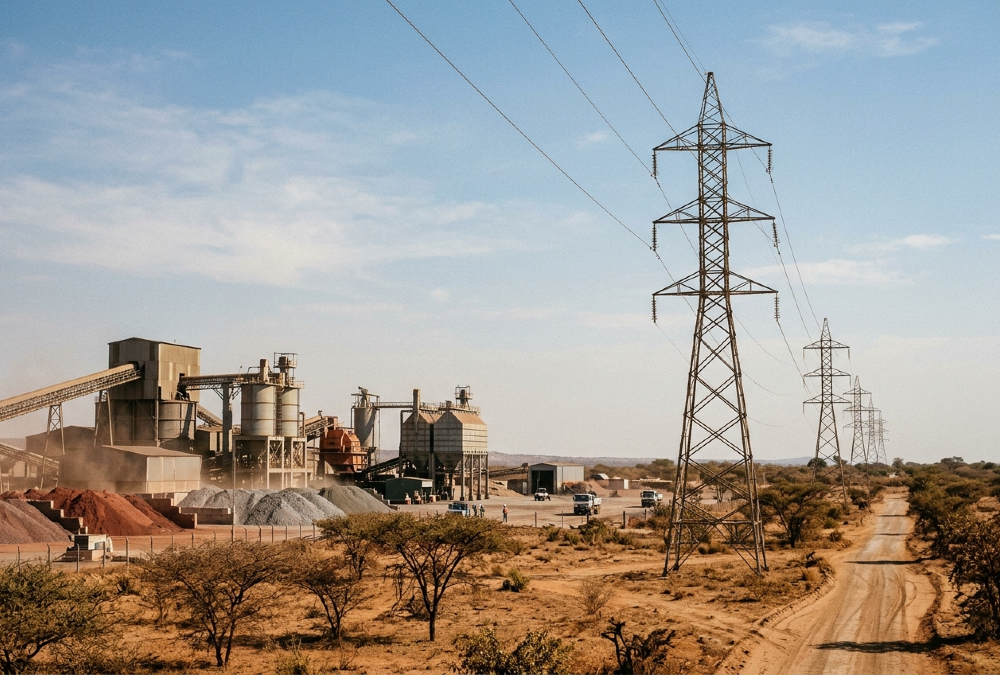
There is, however, a problem that no decree can legislate away. Processing minerals is ferociously energy-intensive. Smelting, refining and chemical conversion demand large volumes of reliable, affordable electricity around the clock. Across much of Africa, that is precisely what is lacking.
Hundreds of millions of Africans still live without access to electricity. Industrial users fare better, but not by much. Grids are fragile, tariffs are often punishing, and blackouts are routine in economies where utilities are cash-starved and generating capacity has failed to keep pace with demand. South Africa’s years of rolling blackouts and Zambia’s drought-induced hydropower shortfalls are only the most visible examples of a continental pattern.
For a mining company weighing whether to build a processing plant, the arithmetic is unforgiving. A smelter that must run on expensive diesel generators, or that sits idle during outages, will struggle to compete with established processors in Asia, where power is abundant and cheap. Ministers may demand local processing, but capital goes where the electrons are. Unreliable, costly power is already deterring the very investment that value-addition policies are meant to attract.
Why the Obstacle Is Also an Opportunity
It would be easy to conclude that the energy gap dooms Africa’s industrial ambitions. That reading is too pessimistic. The short-to-medium-term picture is undeniably difficult, but the same shortfall that frustrates miners creates a substantial opening for investors in the energy sector itself.
Consider the incentives. If governments hold firm on local processing requirements, mining firms will have to secure power, whether by building it, buying it or underwriting someone else’s project. That generates anchor demand of exactly the kind that makes energy projects bankable: large, predictable, long-term offtake from industrial customers with every reason to keep the lights on. For energy developers who have struggled to find creditworthy buyers in fragmented markets, such customers are gold.
The economics may also work in both directions. If value-addition ventures deliver stronger returns on investment than simply shipping raw ore, as their advocates argue, then the miners behind them will have a greater capacity, and a greater willingness, to pay for dependable power. Better returns upstream can finance better infrastructure downstream.
Who Will Move First
Expect the interest to come from several directions. External energy companies, hungry for growth and wary of saturated home markets, are likely to look harder at African opportunities as governments scramble to expand access. State-backed organizations, particularly those with strategic interests in securing critical minerals, may prove equally willing to commit capital and political backing to power projects tied to processing hubs.
Public-private partnerships are also likely to flourish, especially in countries blessed with available fuel supplies, whether natural gas, coal or abundant hydro and solar resources. In such places, governments can contribute resources and regulatory certainty while private partners bring capital and operating expertise. Neither side can solve the problem alone.
The Verdict
Resource nationalism is not a passing fashion. It reflects a durable political consensus that Africa’s wealth should enrich Africans, and governments that retreat from it will pay at the ballot box. But slogans do not smelt copper or refine lithium. Electricity does.
The countries that win this race will be those that treat energy and industrial policy as a single project, pairing local-processing mandates with credible plans for power generation, grid reliability and fair, transparent pricing. The investors that win will be those who recognize that, in Africa’s new resource economy, the most valuable asset is not always in the ground. Sometimes it is the power station that makes everything else possible.
Fidel Amakye Owusu is an International Relations and Security Analyst. He is an Associate at the Conflict Research Consortium for Africa and has previously hosted an International Affairs program with the Ghana Broadcasting Corporation (GBC). He is passionate about Diplomacy and realizing Africa’s global potential and how the continent should be viewed as part of the global collective.
