
Opinion
A Church Under Pressure, and an Emperor the World Still Argues About
Orthodox churches have been burned and worshippers killed. Deacon Dr. Dawit Muluneh argues that the Church has been wrongly fused with one ethnic group, and that Haile Selassie’s legacy shows what Ethiopia meant to the world.
The Living Canon, Part 3 of 3
A tradition that has survived for well over a millennium might be expected to feel secure. The Ethiopian Orthodox Tewahedo Church does not. It has faced serious pressure at home: ethnic tension, attacks on churches and violence against believers. To understand why, Deacon Dr. Dawit Muluneh says, you have to start with an unexpected sentence.
The Church is the Church
“Christianity did not originate in Ethiopia.” Muluneh says it often, and it sounds like a non sequitur until the reason emerges. If the faith is a gift received and preserved rather than a possession born in one place, then it cannot belong to a single people. Yet that is precisely how Ethiopian Orthodoxy is sometimes described: as an Amhara religion.
The association has a history. Christianity grew particularly strong in northern Ethiopia, and those regions became closely linked with the Orthodox tradition. But Muluneh stresses that this is not the same as ownership. The Church includes Amhara, Oromo, Tigrayan and many other communities. “The Church is the Church,” he says. “It is not the church of one ethnic group.”
His own research supports the point. Reading texts spanning centuries, he found that modern ethnic categories did not function as they do in politics today. Regional identities existed. Amhara and Tigray named regions. People had languages, communities and loyalties, of course. But the contemporary political understanding of ethnicity, he argues, is much more recent and increasingly institutionalized.
When Grievance Turns Religious
The danger arrives when those categories harden. Once ethnicity is politicized, people reread history through it. Orthodoxy becomes “Amhara.” Other faiths become attached to other regions. Religious and ethnic identity fuse.
The consequences are ugly. The Church is sometimes portrayed as having represented the domination of other Ethiopian communities, a portrait that breeds what Muluneh calls a retaliatory mentality. “We have seen churches burned,” he says. “We have seen Orthodox believers killed. We have seen homes destroyed.”
He adds a detail that spoils the simple story. This is not only Amhara Christians under attack. Oromo Orthodox Christians have suffered too, as have others. That, he says, tells you the underlying question is more complicated than ethnicity alone. Religion, ethnicity and politics have become intertwined, and untangling them is the work of a generation.
An Older Story of Coexistence
It would be easy, and wrong, to draw a sectarian conclusion. Muluneh is emphatic that Ethiopian Muslims as a whole cannot be blamed for extremist violence. Extremists who identify as Muslim exist, just as extremist movements can emerge in any religious setting. But treating a whole community as though it were at war with Ethiopian Christians would be false.
History offers a rebuke. When some of the earliest Muslims faced persecution in Arabia, they found refuge in the Christian Kingdom of Aksum, where the Ethiopian ruler gave them sanctuary. There have been periods of tension between Christians and Muslims in Ethiopia, Muluneh acknowledges. But there have also been long stretches in which they lived and worked alongside each other. Today’s violence, he argues, should not erase that much longer relationship.
The Emperor and the Idea
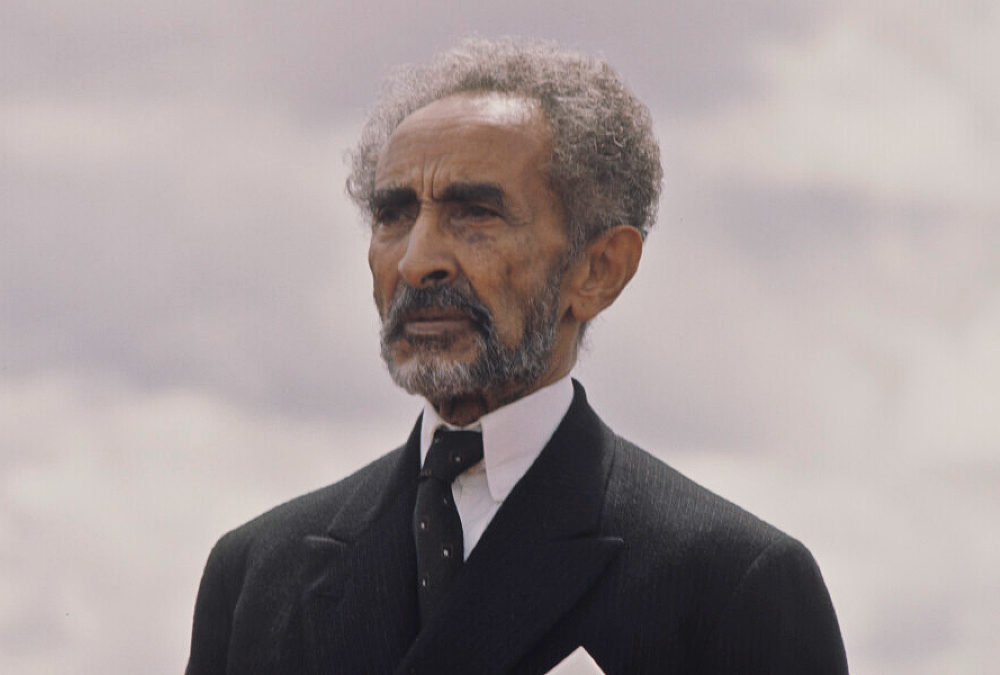
The conversation then turned to the figure who made Ethiopia a symbol far beyond its borders: Emperor Haile Selassie.
Muluneh came to Pan-Africanism late. Growing up, he says, he did not fully grasp it; graduate school changed that. Once you study the movement seriously, “Haile Selassie’s role becomes very difficult to ignore.” He was an important figure in African unity, respected across the continent. During the independence era, Africa was arguing about how to organize itself. Should it unify politically? Or should sovereign states build continental institutions together? Leaders held different visions, but Ethiopia stood at the center of many of those conversations.
For many Africans and people of African descent, Muluneh says, Ethiopia stood for something larger than itself: African sovereignty. In an era when much of the continent lived under European colonial rule, Ethiopia had maintained an extraordinary degree of political independence. The symbolism was powerful.
Ethiopia Stretches Forth Her Hands
The symbolism had biblical roots. The African diaspora had long read scriptural references to Ethiopia as referring, symbolically, to Africa and its descendants. The verse “Ethiopia shall stretch forth her hands” became a refrain of Black liberation and Pan-Africanism. Marcus Garvey and others helped build that consciousness.
Then an African emperor appeared on the world stage, representing a country that had kept its sovereignty. When Haile Selassie spoke internationally, many Africans and people in the diaspora saw someone representing African dignity before the world.
When he visited Jamaica in the 1960s, expectations were already enormous. Stories about his arrival, including accounts involving rain, took on religious significance for Rastafarians who already understood him in spiritual terms. It helps to remember the period, Muluneh says. Black people across the world were confronting colonialism, segregation and racial injustice. Ethiopia was a beacon, and Selassie became, in many minds, more than a head of state. Some saw something divine in him.
Two Faiths, One Bridge
Here Muluneh draws a careful line. Haile Selassie was himself an Ethiopian Orthodox Christian. Rastafari developed its own understanding of him. The two are not identical. Selassie did not teach that he was God; he emphasized his own Christian faith. So respect for the man carried an implicit invitation to understand the faith he followed. For some Rastafarians, that invitation became a bridge to the Ethiopian Orthodox Church.
The best-known crossing is Bob Marley’s. One of the most recognizable figures associated with Rastafari was baptized into the Ethiopian Orthodox Church before his death. The episode shows how complicated the relationship is. Rastafari brought many people into contact with Ethiopia, and Ethiopia brought some of them into contact with Ethiopian Christianity. What begins as a political and cultural identification with Africa can become a religious journey.
A Tradition that Cannot Sit in a Museum
All of which returns us to the question the series began with: what does it mean to preserve a tradition?
The Ethiopian Orthodox heritage survived because manuscripts were kept. But manuscripts do not explain its endurance. It survived because communities could read them, priests and scholars could teach them, worshippers could hear them, and generations of Ethiopians folded biblical language into their understanding of themselves. That is what Muluneh means by a “lived canon.”
The phrase also names the dilemma of the present. A living tradition must move through time, and time is not kind. Languages change. Diaspora communities form. Young Ethiopians grow up far from the institutions that shaped their elders. Artificial intelligence and digital publishing make ancient texts more accessible than ever while creating new risks of mistranslation and decontextualization. Global interest in Africa is growing, and with it come questions of commercialization and ownership. At home, ethnic and political conflict is forcing ancient institutions to navigate modern identity struggles.
The question, then, is no longer simply whether Ethiopia can preserve its manuscripts. It is whether Ethiopia can preserve the meaning around them. That may be the harder task, because the survival of a civilization is not measured by whether its books stay intact. It is measured by whether future generations still understand what those books meant to the people who lived by them.
Editor’s note: This series is drawn from an interview that has been edited and condensed for clarity, length and readability. Repetition, verbal fillers and portions of conversational overlap have been removed or consolidated while preserving the substance, context and intended meaning of the participants’ questions and responses.
