
Owusu on Africa
How Unrest in Eastern DR Congo Is Undermining Counterterrorism in Southern Africa

By Fidel Amakye Owusu
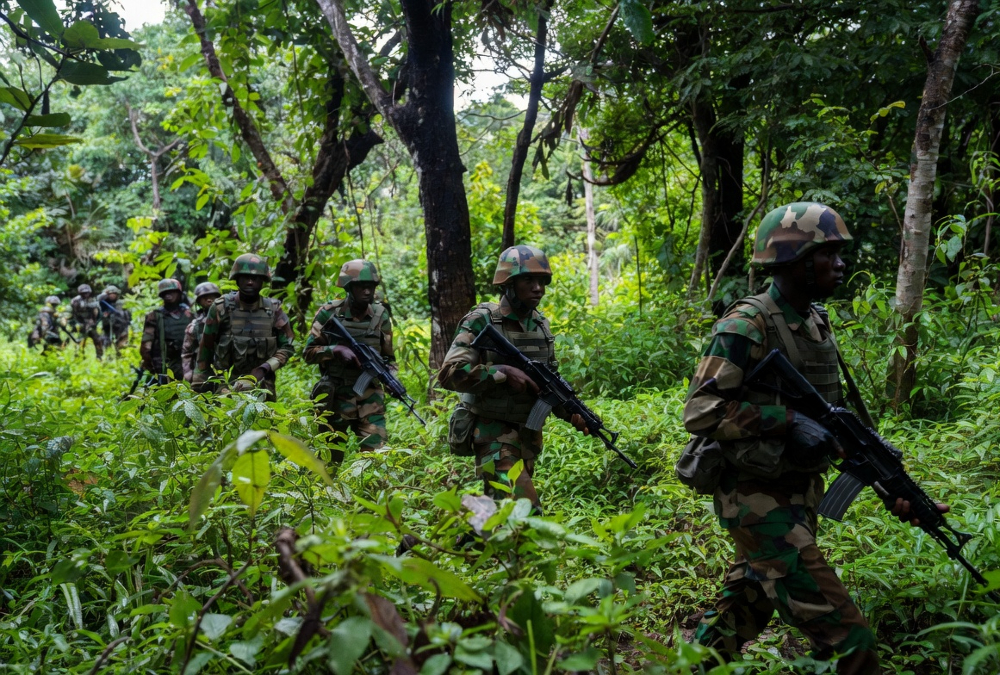
On Saturday, March 14, 2026, Rwanda announced it may pull its troops from Cabo Delgado, the northern Mozambican province where an Islamist insurgency has terrorized civilians and destabilized one of Africa’s most strategically significant energy corridors. The announcement was framed in the language of grievance – Rwandan authorities complained that their efforts were not being sufficiently “appreciated,” and that external funding had fallen critically short.
But the real story is not about ingratitude. It is about eastern Democratic Republic of Congo.
A Fragile Stabilization Under Threat
Rwanda’s military presence in Cabo Delgado has been, by most credible assessments, indispensable. The insurgency – waged by a group locally referred to as Al-Shabaab, though organizationally distinct from its Somali namesake – once held the province in a grip of indiscriminate violence.
Communities were attacked, civilians massacred, and foreign investment fled. TotalEnergies suspended its liquefied natural gas operations entirely, a damaging blow to a country desperate for economic development.
Rwandan forces helped reverse that trajectory. Security improved, displacement slowed, and last year TotalEnergies announced it would return to the province – a significant vote of confidence in the stabilization effort. The Southern African Development Community (SADC) has nominally been engaged, with South Africa contributing troops, but the bloc’s response has been modest relative to the scale of the threat.
Rwanda, not SADC, has been the effective backbone of counterterrorism operations in the region. That backbone is now at risk of snapping – and the fracture point is more than a thousand miles away.
The Congo Variable
Over the past year, Rwanda’s international standing has been battered by its alleged support for M23 rebels in eastern DR Congo, a conflict that has displaced millions and drawn increasingly sharp condemnation from Western governments. European nations have imposed aid restrictions. The United States has sanctioned Rwandan military commanders, seeking to curtail Kigali’s influence in a region rich in the minerals that power the global technology economy.
The consequences of those sanctions extend far beyond eastern Congo. For donor governments and international institutions evaluating whether to fund Rwanda’s operations in Mozambique, the calculus has become deeply uncomfortable.
Supporting Rwanda’s mission in Cabo Delgado means, however indirectly, strengthening a military apparatus that Western capitals have formally designated as a destabilizing force elsewhere on the continent. The funding, in other words, risks subsidizing both the solution in Mozambique and the problem in Congo.
This is not a hypothetical tension – it is the mechanism behind Rwanda’s funding shortfall. Sponsors are not being miserly. They are being, as the situation demands, meticulous.
No Obvious Replacement
The difficulty is that there is no readily available alternative. Rwanda has spent years building a professional, battle-tested expeditionary force.
Its troops have served in the Central African Republic, performed capably in Cabo Delgado, and developed an institutional competency in stabilization operations that few African militaries can match. Replacing them is not simply a matter of political will; it requires military capacity that does not currently exist in the region.
SADC could theoretically step into the breach, but the bloc’s track record in Mozambique offers little grounds for optimism. South Africa has contributed forces, but there has been no serious multilateral commitment of the kind that the situation demands.
The African Union, perpetually constrained by funding and political divisions, is not positioned to move quickly.
In the near to medium term, then, the security of Cabo Delgado is contingent – alarmingly so – on the resolution of a conflict in a different country entirely.
The Broader Lesson
What the Rwanda-Mozambique-Congo triangle illustrates is the degree to which African security architectures remain fragile, underfunded, and dangerously interdependent. A geopolitical dispute in the Great Lakes region can, through the mechanics of sanctions and donor reticence, directly compromise a counterterrorism operation nearly 2,000 miles to the south.
The civilians of Cabo Delgado did not choose to be caught in that web – but they may yet bear its consequences.
If the insurgency in Mozambique reignites, the responsibility will not rest with Rwanda alone. It will belong equally to a donor community that has yet to develop a coherent strategy for separating its counterterrorism funding from its broader political grievances – and to a regional bloc that has consistently treated stabilization as someone else’s problem.
The fire in Cabo Delgado is not fully out. Without sustained attention, it will not stay contained.
Fidel Amakye Owusu is an International Relations and Security Analyst. He is an Associate at the Conflict Research Consortium for Africa and has previously hosted an International Affairs program with the Ghana Broadcasting Corporation (GBC). He is passionate about Diplomacy and realizing Africa’s global potential and how the continent should be viewed as part of the global collective.
