
Owusu on Africa
When Politics Redraw the Sky: DR Congo – Rwanda Tensions Reshaping African Aviation
Geopolitical fault lines are no longer confined to the ground. In central Africa, a diplomatic rupture between two neighbors is quietly reshaping the flight paths of an entire continent.

By Fidel Amakye Owusu
Airspace, like so much else in international affairs, is rarely neutral. When conflict erupts between nations, the skies above them become contested territory – invisible battlegrounds that civilian aircraft must navigate with the same caution afforded to land borders and mined roads.
The world was reminded of this reality when fighting in the Middle East prompted commercial airlines to reroute thousands of flights, flooding adjacent airspace and inflating travel times across the region. The calculus was simple: no airline willingly risks a surface-to-air missile, whether fired with intent or by tragic accident. History has provided sobering precedents.
But the Middle East is not the only place where geopolitics is bending flight paths into unfamiliar shapes.
A Detour That Demands Explanation
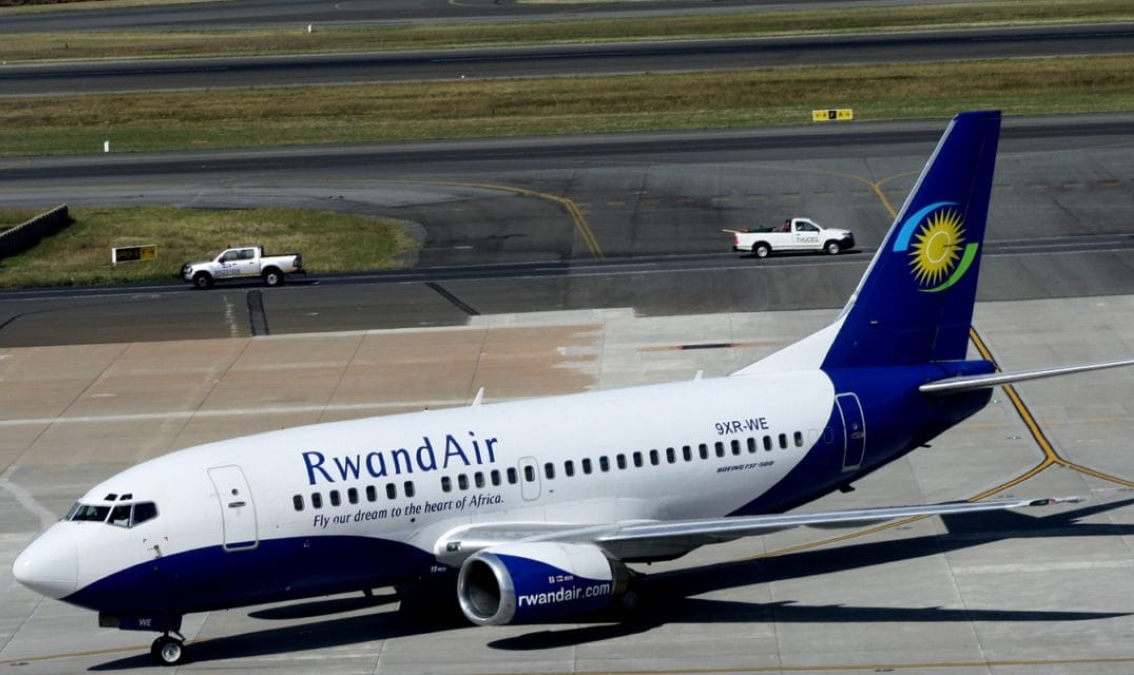
On a recent flight from Kigali, Rwanda’s capital, to Accra, Ghana, the aircraft’s route told a story that no in-flight map annotation was forthcoming enough to explain. Rather than taking the direct northwest trajectory across the Democratic Republic of the Congo (DR Congo) – the most logical and efficient corridor – the RwandAir flight climbed northward into Uganda, pushed on through South Sudan, curved into the Central African Republic, and finally entered Cameroon before descending toward the Ghanaian coast.
The Ebola outbreak in eastern DR Congo was not the reason. The reason was simpler, starker, and more instructive: Rwandan-registered aircraft are now effectively banned from DR Congo airspace entirely.
This prohibition is a direct consequence of the deteriorating relationship between Kinshasa and Kigali. Since M23 rebels – widely alleged to have enjoyed Rwandan support, a charge Kigali denies – seized substantial swaths of eastern DR Congo, the Congolese government has hardened its posture toward its smaller neighbor in every domain available to it, including the one that sits 35,000 feet above the conflict.
Closing airspace is one of the few asymmetric tools a larger, weaker-administered state can deploy against a smaller, more capable one.
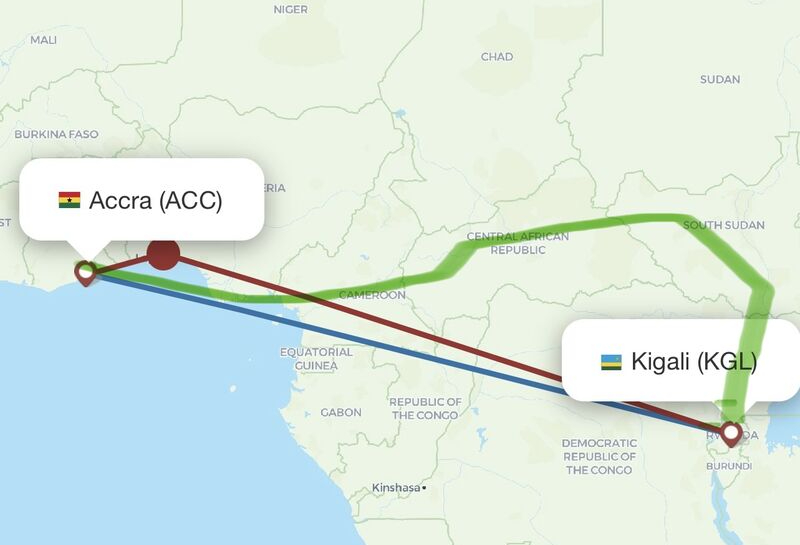
Map showing RwandAir flight path diversion from Kigali to Accra avoiding DRC airspace due to Rwanda-DRC tensions
Two Nations, One Lesson in Contrasts
The irony is not lost on regional observers. Rwanda, a country that has arguably achieved more institutional efficiency per square kilometer than almost any other post-conflict state in Africa, shares a border with the DR Congo, a nation of extraordinary natural wealth and extraordinary administrative dysfunction.The contrast between the two countries is almost pedagogical in its sharpness: one has rebuilt from genocide to become a regional model of governance; the other, despite possessing mineral reserves that could theoretically fund the development of an entire continent, remains mired in cycles of armed group proliferation and state fragility.
There is, in this tension, the outline of a genuine opportunity – if both governments can summon the political will to pursue it. Rwanda stands to gain enormously from stable access to the DR Congo’s vast internal market.
The DR Congo, for its part, has much to learn from Rwanda’s post-conflict institutional reconstruction, from its land registration reforms to its health system architecture. A normalized relationship would benefit both economies and, critically, would benefit the millions of civilians in eastern Congo who have borne the greatest cost of the current confrontation.
The Sky Doesn’t Lie
For now, however, the détente remains elusive, and the flight paths remain strange. Commercial aviation has an unintended talent for revealing the true state of diplomatic relations – more honestly, sometimes, than any communiqué or summit declaration.
When an aircraft must add hundreds of miles to its route simply to avoid a neighboring country’s airspace, the message encoded in that detour is unambiguous. The skies over central Africa are telling us something. The question is whether the governments below them are listening.
Fidel Amakye Owusu is an International Relations and Security Analyst. He is an Associate at the Conflict Research Consortium for Africa and has previously hosted an International Affairs program with the Ghana Broadcasting Corporation (GBC). He is passionate about Diplomacy and realizing Africa’s global potential and how the continent should be viewed as part of the global collective.
