
Owusu on Africa
Mr. President, the Nile Crisis Demands More Than Diplomacy by Tweet


By Fidel Amakye Owusu
Mr. President, your willingness to engage in the Nile River dispute is a rare opportunity – one that could redefine U.S. leadership in Africa. Egypt and Ethiopia are not just regional players; they anchor the continent’s economic and strategic future.
With 200 million people and US$350 billion in combined GDP, their conflict over the Grand Ethiopian Renaissance Dam (GERD) threatens instability across the Horn of Africa and beyond.
But this isn’t a deal to be closed with a handshake. What’s needed is a masterclass in granular diplomacy – one that acknowledges the fault lines running deeper than the Nile itself.
Beyond the Water: The Five Layers of Crisis
This isn’t merely about hydropolitics. To treat it as such guarantees failure.
The GERD conflict is:
- Historical: Centuries of colonial-era water agreements haunt negotiations.
- Existential: Egypt sees the Nile as its lifeline; Ethiopia views the dam as emancipation from poverty.
- Geopolitical: Sudan’s fragile transition hangs in the balance, while Gulf states jockey for influence.
- Prestige-Driven: National pride is cemented in concrete – both sides cannot afford to lose face.
- Ecological: Climate change looms over all calculations, with droughts intensifying scarcity.
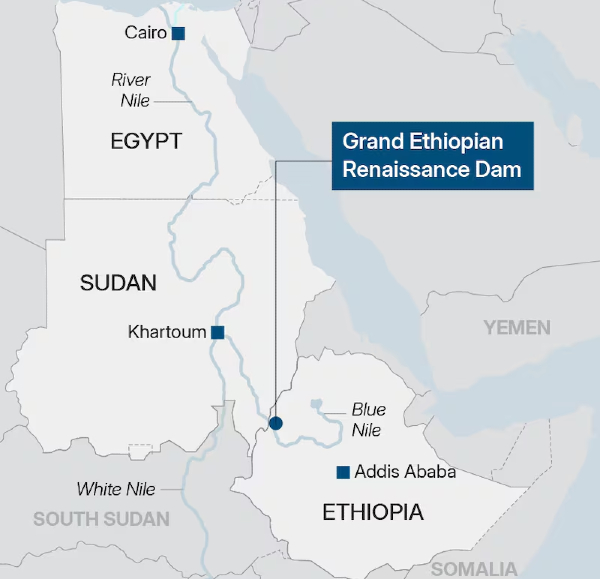
Map of the Nile River Basin highlighting Egypt, Ethiopia, Sudan, and the Grand Ethiopian Renaissance Dam (GERD) amid the regional water dispute.
Recent failed talks prove phone calls and photo-ops won’t cut it. The Rwanda-DR Congo “peace deal” you referenced?
It papered over fissures in Eastern Congo while militias kept fighting. The Nile can’t follow that script.
The Path Forward: Expertise, Not Expediency
Here’s the good news: Unlike Eastern Congo’s warlord labyrinth, the Nile dispute revolves around three core actors. That clarity makes a solution possible – if we pivot from spectacle to strategy.
Your administration should:
- Deploy a Special Envoy Team with hydro-diplomacy expertise – not generalists.
- Leverage Intelligence Assets to map hidden pressures (e.g., Saudi/UAE interests, internal factionalism).
- Anchor Talks in Data – joint impact studies on water flow, agriculture, and energy grids.
- Guarantee International Financing for compromise solutions (e.g., desalination for Egypt, alternative energy for Ethiopia).
The Ultimate Prize
Get this right, and you won’t just avert a water war – you will create a template for 21st-century resource diplomacy. Egypt and Ethiopia could catalyze integration from Khartoum to Nairobi, turning a zero-sum fight into a coalition for drought resilience and trade.
But shortcuts will backfire. Send experts, not tweets. Invest in quiet groundwork, not headlines. The Nile’s 400 million dependents deserve nothing less.
Fidel Amakye Owusu is an International Relations and Security Analyst. He is an Associate at the Conflict Research Consortium for Africa and has previously hosted an International Affairs program with the Ghana Broadcasting Corporation (GBC). He is passionate about Diplomacy and realizing Africa’s global potential and how the continent should be viewed as part of the global collective.
