
Owusu on Africa
The Gulf States’ Growing Influence in Africa Amid Great Power Competition

By Fidel Amakye Owusu
More than a year after this piece was first written, the presence of the Gulf states in Africa has become increasingly pronounced. As global power dynamics shift, these Middle Eastern actors are positioning themselves as key players in a continent that is once again at the center of international competition.
Experts suggest that the Gulf states may stand to “benefit” from the ongoing great power rivalry unfolding across Africa. Recently, Saudi Arabia hosted a peace summit focused on the Russia-Ukraine conflict.
Although Russia declined to attend, China – Moscow’s strategic ally – was present. Like many such initiatives since Russia’s full-scale invasion of Ukraine in February 2022, the summit yielded no concrete results.
Ukraine continues to demand an unconditional Russian withdrawal from all occupied territories, while Russia insists Kyiv accept its so-called “new realities.”
Despite the lack of tangible outcomes, Riyadh successfully projected itself as a neutral broker between East and West. This carefully cultivated image grants the kingdom a degree of diplomatic leverage with both sides – a position that could prove valuable in the long run.
In conflicts like Ukraine and other theaters of global competition, many Gulf states have adopted a stance of what might be called “constructive neutrality.” This approach allows them to maintain relationships across blocs without becoming entangled in the deeper ideological or military rivalries dividing the world.
A Shifting Geopolitical Landscape in Africa
So what does this mean for Africa?
Over the past decade, Africa has become a hotspot for intensified geopolitical competition. This marks a stark contrast to the early post-Cold War years, when U.S. dominance left African countries with fewer choices about their international alignments.
Today, however, the situation is far more complex.
Major global powers – including the United States, the European Union, China, Russia, the United Kingdom, and India – are vying for influence across the continent. The contest is often framed simplistically as an East-West divide, but beneath the surface lies a nuanced web of interests and alliances.
Amid this struggle, many African nations are seeking out “third forces” – actors not deeply aligned with either side. Herein lies the opportunity for the Gulf states.
With vast hydrocarbon wealth, significant financial reserves, and growing ambitions in global investment, they are well-positioned to fill this emerging niche.
Gulf Investments and Strategic Moves in Africa
Countries like the United Arab Emirates (UAE), Qatar, Saudi Arabia, Kuwait, and Bahrain have been steadily expanding their footprint in Africa. The UAE, for instance, has made major investments in transportation infrastructure, agriculture, and mining – particularly in the Democratic Republic of the Congo (DR Congo).
Similarly, Saudi Arabia and Kuwait have pursued diverse economic interests across the continent. Kuwait, for example, operates a large fruit farm in Ghana.
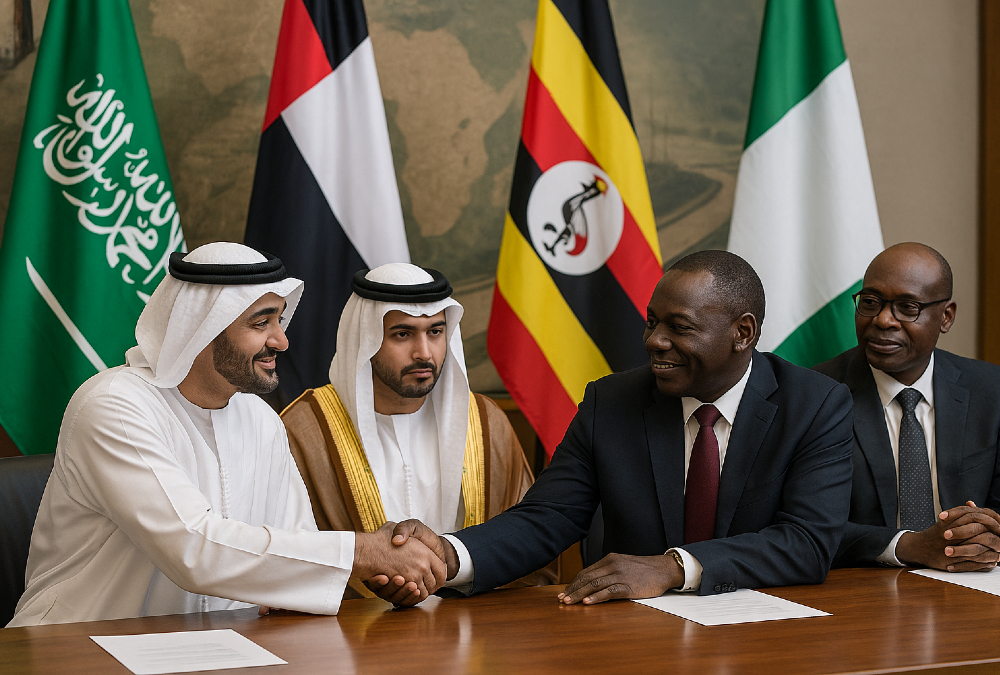
A recent development underscores this trend: Uganda has signed an exclusive agreement with Vitol Bahrain E.C. to supply all of the landlocked nation’s petroleum products. Given that Uganda imported approximately US$1.2 billion worth of oil products in 2022, this deal represents a significant foothold for Gulf interests in East Africa.
While critics have raised concerns over the monopolistic nature of the arrangement, it also highlights how Gulf actors are capitalizing on the vacuum created by the competing agendas of traditional global powers.
As the Gulf states deepen their engagement in Africa, it is crucial for African governments to ensure that these partnerships serve their national interests. Engagement should be mutually beneficial – fostering development, sovereignty, and long-term stability.
In this new era of global competition, the Gulf states are no longer just regional players. They are emerging as influential actors in Africa’s future.
For African countries navigating this shifting landscape, the challenge will be to harness these relationships to their own advantage – without compromising their autonomy or long-term development goals.
Fidel Amakye Owusu is an International Relations and Security Analyst. He is an Associate at the Conflict Research Consortium for Africa and has previously hosted an International Affairs program with the Ghana Broadcasting Corporation (GBC). He is passionate about Diplomacy and realizing Africa’s global potential and how the continent should be viewed as part of the global collective.
