
Owusu on Africa
The New Cold War: Why Africa Has Become the World’s Most Dangerous Chessboard
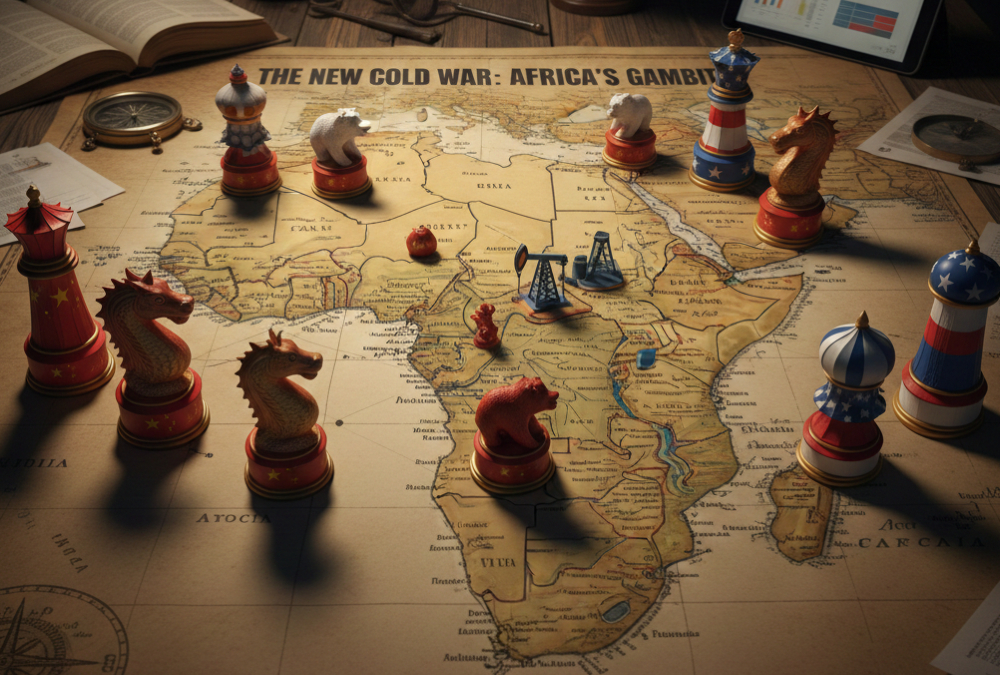

By Fidel Amakye Owusu
Great-power competition has returned to Africa. But this is no simple reprise of the Cold War – it is more chaotic, more mercantile, and potentially more devastating.
The Multipolar Battlefield
The era of African geopolitics as an afterthought is over. From the copper mines of the Democratic Republic of Congo (DR Congo) to the Red Sea ports of Sudan, a new and treacherous contest for influence is unfolding – one that defies the tidy ideological binaries of the last century.
Where the twentieth century featured two superpowers armed with competing visions of modernity, today’s competition involves at least a half-dozen major powers pursuing overlapping and often contradictory objectives.
The United States and China anchor one axis of competition, with Washington struggling to maintain security partnerships while Beijing deploys infrastructure financing and resource extraction on an industrial scale. Russia, meanwhile, has executed a remarkable pivot into Francophone Africa, positioning itself as the anti-colonial spoiler to French influence while simultaneously fueling conflicts that serve its mercantile interests.
The Gulf states have transformed from check-writers into active geostrategic players: Saudi Arabia and the United Arab Emirates, ostensibly allies, now compete for port access, religious influence, and agricultural investments across the Horn and the Sahel. Türkiye and Israel have joined the fray, with Ankara projecting military power through drone diplomacy and Jerusalem cultivating security relationships that extend its reach far beyond the Levant.
What distinguishes this competition is its fluidity. Alliances shift with the velocity of commodity prices. Yesterday’s security partner becomes today’s rival. There is no Warsaw Pact or NATO – only provisional arrangements of convenience.
The Resource Imperative
Ideology has been supplanted by minerals. The new Great Game is fundamentally extractive, driven by the global energy transition’s insatiable appetite for cobalt, lithium, and copper.
African states possess an estimated 30 percent of the world’s mineral reserves that will determine which powers dominate green technology, electric vehicles, and advanced defense systems over the coming decades.
But the competition extends beyond the subsoil. Agricultural land – particularly in the Sahel and the Horn – has become a strategic asset as Gulf states and Asian powers seek to secure food supplies against climate volatility.
Access to Africa’s rapidly urbanizing consumer markets, projected to reach 2.5 billion people by 2050, represents a commercial prize that rivals the resource base itself.
This resource orientation makes the competition simultaneously more transactional and more brutal.
Without the moderating framework of ideological alignment, there is little to constrain powers from supporting abusive regimes, fueling insurgencies, or ignoring humanitarian catastrophes when commercial interests are at stake.
The Theaters of Competition
The geography of contestation reveals the stakes. In Sudan and the greater Horn, the collapse of the state has drawn in competing security partnerships – Emirati support for the Rapid Support Forces, Russian Wagner Group operations, Turkish drone deployments, and American counterterrorism bases – creating a conflict system that threatens regional stability.
The DR Congo and the Great Lakes have become the epicenter of mineral warfare, where Rwandan-backed M23 rebels and a constellation of militias compete for control of cobalt-rich territories while external powers negotiate access with whoever controls the ground.
The Sahel has witnessed the most dramatic realignment, with military juntas in Mali, Burkina Faso, and Niger expelling French forces and welcoming Russian security contractors – a shift that has severed decades of Western security architecture without establishing viable alternatives.
Libya remains a shattered state serving as a weapons bazaar and migration chokepoint. The Copperbelt in south-central Africa has reemerged as a zone of intense Chinese investment and American counter-efforts.
Meanwhile, the Gulf of Guinea’s littoral states face mounting pressure as external powers seek naval access to protect energy infrastructure and project power into the Atlantic.
Instruments of Modern Competition
The tools of influence have evolved beyond the military advisors and development aid of the Cold War era. Today’s powers deploy security pacts that embed training missions and intelligence cooperation; resource-for-infrastructure deals that mortgage future revenues; and private military companies – Wagner, nominally reconstituted as “Africa Corps,” and emerging competitors – that provide regime security while securing mining concessions.
Diplomatic incentives have grown more sophisticated, with competing development visions (China’s Belt and Road versus America’s Partnership for Global Infrastructure and Investment) offering African capitals alternative patrons. Hybrid instruments – cyber capabilities, information operations, and climate finance – round out the arsenal.
Most concerning is the proliferation of autonomous and semi-autonomous weapons systems. Drones, once the preserve of advanced militaries, have become the Kalashnikovs of the twenty-first century: cheap, accessible, and destabilizing.
Turkish Bayraktars, Chinese Wing Loongs, and Iranian systems now circulate among African militaries and non-state actors alike, lowering the threshold for interstate violence and enabling sustained insurgencies.
The Human Cost
The signatures of this competition are written in blood and displacement. Protracted civil wars in Sudan and the DR Congo have entered new phases of intensity as external arming of both state and sub-state actors ensures that military solutions remain elusive.
Diplomatic frictions have paralyzed regional organizations from the Economic Community of West African States (ECOWAS) to the East African Community (EAC). Humanitarian crises – 2.5 million displaced in Sudan alone, catastrophic food insecurity across the Sahel – deepen as political solutions are subordinated to strategic competition.
Interstate tensions are escalating accordingly. Ethiopia and Egypt remain at loggerheads over Nile waters, with external powers choosing sides.
Rwanda and the DR Congo teeter on the edge of open warfare. The Horn of Africa has become an arena of naval competition and proxy conflict extending from Somalia to the Red Sea.
African Agency in the Age of Competition
Perhaps the most consequential difference from the old Cold War lies in the position of African states themselves. The excuse of recent independence no longer obtains; most nations have been sovereign for six decades or more.
The institutional weakness, governance failures, and economic dependencies that render them vulnerable to external manipulation are increasingly matters of domestic choice rather than colonial legacy.
This presents both peril and opportunity. African states can leverage competition for infrastructure, technology transfer, and diversified partnerships – or they can be reduced to arenas for proxy conflict, their resources extracted and their populations abandoned to violence.
The difference will depend on whether continental and regional institutions can coordinate positions, enforce norms against foreign interference, and translate resource wealth into developmental capacity.
The new Cold War in Africa will not be won by external powers; it will be lost by African states that fail to consolidate sovereignty, or won by those that do. The continent’s leaders have less time than they imagine to choose which outcome prevails.
Fidel Amakye Owusu is an International Relations and Security Analyst. He is an Associate at the Conflict Research Consortium for Africa and has previously hosted an International Affairs program with the Ghana Broadcasting Corporation (GBC). He is passionate about Diplomacy and realizing Africa’s global potential and how the continent should be viewed as part of the global collective.
