
Owusu on Africa
The DR Congo Rebellion That Washington Is Getting Wrong

By Fidel Amakye Owusu
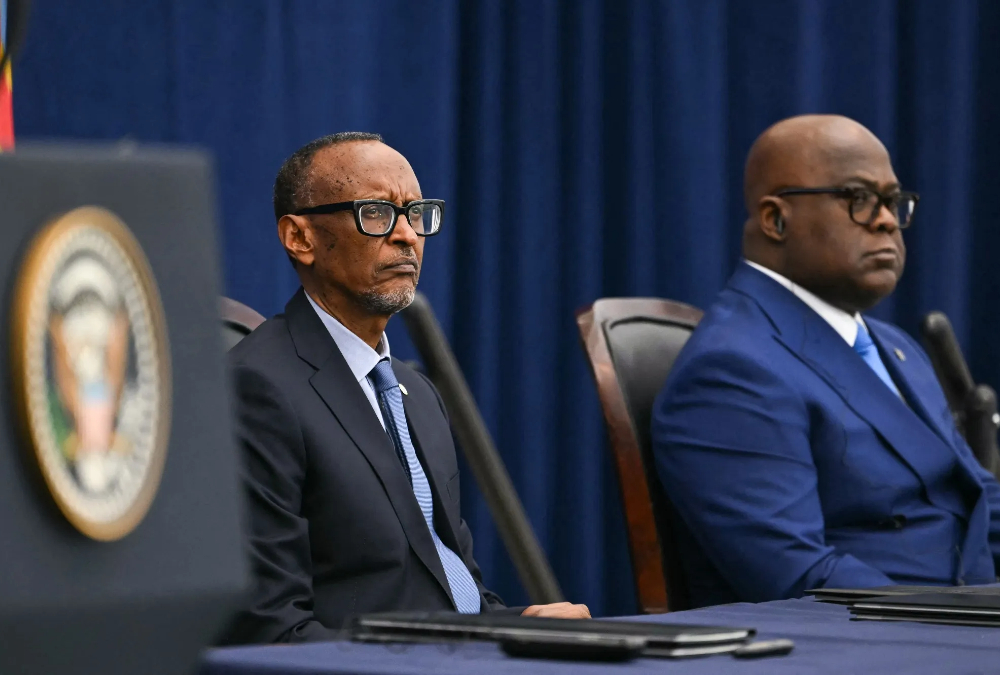
A stark challenge has emerged to the diplomatic consensus taking shape in Washington last week: while world powers negotiate with governments over the future of eastern Democratic Republic of Congo (DR Congo), the rebels controlling vast swaths of territory are busy building their own state.
Among Africa’s numerous conflict zones, none has commanded more international attention this year than the rebellion in the DR Congo. At DefSEC Analytics Africa Ltd., we anticipated this surge in global focus before 2025 began.
Our close monitoring of developments in North and South Kivu provinces reveals a troubling reality that undermines the optimistic pronouncements emerging from peace talks between national governments and armed factions.
The gap between diplomatic announcements and ground-level realities has never been wider – and the consequences of ignoring this disconnect could prove catastrophic.
Building a Shadow State
The M23 rebels have moved far beyond guerrilla tactics. They are systematically constructing an alternative administration to replace Kinshasa’s provincial governance structures.
In western North Kivu, rebel engineers are repairing dilapidated roads and building entirely new transportation infrastructure – the unglamorous but essential work of state-building.
More revealing still is their creation of a parallel financial system. The rebels have established banking services for the local economy and implemented an elaborate taxation regime that reaches into every economic sector.
From individual wage earners and street vendors to established mining operations, the M23 has created a comprehensive revenue apparatus. They are not merely occupying territory; they are governing it.
This is tax collection with a purpose – and that purpose is permanence.
The Illusion of Leverage
These developments carry profound implications that Washington and other capitals appear reluctant to confront. The rebels’ actions signal an unwavering determination to retain captured territories indefinitely.
The establishment of a political wing – the Alliance Fleuve Congo (AFC) – early in the conflict already telegraphed their long-term ambitions. What we are witnessing now is the execution of that vision.
Here lies the uncomfortable truth: even if Rwanda were to withdraw the substantial support it allegedly provides to the M23 – a key demand in current negotiations – it may no longer be sufficient to dislodge the group. The rebels have accumulated the resources, infrastructure, and administrative capacity to maintain de facto control over portions of North and South Kivu without external assistance.
Increased cash liquidity from taxation has fueled aggressive recruitment drives, swelling the rebels’ ranks and reinforcing their frontlines. Recent weeks have brought reports of significant M23 buildups across multiple districts in both provinces.
The Masisi district near Walikale in North Kivu and the southwestern corridor along the RN2 highway in South Kivu have experienced particularly notable surges in rebel presence.
Most ominously, the M23 continues capturing new territory while simultaneously reoccupying areas it had previously evacuated as goodwill gestures in earlier peace processes. Each abandoned commitment erodes the credibility of future agreements.
The Fatal Flaw in International Strategy
The fundamental flaw in the current international approach is its fixation on state actors as the primary drivers of peace. The United States and other influential powers concentrate their diplomatic energies on pressuring governments in Kinshasa, Kigali, and Kampala, operating under the assumption that executive decisions in national capitals will translate into changed behavior on the battlefield.
This assumption is dangerously outdated.
The most consequential players in this conflict are not presidents or foreign ministers – they are the fighters entrenched in the hills and forests of eastern Congo.
These combatants have their own interests, their own command structures, and their own calculus of risk and reward. As history demonstrates, elements within the M23 have defied Rwandan directives before.
It could happen again – particularly if the rebels believe they have achieved self-sufficiency. The rebels are no longer merely proxies; they are becoming principals in their own right.
A Reckoning Ahead
The international community faces an uncomfortable reckoning. The frameworks that have guided peace processes in the Great Lakes region for decades – frameworks built on state-to-state negotiations and top-down implementation – are proving inadequate for a conflict where non-state actors have achieved quasi-governmental status.
Peace in eastern DR Congo will require more than deals struck in conference rooms between governments. It will demand direct engagement with the armed groups that actually control territory, population, and resources.
It will require acknowledging that the M23 has evolved from an insurgency into an administrative entity with staying power.
Until Washington and its partners accept this reality, the announcements of breakthrough agreements will continue to mean little to the people living under M23 rule – or to the fighters who show no signs of relinquishing what they have built.
The question is no longer whether the international community can pressure Rwanda into withdrawing support for the rebels. The question is whether anyone is prepared to deal with what the M23 has already become: a proto-state that may outlast any diplomatic solution focused solely on external actors. That is the challenge Washington confronted this week – whether it recognizes it or not.
Fidel Amakye Owusu is an International Relations and Security Analyst. He is an Associate at the Conflict Research Consortium for Africa and has previously hosted an International Affairs program with the Ghana Broadcasting Corporation (GBC). He is passionate about Diplomacy and realizing Africa’s global potential and how the continent should be viewed as part of the global collective.
