
Owusu on Africa
Africa’s Most Overlooked Bloc Is Also Its Most Crowded
The Economic Community of Central African States is burdened by competing regional memberships, aging leaders, and compounding security crises. To harness its vast mineral wealth, the region must finally deliver for its restless, youthful population.

By Fidel Amakye Owusu
Central Africa is a geological lottery winner but a geopolitical labyrinth. Designed to foster integration and shared prosperity, the Economic Community of Central African States (ECCAS) has instead become a byword for institutional congestion. Of all the regional economic communities on the continent, ECCAS is arguably the most challenged, its mandate diluted by overlapping memberships, entrenched gerontocracies, and a sprawling array of security threats.
The Institutional Labyrinth
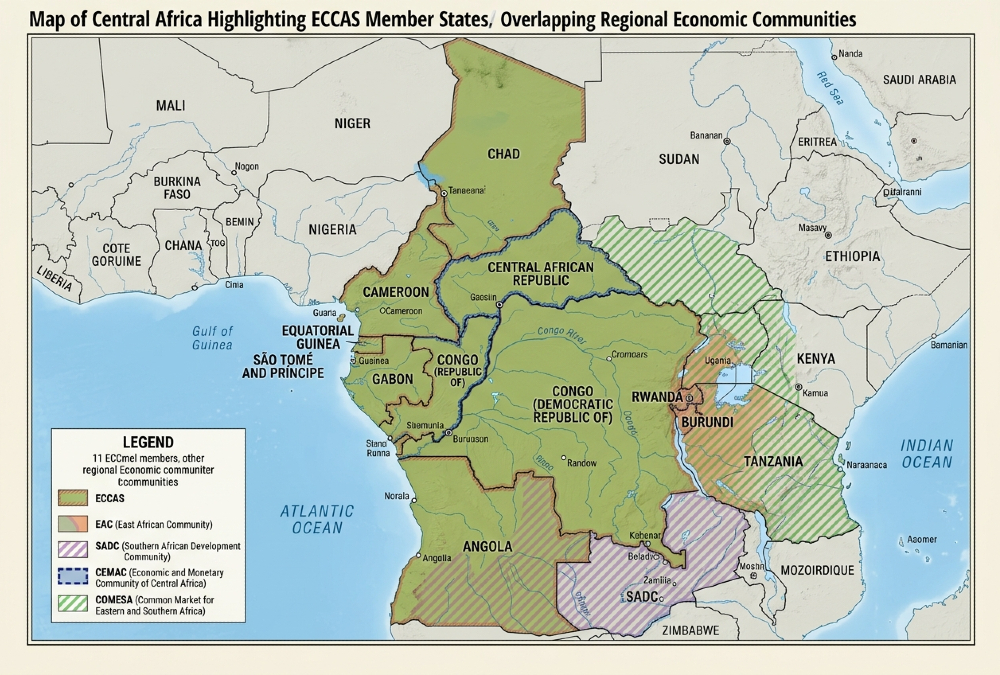
The root of ECCAS’s structural weakness lies in a web of competing loyalties. The Democratic Republic of the Congo (DR Congo), the bloc’s largest and most populous member state, suffers from severe diplomatic split personality. It simultaneously belongs to ECCAS, the Southern African Development Community (SADC), and the East African Community (EAC). Angola, another heavyweight, looks southward to SADC, while Rwanda and Burundi have firmly anchored their economic and political futures in the EAC.
This is not regional integration; it is diplomatic hedging. When member states can forum-shop for the most favorable political or security arrangements, the central coordinating body is inevitably reduced to a secondary talking shop, starved of genuine commitment and resources.
The Gerontocratic Grip
Compounding this institutional drift is a striking concentration of long-serving leaders. The bloc’s current chairperson is the president of Equatorial Guinea, a nation synonymous with entrenched autocracy. The region’s political landscape is dominated by stalwarts such as Paul Biya of Cameroon, Denis Sassou Nguesso of the Republic of the Congo, and Paul Kagame of Rwanda.
Meanwhile, democratic backsliding is accelerating. In the Central African Republic (CAR), the president has successfully extended his stay in office through convenient constitutional changes. The DR Congo, despite its vast potential, appears to be inching toward a similar trajectory of executive overreach. In a region where political longevity is routinely prized over political renewal, the mechanisms for peaceful, democratic transition remain dangerously fragile.
A Quagmire of Security Crises
This political stagnation provides fertile ground for instability. The region is grappling with a multifaceted security nightmare. Terrorism and armed insurgencies threaten the fragile stability of Chad, Cameroon, and the DR Congo. Simultaneously, separatist movements and localized rebellions continue to ravage Cameroon, Chad, the DR Congo, and the CAR, displacing millions and crippling local economies.
At the interstate level, the festering tensions between the DR Congo and Rwanda remain the region’s most dangerous fault line. Despite high-stakes mediation efforts led by Angola, resolving this dispute has proven exceptionally difficult. Until the underlying security dilemmas are addressed, any grand vision for Central African economic integration will remain purely theoretical.
The Geopolitical Prize
Yet, for all its dysfunction, the region possesses a trump card: vast reserves of globally significant resources. The soils of Central Africa are rich with cobalt, manganese, gold, coltan, copper, oil, and natural gas. As the world accelerates its green energy transition, these minerals have become the lifeblood of modern technology and renewable infrastructure.
Consequently, this wealth has turned the region into a theater of intense competition among major and middle powers. From Washington and Beijing to Moscow and European capitals, external actors are vying for access, often propping up favored factions and further complicating the local security architecture. The resource curse remains a potent threat, ensuring that wealth extraction frequently outpaces domestic value creation.
The Demographic Imperative
Ultimately, the most pressing challenge for ECCAS is not geopolitical, but demographic. While calls for regional unity are timely, the region’s exploding population demands something far more tangible: results-oriented leadership. The vast majority of Central Africans are aged 25 and under. This youthful demographic does not care about the architectural nuances of overlapping regional blocs or the diplomatic pleasantries of summitry. They care about jobs, physical security, education, and economic opportunity.
If the current crop of leaders continues to prioritize regime survival over structural reform, this demographic dividend will curdle into a demographic time bomb. The youth bulge represents either the greatest economic engine of the 21st century or a catalyst for unprecedented social upheaval.
For ECCAS to survive and thrive, it must evolve. It must streamline its overlapping mandates, enforce democratic norms, and pivot from being a shield for aging incumbents to a catalyst for inclusive growth. Central Africa’s resources are more than sufficient to fund its own renaissance. What remains in critically short supply is the political will to realize it.
Fidel Amakye Owusu is an International Relations and Security Analyst. He is an Associate at the Conflict Research Consortium for Africa and has previously hosted an International Affairs program with the Ghana Broadcasting Corporation (GBC). He is passionate about Diplomacy and realizing Africa’s global potential and how the continent should be viewed as part of the global collective.
