
Owusu on Africa
Ghana Is Rewriting Its Rulebook – On Gold and On Power
As Accra tightens its grip on illicit gold flows and debates stretching the presidential term to five years, the country is testing a bigger question: can stronger institutions coexist with weaker accountability?

By Fidel Amakye Owusu
Ghana has always been a country of two currencies: the gold beneath its soil and the votes cast at its ballot box. In 2026, both are up for renegotiation.
The government has just posted a windfall of roughly US$12 billion from a gold sector it barely controlled a year ago, and it is simultaneously pushing a constitutional amendment that would extend the president’s term from four years to five. Taken separately, these look like two unrelated policy stories. Taken together, they reveal a country wrestling with the same underlying dilemma: how much power should the state consolidate in the name of stability and results, and at what cost to oversight?
From the Gold Coast to GoldBod
Ghana’s relationship with gold predates the nation itself. The territory was known as the Gold Coast long before independence in 1957, and foreign interest in its deposits has never really waned. For decades, formal large-scale mining was the sector’s backbone, with the state collecting its share through taxes, royalties, and equity stakes, while governments periodically debated how much ownership they should hold.
The real disruption came from below. Artisanal and small-scale mining – long a community-level activity – exploded in scale as cheap equipment, much of it imported from Asia, gave informal miners industrial-grade capability. That growth came at a steep price. Unregulated mining became a genuine national security problem: rivers turned toxic, farmland across southern and central Ghana was gouged apart, and a booming, largely unpoliced gold trade let staggering volumes of the metal slip out of the country, frequently through networks run by foreign traders. Estimates of the resulting revenue losses ran into the billions of dollars annually.
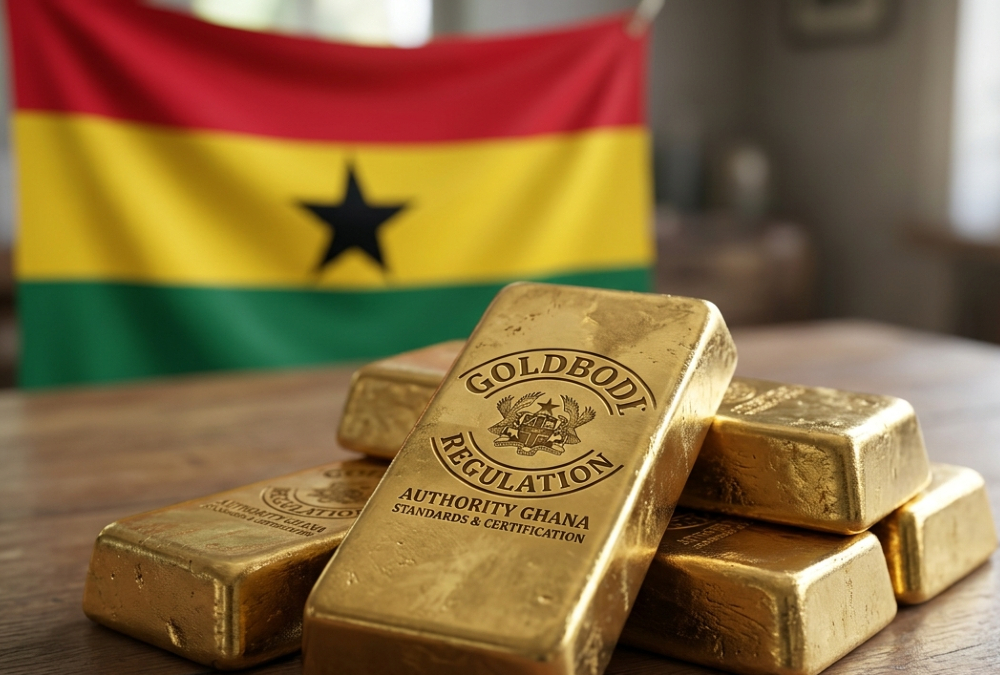
The government’s response was to create GoldBod in 2025 – a dedicated Gold Board tasked with regulating small-scale mining and formalizing domestic gold trade. The results have been hard to argue with: roughly US$10 billion in sector revenue in its first year, a string of high-profile arrests targeting smugglers (many of them foreign nationals who had previously dominated the illicit trade), and a projection from the Ghana Statistical Service that this year’s haul will be even larger.
It is, by most measures, a regulatory success story. But it is an incomplete one. Criminal networks are adaptive, and smuggling continues to exploit gaps in border surveillance and monitoring. Sustaining these gains will likely require Ghana to invest in more sophisticated screening, tracking, and detection technology – the kind of infrastructure that turns a one-year revenue spike into a durable national asset rather than a temporary crackdown.
A Longer Leash for the Presidency
While GoldBod has been busy asserting state control over the ground, Ghana’s political class has been debating how much control any one leader should have over the state itself.
Like much of Africa, Ghana inherited its early constitutional architecture from its colonizer – Britain’s parliamentary model, in this case, in contrast to the hybrid presidential systems that former French colonies such as Côte d’Ivoire (Ivory Coast) and Cameroon adopted. Most former British territories eventually pivoted to presidential systems of their own. For a long stretch after independence, though, term limits were almost beside the point: one-party states, indefinite incumbencies, and military rule were far more common than competitive, time-bound elections. Léopold Senghor’s voluntary exit from power in Senegal in 1980 was a rarity worth remarking on precisely because it was so unusual.
Term limits only became a serious constitutional feature after the Cold War, when Western-backed institutions made good governance a condition of financial support. A wave of new constitutions followed, generally settling on four- or five-year presidential terms with a two-term cap – Liberia’s six-year term was the outlier. In the years since, several countries have quietly walked those limits back as incumbents sought more time in office.
Ghana’s current proposal to move from a four-year to a five-year presidential term – notably, without resetting the clock for the sitting president – sits squarely in this tradition. The case for it is familiar: four years, proponents argue, is simply not enough time to execute complex development programs, and frequent elections are costly and increasingly divisive in a way that undermines national cohesion. Supporters often cite the long-term planning horizons of high-growth Asian economies in the 20th century as a model worth emulating.
Critics see it differently. A longer term, they warn, entrenches incumbents and dulls the responsiveness that regular elections are designed to enforce. In their view, accountability at the ballot box isn’t a design flaw to be minimized – it is the point.
The Common Thread
Set side by side, GoldBod and the term-limit debate tell a consistent story about Ghana in 2026: a state deciding, sector by sector, that it needs more authority and more runway to fix problems that short-term, loosely governed systems failed to solve. In mining, that logic has produced measurable results – billions of dollars in recovered revenue and a visible dent in smuggling. In politics, the same logic is being asked to justify a fundamentally different kind of trade-off, one where the “return on investment” isn’t tax revenue but the health of democratic accountability itself.
Ghana’s gold reforms suggest that stronger, better-resourced state institutions can outperform weak, informal ones. Whether that lesson translates cleanly to the presidency is a far more contested question – and one Ghanaians, not outside observers, will ultimately have to answer.
Fidel Amakye Owusu is an International Relations and Security Analyst. He is an Associate at the Conflict Research Consortium for Africa and has previously hosted an International Affairs program with the Ghana Broadcasting Corporation (GBC). He is passionate about Diplomacy and realizing Africa’s global potential and how the continent should be viewed as part of the global collective.
