
Owusu on Africa
A Cameroonian Tycoon’s $900m Bet on Central African Aviation Amid Instability
A billionaire’s $900 million airline gamble could finally solve one of Africa’s most stubborn connectivity problems.

By Fidel Amakye Owusu
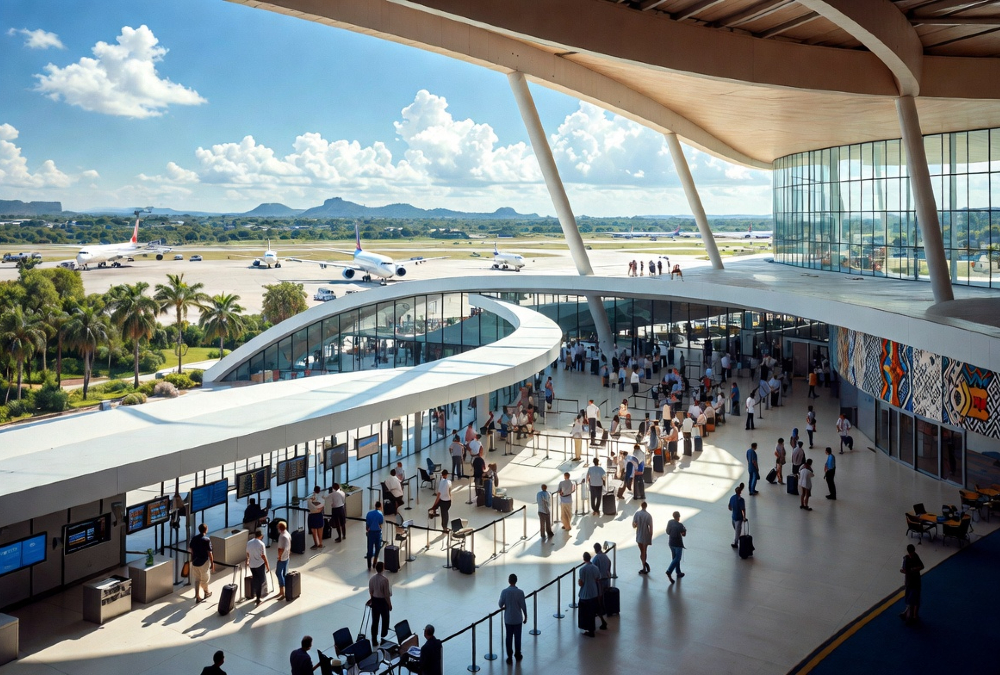
Baba Ahmadou Danpullo, francophone Africa’s wealthiest man, is about to find out whether a single fortune can succeed where decades of government policy have failed. His plan: commit roughly 500 billion CFA francs, or US$900 million – nearly the entirety of his estimated net worth – to launch Danpullo Air Line and build two private airports in Cameroon.
It is one of the boldest private infrastructure bets in African aviation history, and it is aimed squarely at a problem that has quietly throttled the region’s economy for generations: getting people and goods from one place to another. Skeptics will call it reckless. A more careful look at Central Africa’s economic geography suggests it might be shrewd.
The Scale Problem Hiding in Plain Sight
Central Africa is enormous, and that fact alone makes the case for aviation. The region contains the Democratic Republic of Congo (DR Congo), the largest country in sub-Saharan Africa, and Chad, Africa’s largest landlocked nation.
Angola, Cameroon, the Central African Republic, and the Republic of the Congo would each count as sizable countries by European standards. When distances are this vast, and roads and railways this sparse, flying stops being a luxury and starts becoming the only practical option.
That is not a coincidence Danpullo is ignoring. It is the thesis of his entire venture.
Critical Minerals Rewriting the Region’s Economic Map
Central Africa has become one of the hottest fronts in the global race for critical minerals – the cobalt, coltan, and rare earths that power everything from smartphones to electric vehicles. That has pulled in a new wave of investors, mining companies, and international stakeholders, all of whom need to move people, equipment, and capital efficiently across a region where infrastructure has not kept pace with ambition.
Combine that economic momentum with the region’s sheer geographic scale, and a picture emerges of an aviation market that is underserved relative to its potential – precisely the kind of gap that attracts investors willing to build first and let demand catch up.
When Bad Roads Become a Business Case
Here is the counterintuitive part: Central Africa’s chronically underdeveloped road and rail networks, usually cited as one of the region’s biggest liabilities, may actually work in aviation’s favor. Decades of underinvestment in surface transport have left much of the region without reliable alternatives.
Until governments close that gap, air travel offers the fastest – and often the only reasonable – way to move across these countries.
That is not a defense of poor infrastructure. It is simply a recognition that, in the short and medium term, aviation can fill a void that roads and railways will take years, if not decades, to fill themselves.
Why Flying May Be the Safer Bet
Insecurity remains a real concern in parts of Central Africa, and that fact might seem, at first glance, to argue against any major investment. But conflict in the region has been overwhelmingly terrestrial, notwithstanding the recent emergence of drone warfare.
Airports and other strategic facilities have received heightened security attention, which means air transport can, somewhat paradoxically, be safer than overland alternatives in contested areas. For investors weighing risk against reward, that distinction matters.
A Hub At the Heart Of the Continent
Central Africa’s location is itself a strategic asset. Sitting at the geographic center of the continent, the region is well positioned to serve as a connective hub linking West, East, and Southern Africa.
A functioning regional carrier does not just serve Cameroon and its immediate neighbors – it has the potential to become essential connective tissue for continent-wide trade and travel, aligning with broader efforts like the African Continental Free Trade Area and the Single African Air Transport Market.
The Long Game: Demographics as Destiny
Perhaps the most compelling argument for patient capital is demographic. Central Africa, with the DR Congo leading the way, is projected to account for a substantial share of both Africa’s and the world’s population by 2100.
Infrastructure investments made today – airlines, airports, logistics networks – are effectively bets on tomorrow’s population and purchasing power. Viewed on that time horizon, an US$900 million wager looks less like a gamble and more like an early position in a market that has not yet arrived.
The Risks Are Real, And They Are Large
None of this guarantees success. Launching an airline is among the most capital-intensive undertakings in business, before you even factor in the construction of two entirely new airports.
Danpullo Air Line will face established international competitors – Air France, Turkish Airlines, Brussels Airlines, and Royal Air Maroc among them – along with the regulatory complexity, fuel-price volatility, and currency risk that have sunk previous African aviation ventures. Cameroon’s own state carrier, Camair-Co, remains a cautionary tale of how difficult sustainable air travel is to build in this market.
But Danpullo’s wager is a useful test case for a broader question facing the continent: can private capital succeed where state-led infrastructure projects have repeatedly stalled? If Central Africa’s connectivity problem is ever going to be solved, someone has to be willing to risk real money on the answer being yes.
Cameroon’s richest man just did.
Fidel Amakye Owusu is an International Relations and Security Analyst. He is an Associate at the Conflict Research Consortium for Africa and has previously hosted an International Affairs program with the Ghana Broadcasting Corporation (GBC). He is passionate about Diplomacy and realizing Africa’s global potential and how the continent should be viewed as part of the global collective.
