
Zina’s Youth View on Africa
Somalia’s Fight Against al-Shabaab: Why Political Unity Must Precede Military Victory
Al-Shabaab is not just a military problem. It is a symptom of Somalia’s unfinished political settlement – and no amount of firepower will cure it until Mogadishu does.

By Godfred Zina
Ask a Somali official how the war against al-Shabaab is going, and you will likely hear about airstrikes, territorial gains, and the resilience of Somali forces. Ask a resident of a contested district, and you may hear something else entirely: a story about which government – federal or regional – actually controls the checkpoint down the road, and whether either one can be trusted.
That gap in perception is the real battlefield. Somalia’s fight against al-Shabaab is routinely described as a military campaign. It would be more accurate to call it a test of political cohesion – one the country has yet to pass.
A Militant Group That Feeds on Discord
Al-Shabaab has survived nearly two decades of foreign intervention, African Union peacekeeping, and repeated Somali offensives not primarily because it is militarily unbeatable, but because it is politically opportunistic. The group thrives less on ideological conviction among ordinary Somalis than on the vacuum left by state dysfunction. Where clan rivalries fester, where federal and regional governments compete rather than cooperate, and where communities view the state as distant, corrupt, or predatory, al-Shabaab positions itself as an alternative – sometimes a brutal one, but often a more predictable one than the state itself.
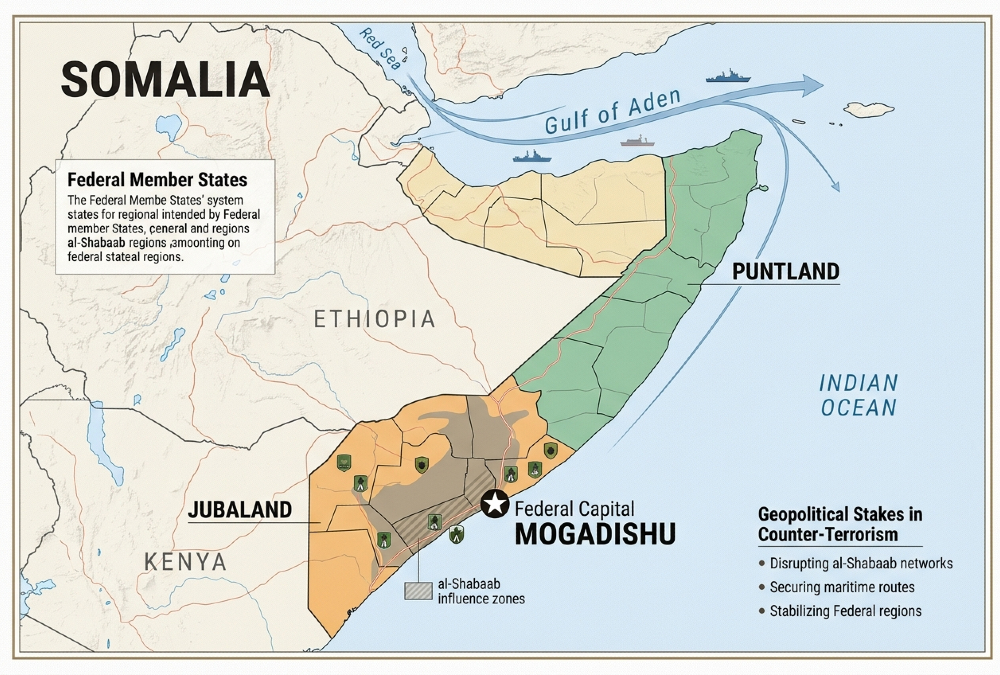
This is why the unresolved tug-of-war between Mogadishu and regional administrations such as Puntland and Jubaland matters as much as any battlefield gain. Disputes over elections, constitutional powers, and control of security forces are not peripheral to the counterterrorism campaign; they are the campaign’s greatest vulnerability.
The Federalism Trap
Somalia’s federal experiment remains a work in progress, and both extremes of the spectrum carry real danger. A federal government that overreaches risks alienating regional states that already guard their autonomy jealously, reviving old grievances about domination from Mogadishu. But a federal government that is too weak to coordinate a unified response leaves regions to fend for themselves – each with its own security apparatus, its own political calculations, and, in effect, its own foreign policy.
The result is a country with multiple armed forces nominally fighting the same enemy but answering to different masters. Puntland’s forces, Jubaland’s forces, and the national army do not always share intelligence, strategy, or trust. An insurgency as adaptive as al-Shabaab needs no better gift than a fragmented opponent.
Building a security structure that regional states view as genuinely national – rather than as an extension of whichever administration currently holds power in Mogadishu – is not a technical fix. It is a political negotiation that Somalia has repeatedly postponed.
Legitimacy, Not Just Firepower
There is a harder truth beneath all of this: military operations cannot deliver lasting victory in places where communities do not trust the government asking for their loyalty. Clearing a town of al-Shabaab fighters means little if residents believe the force that replaces them is corrupt, ethnically exclusive, or indifferent to their needs.
Insurgencies of this kind are ultimately defeated by governance, not just by gunfire – a lesson borne out from the Sahel to the Horn of Africa.
Washington’s Double-Edged Support
Enter the United States, whose support – through airstrikes, training, and intelligence – has undeniably strengthened Somalia’s tactical capacity against al-Shabaab. But American engagement is not a neutral variable in Somalia’s internal politics. It can reinforce unity, or it can deepen fracture, depending on how it is deployed.
Washington’s growing security cooperation with Puntland, Jubaland, and Somaliland – valuable in its own right for counterterrorism and maritime security – carries a risk that is often underappreciated: if such partnerships consistently bypass Mogadishu, they risk legitimizing a de facto fragmentation of Somali sovereignty. Regional administrations empowered directly by foreign patrons have less incentive to negotiate with the federal government, and more incentive to entrench their own autonomy.
External support, in other words, can be a stabilizing force or an accelerant of division. The difference lies entirely in coordination.
Why the World Should Care
This is not a story confined to Somalia’s borders. Puntland and Somaliland sit along some of the world’s most strategically vital waters – the Gulf of Aden and the approaches to the Red Sea – making them prizes for shipping security, counterterrorism basing, port access, and foreign military footholds. Somalia’s internal fault lines are increasingly entangled with a wider contest involving Ethiopia’s regional ambitions, Somaliland’s push for international recognition, and great-power competition for access to the Red Sea corridor.
Meanwhile, the African Union Support and Stabilization Mission in Somalia (AUSSOM) – meant to usher in an era of Somali-led security – remains heavily dependent on international funding and logistics. That dependence raises an uncomfortable question about the entire premise of African-led peacekeeping: can it truly be sustainable if it cannot yet sustain itself?
The Bottom Line
Somalia does not have the luxury of treating political reconciliation and counterterrorism as separate projects to be sequenced one after the other. They are the same project. Every unresolved dispute over federal power, every regional security force operating outside a unified command, and every foreign partnership that sidesteps Mogadishu adds up to the same outcome: a Somalia that fights al-Shabaab with one hand while undermining its own cohesion with the other.
Foreign partners, chief among them the United States, have real influence here – not just as suppliers of firepower, but as potential brokers of coordination. Used wisely, their support could help Somalia knit its security architecture into something genuinely national. Used carelessly, it could simply fund the next round of division.
Somalia will not defeat al-Shabaab through military pressure alone. It will do so, if at all, by resolving the political question its leaders have avoided for two decades: what kind of state Somalia actually intends to be – and who gets to decide.
Godfred Zina is a freelance journalist and an associate at DefSEC Analytics Africa, a consultancy specializing in data and risk assessments on security, politics, investment, and trade across Africa. He also serves as a contributing analyst for Riley Risk, which supports international commercial and humanitarian operations in high-risk environments. He is based in Accra, Ghana.
