
Owusu on Africa
Cameroon: The 93-Year-Old President and the Succession Gambit

By Fidel Amakye Owusu
For former French colonies in Africa, inheriting the metropole’s model went far beyond language and lycées. It meant adopting the Constitution of France’s Fifth Republic – and with it, a hyper-presidential system designed by Charles de Gaulle.
That gave presidents the power to appoint and dismiss prime ministers at will, dissolve national assemblies, and concentrate authority in ways that made them effectively monarchical.
But one feature of that system has become a growing liability: the line of succession.
Under the original Gaullist blueprint, if a president dies or is incapacitated, the head of the National Assembly takes over temporarily, pending new elections. There is no vice president. There is no automatic completion of the electoral cycle. Instead, there is a vacuum – and in fragile states, vacuums attract coups.
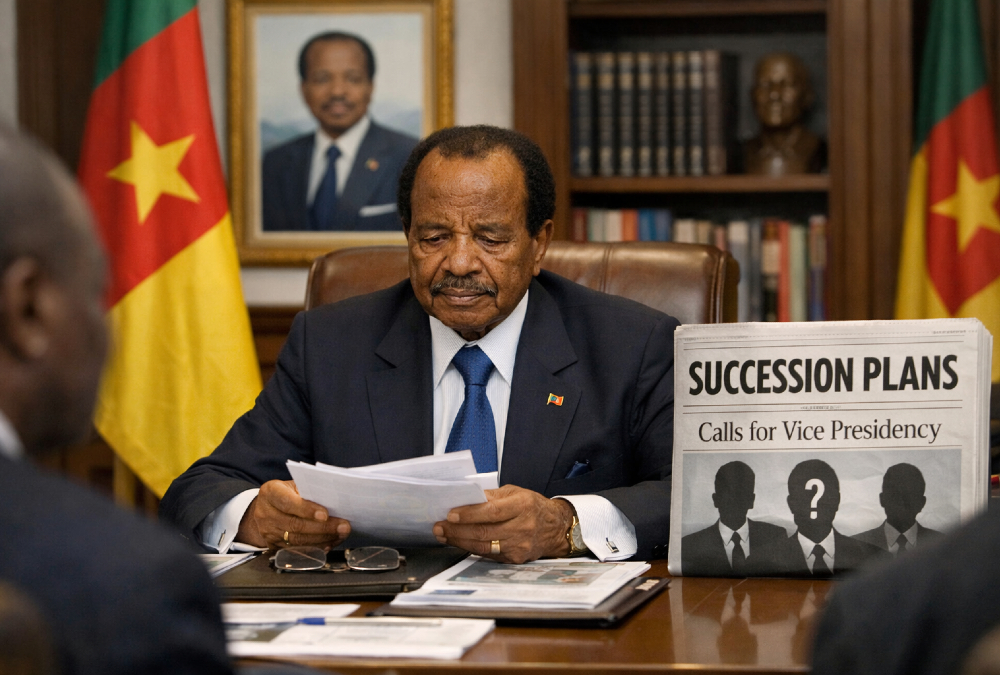
That is why Cameroon, now led by 93-year-old President Paul Biya, is reportedly seeking to create a vice-presidential position. The move is not merely administrative. It is an urgent act of political self-preservation.
The Anglophone–Francophone Divide
Across the continent, the contrast is striking. Many Anglophone African countries inherited the British parliamentary model but later moved toward presidential systems with clear succession plans – usually a vice president who steps up without triggering snap elections.
That provides continuity and predictability.
Francophone countries, by contrast, largely stuck with the Fifth Republic template. For decades, that served strongmen well. But as aging presidents cling to power and regional coup belts expand, the absence of a clear successor has become a dangerous flaw.
Consider Côte d’Ivoire (Ivory Coast). When Félix Houphouët-Boigny died in 1993 after more than three decades in power, the constitutional ambiguity triggered a power struggle between National Assembly leader Henri Konan Bédié and Prime Minister Alassane Ouattara.
The resulting instability helped lead to the country’s first successful coup. Today, Ivory Coast has a vice president.
Cameroon seems to have learned that lesson – late, but not too late.
Biya’s Delicate Dilemma
Paul Biya has ruled Cameroon for over 40 years. His physical decline is no longer a secret. The ruling elite – those who have prospered under his long shadow – fear not democracy but disorder. They want continuity without chaos. They want a trusted insider ready to step in before the military feels compelled to step up.
In a region where coups have returned with a vengeance (from Mali to Burkina Faso to Niger), the stakes could not be higher. A sudden vacancy in Yaoundé without a designated successor would invite exactly the kind of power struggle that soldiers love to exploit.
Creating a vice presidency is not about democratization. It is about control. The appointee will almost certainly be a loyal ally, not a reformer. But even a managed transition is preferable to the alternative: a frantic scramble for power that leaves the barracks as the final arbiter.
What Comes Next
Cameroon’s move is unlikely to be an exception. Other Francophone nations with aging leaders and no vice president may follow. But not all will. Some fear that creating a formal successor creates a rival center of power – a potential co-president who could accelerate their departure. For autocrats accustomed to ruling until death, even planning for a transition can feel like inviting it.
Still, the arithmetic of aging is unforgiving. The French Fifth Republic’s succession gap made sense in de Gaulle’s France, with robust institutions and no recent history of military putsches.
In today’s Sahel and Central Africa, it is an invitation to catastrophe.
Cameroon is not becoming a democracy. It is becoming a more pragmatic autocracy – one that has read the headlines and does not wish to become one.
Fidel Amakye Owusu is an International Relations and Security Analyst. He is an Associate at the Conflict Research Consortium for Africa and has previously hosted an International Affairs program with the Ghana Broadcasting Corporation (GBC). He is passionate about Diplomacy and realizing Africa’s global potential and how the continent should be viewed as part of the global collective.
