
Opinion
Distance, Not Production, Is Holding Back Emerging Industry
The Industrial Revolution made Britain rich by making goods cheap to move, not merely cheap to make. The lesson is hiding in plain sight on a continent still paying a punishing toll to the map.

By Dishant Shah
Picture a cocoa farmer in northern Ghana, a textile maker in Kano or a copper miner in Zambia’s Copperbelt. Each can produce in abundance. Each then discovers that the real contest begins at the factory gate. A few hundred miles of potholed road, a congested port and a border crossing that swallows days can consume most of the margin. The goods were made. The profit was lost in transit.
Economists in the age of steam would have recognized the problem at once. It is the constraint that shaped the pre-industrial economy, and it is the one that quietly governs much of Africa’s today.
How a Revolution Shrank the Map
The popular story of the First Industrial Revolution is about production: spinning machines, blast furnaces and the steam engine. But the deeper change was about movement. Before railways, inland freight in Britain depended on horse-drawn wagons, rivers and canals. Wagons were slow, costly and limited in load. Rivers went only where geography allowed. Canals were marvels, but each demanded heavy investment and none could reach every mine or mill.
Steam changed the arithmetic. The decisive breakthrough was not speed but scale. A single locomotive could haul many wagons of coal, iron or grain in one journey, with far less reliance on animal power. Trains ran to dependable schedules in every season and linked mines, factories, farmland and ports into one system.
Three consequences followed, and each has an African echo.
First, the cost of distance fell. Markets once too expensive to serve became profitable. Manufacturers could draw raw materials from farther away and sell finished goods across wider territory.
Second, industry became more competitive. Cheaper coal and iron reached factories, and cheaper delivery reached customers. Larger production runs made sense because larger markets were suddenly within reach.
Third, markets fused. Price gaps between regions narrowed as goods moved freely. Producers were no longer prisoners of the customers within a day’s cart ride.
One caution is in order. Railways did not erase canals and roads overnight. In many places they complemented them, and building them demanded staggering sums of capital. But the direction of travel was unmistakable. The steam engine raised what industry could produce. The railway spread that productivity across geography.
Africa’s Hidden Tariff
Now consider the African continent. Africa’s leaders have spent years negotiating the African Continental Free Trade Area (AfCFTA), an ambitious pact to create a single market of more than a billion people. It is a worthy project, and trade barriers on paper do matter. Yet intra-African trade still hovers at roughly 15 percent of the continent’s total trade, a fraction of the share seen within Europe or Asia.
Tariffs explain part of that gap. Distance explains far more. A freight bill is a tariff that no parliament can repeal. When a truck from Mombasa to Kampala can lose days at a border, when a landlocked country pays heavily to reach a distant port, and when a container takes longer to leave a harbor than to cross an ocean, the effective barrier to trade dwarfs anything written in a customs schedule.
The colonial legacy deepens the trap. Many of Africa’s older railways were built to carry minerals and cash crops from the interior to the coast, in other words out of the continent, not across it. They were designed as straws, not as webs. Lines that slope toward the sea tell a story about whose markets the infrastructure was meant to serve. An independent Africa inherited a map of extraction and was left to redraw it.
The Case for Building – and Caution
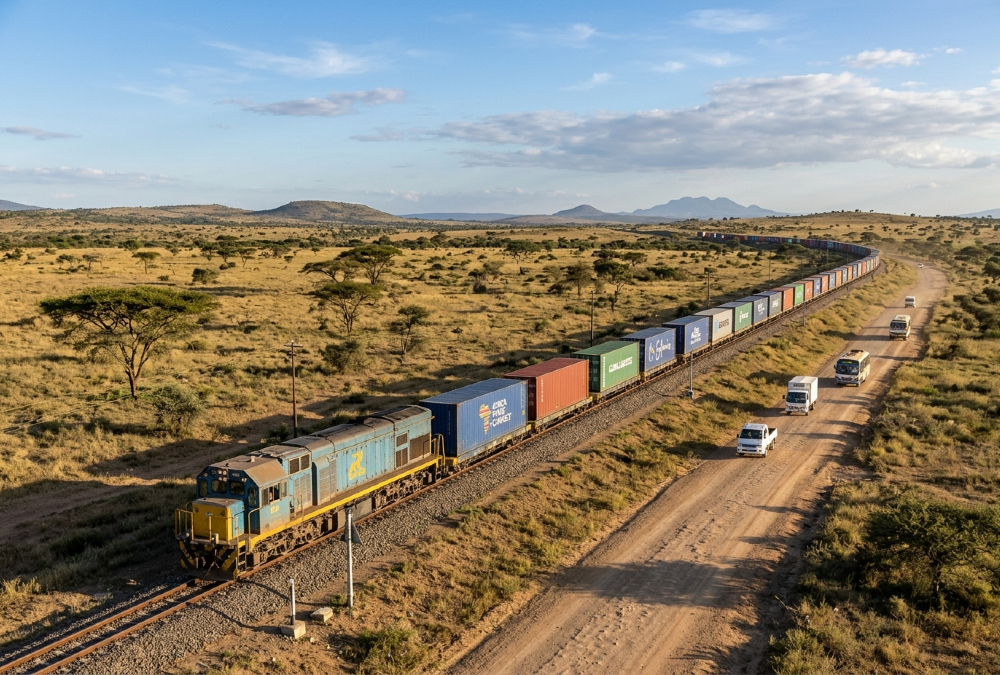
There are signs of a different logic. Kenya’s standard gauge railway between Mombasa and Nairobi, Ethiopia’s electrified line to Djibouti, the Lagos–Ibadan railway and the Tazara line linking Zambia to Tanzania’s coast all reflect a conviction that movement is development. The Lobito Corridor, which aims to refurbish the rail route from Angola’s Atlantic coast toward the mineral belts of Zambia and the Democratic Republic of Congo, is the latest and most geopolitically charged example.
But the Victorian parallel cuts both ways. Britain’s railway boom produced great fortunes and spectacular bankruptcies, and the speculative frenzy of the 1840s ruined many investors. Africa has its own cautionary tales: lines built at high cost, financed by debt that strained public budgets, and then starved of the traffic and maintenance needed to pay their way. A railway that carries too little freight is not an engine of growth. It is a very expensive monument.
The lesson is that steel alone does not collapse distance. Trains need cargo, and cargo needs predictable rules. A railway that ends at a clogged port, or at a border where inspections are arbitrary, merely relocates the bottleneck. The real prize is a system: rail, road, port, customs and power working as one network, with digital tracking and harmonized procedures that make a journey across three countries feel like a journey across one.
Blueprint for an Industrial Revolution
Defenders of the status quo like to say Africa must first industrialize before it can afford better logistics. History suggests the reverse is at least as true. Industry follows cheap movement as often as it precedes it. Factories locate where inputs arrive affordably and customers are reachable. A manufacturer in Accra will invest in scale only if she can sell to Abidjan, Lagos and Nairobi without the journey devouring her margin.
That reframes the policy debate. Africa’s governments often compete to announce flagship factories and free-trade zones. They would do better to treat freight corridors, border efficiency and port productivity as first-order industrial policy. Every day shaved from a border crossing, every mile of reliable track and every reform that lets a truck cross a frontier without a ransom of delay is worth more to a continent of makers than another round of ribbon-cutting.
The original lesson of steam is both simple and subversive. An economy does not become dramatically more productive just by producing more. It becomes productive when it gets better at moving what it produces. Africa has the land, the labor, the minerals and, increasingly, the young consumers. What it still lacks, in too many places, is a map that works in its favor.
The steam age shrank Britain. The question for the 2020s is who will shrink Africa, and whether they will do it for Africans.
Dishant Shah is a partner at Legion Exim, a company specializing in facilitating the export of high-quality engineering products directly sourced from manufacturers in India to Africa. His areas of expertise include new business development and business management.
