
Owusu on Africa
Algeria’s Overture to Mali Could Reshape Sahel Security

By Fidel Amakye Owusu
The coordinated attacks that allowed extremist forces and rebel groups to seize strategic positions across Mali – and assassinate the country’s defense minister – have triggered a flurry of responses from the ruling junta. Investigations into suspected insider collusion with extremists have been launched, with the military itself placed under scrutiny.
Russia’s African Corps, after an apparent withdrawal that left the key northern city of Kidal exposed, has since resumed anti-rebel operations. Fellow Alliance of Sahel States (AES) members have pledged solidarity, even as questions linger over why the bloc’s standby force was nowhere to be seen when the attacks unfolded.
Yet of all the reactions that have followed, one stands apart: the signal from Algerian President Abdelmadjid Tebboune to Bamako that Algiers may be willing to re-engage. If Mali’s junta responds constructively, this could prove the most consequential diplomatic development since the crisis began.
A Border That Demands Cooperation
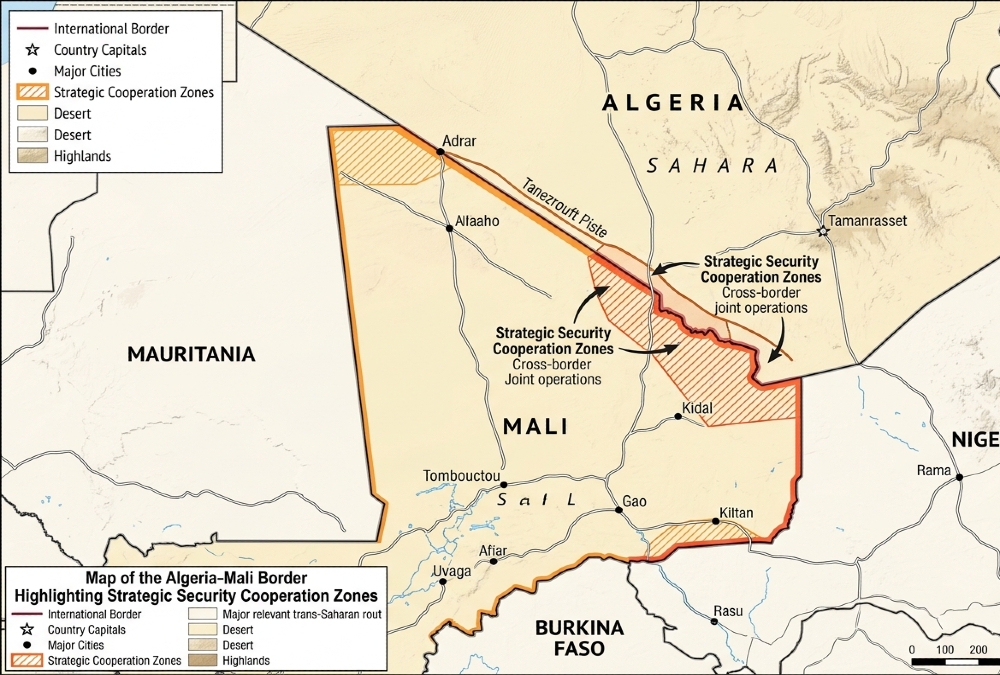
The case for rapprochement begins with geography. Algeria shares one of Africa’s longest land borders with Mali – a vast, largely ungoverned frontier that stretches across nearly the entire northern edge of the country.
Only Mali’s border with Mauritania is longer. A boundary of that scale cannot be secured by one country alone. Without genuine coordination between Algiers and Bamako, it functions less as a border and more as an open corridor for armed groups, weapons, and fighters.
A History Impossible to Ignore
Algeria’s relevance to Mali’s security crisis is not merely logistical – it is historical. The remnants of Algeria’s brutal civil war of the 1990s directly contributed to the formation of Al-Qaeda in the Islamic Maghreb (AQIM), one of the earliest and most enduring jihadist franchises in the Sahel-Sahara region.
Algeria did not export this problem passively; it lived through it at enormous human cost. That experience has produced hard-won institutional knowledge, deep intelligence networks, and a security establishment with genuine expertise in countering the very forces now destabilizing Mali.
Any serious counterterrorism strategy in the region that overlooks Algeria overlooks one of its most capable potential partners.
The Diplomatic Record
Before relations soured, Algeria played a central role in brokering the 2015 Algiers Peace Accord – a landmark, if imperfect, agreement that brought moderate Tuareg rebel factions and the Malian government to the table. That process demonstrated both Algiers’ influence over key non-state actors and its willingness to invest diplomatic capital in Mali’s stability.
When Mali’s junta unilaterally walked away from the Algiers framework, it severed a channel that had taken years to build. Reopening it – even partially – would restore an important avenue for managing the country’s complex internal conflicts.
Military Capacity and Economic Weight
Algeria is also, by any regional measure, a serious military power. It ranks among the highest defense spenders on the African continent, fields a well-equipped and battle-tested armed forces, and backs that capability with one of the region’s more substantial economies.
A security partnership with Algiers would offer Mali something that its current reliance on Wagner Group – now rebranded as the African Corps – has conspicuously failed to deliver: sustained effectiveness and strategic depth.
A Moment That Should Not Be Squandered
History offers no shortage of examples of governments repairing fractured relationships when shared interests demand it. The junta in Bamako faces a security environment that is deteriorating, a regional alliance whose solidarity has proven more rhetorical than operational, and a Russian partner whose reliability is increasingly in question.
Algeria’s overture arrives at precisely this juncture.
The opportunity should not be wasted. Responding to Algiers with the same dismissiveness that characterized the junta’s earlier exit from the peace process would be a strategic error.
A measured, reciprocal engagement – one that rebuilds trust incrementally and focuses on the shared imperative of border security and counterterrorism – could lay the groundwork for a far more durable stability than Mali has managed to achieve through any of its recent partnerships. The window is open. Whether Bamako chooses to walk through it remains to be seen.
Fidel Amakye Owusu is an International Relations and Security Analyst. He is an Associate at the Conflict Research Consortium for Africa and has previously hosted an International Affairs program with the Ghana Broadcasting Corporation (GBC). He is passionate about Diplomacy and realizing Africa’s global potential and how the continent should be viewed as part of the global collective.
