
Owusu on Africa
Armed Groups and Africa’s Humanitarian Crisis
From the Sahel to the Congo’s Ebola wards, insecurity is the force multiplier no development agenda can afford to ignore.

By Fidel Amakye Owusu
The Great Green Wall of Africa was, by any measure, an audacious idea: a mosaic of restored ecosystems stretching across the entire width of the continent, from Senegal to Djibouti, designed to reclaim 100 million hectares of degraded land, generate millions of jobs, and push back against the advancing Sahara. It was the kind of visionary, generation-defining project that attracts international applause, donor pledges, and hopeful headlines.
It has also, in large swaths of the Sahel, ground to a near halt – not for want of funding or political will, but because of who got there first.
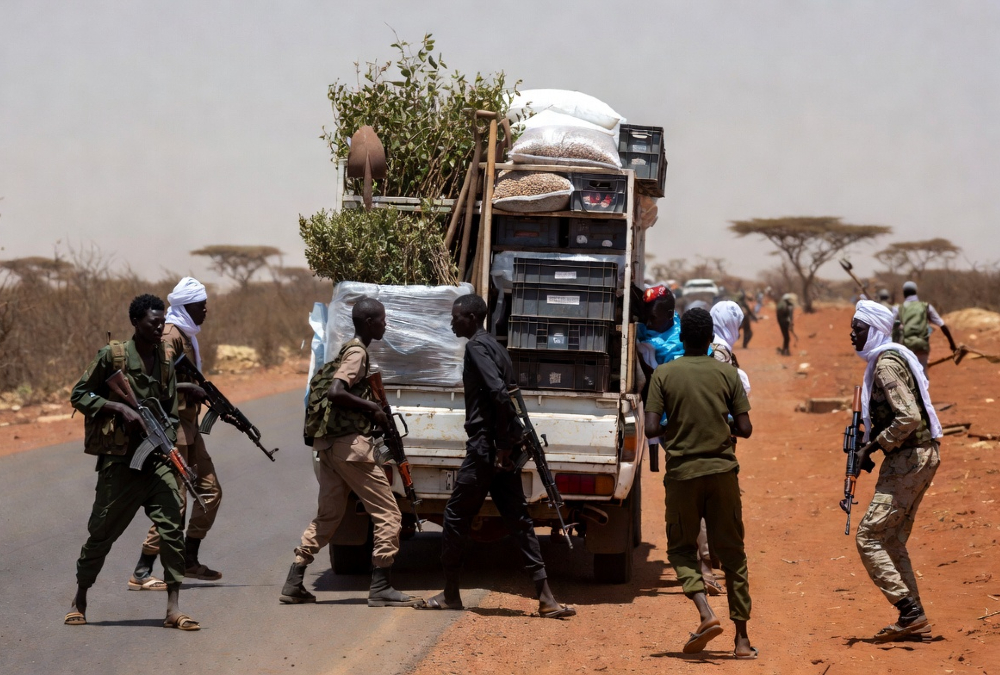
Extremist factions, criminal bandits, vigilante networks, armed ethnic militias, and a constellation of other non-state actors have moved into precisely the territorial and institutional space the Great Green Wall was meant to occupy. The result is a paradox that development economists rarely model but field workers understand viscerally: the lands most desperately in need of restoration are often the same lands where it is most dangerous to plant a tree.
Public agencies cannot operate. Private contractors will not deploy. International implementing partners face security constraints that make meaningful engagement nearly impossible. The mitigation space – the geographic and social terrain where intervention is both most needed and most impactful – has been colonized by armed groups for whom instability is not a problem to be solved but a resource to be exploited.
The Congo Confirms the Pattern
If the Great Green Wall illustrates what happens when insecurity stalls long-term development, the Democratic Republic of Congo is demonstrating, in real time, what happens when it undermines emergency response.
Congolese authorities have confirmed that armed groups operating at the epicenter of the country’s current Ebola outbreak have become a critical obstacle to containment efforts. The outbreak – caused by the Bundibugyo strain of the virus – has already claimed more than one hundred lives.
Perhaps more alarming is the disclosure that the outbreak went undetected for weeks, allowing it to spread far more widely before surveillance systems caught up. The affected provinces – Ituri, North Kivu, and South Kivu – represent some of the most volatile terrain on the continent.
They are also home to some of its most entrenched armed actors. The Allied Democratic Forces maintain a menacing operational presence in Ituri. The M23 rebel movement and its allied forces are deeply embedded across North Kivu and parts of South Kivu. For health workers attempting to mount an emergency response, this is not a bureaucratic inconvenience – it is a daily, mortal calculation.
The situation reached a grim inflection point when a team of health workers traveling to conduct a safe and dignified burial of an Ebola victim was attacked. The assailants seized the body. In the epidemiology of Ebola, where post-mortem transmission remains one of the most significant vectors of contagion, that act was not merely a violation of human dignity – it was a potential accelerant of the outbreak itself.
The Logic of Cascading Insecurity
There is a concept worth naming plainly here, one that practitioners in conflict-affected development zones understand well but that rarely makes it into polite policy discourse: insecurity begets insecurity. It is not merely that armed groups complicate development or humanitarian response as an incidental side effect of their presence.
It is that the conditions these groups create – displacement, institutional collapse, the retreat of the state, the erosion of social trust – are precisely the conditions in which crises like Ebola outbreaks take root and spread. Put differently: the same factors that prevented an early warning system from detecting a dangerous epidemic are the factors now preventing the response teams from containing it.
This is not a coincidence. It is a system.
What This Demands of Policymakers
The Great Green Wall and the DR Congo Ebola response are separated by thousands of miles and are categorically different crises. But they share a foundational lesson that the international community has been disturbingly slow to institutionalize: physical security is not one development prerequisite among many. It is the prerequisite. Without it, the entire architecture of social and economic intervention – reforestation, public health, education, agriculture – rests on sand.
This is not an argument for militarizing development or subordinating humanitarian principles to security agendas. It is an argument for intellectual honesty.
Donor governments and multilateral institutions that continue to fund ambitious programs in conflict-affected zones without commensurate investment in stabilization are not being bold. They are being negligent – wasting resources, raising false hopes, and, in the most acute cases, sending workers into harm’s way with inadequate protection.
Africa’s armed groups have proven adept at recognizing and exploiting the mitigation space. The question now is whether the institutions tasked with protecting and developing that same space are willing to reckon honestly with the security dimension – or whether they will continue to plan around it, pretend it away, and wonder why the trees aren’t growing and the outbreaks aren’t stopping.
Fidel Amakye Owusu is an International Relations and Security Analyst. He is an Associate at the Conflict Research Consortium for Africa and has previously hosted an International Affairs program with the Ghana Broadcasting Corporation (GBC). He is passionate about Diplomacy and realizing Africa’s global potential and how the continent should be viewed as part of the global collective.
