
Owusu on Africa
Why West Africa’s War on Terror Demands Cross-Border Unity

By Fidel Amakye Owusu
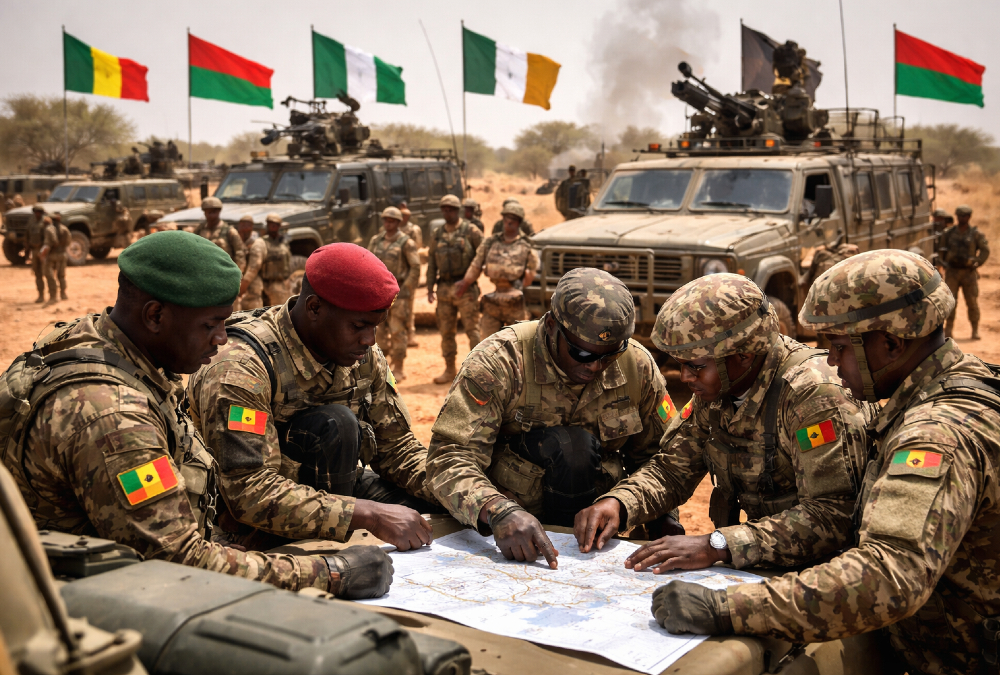
The collapse of the G5 Sahel should serve as a wake-up call: African states cannot defeat violent extremism through fragmented, go-it-alone strategies. Regional security requires what military planners call interoperability – the unglamorous but essential work of coordinating operations across borders, sharing intelligence, and deploying resources where they are needed most.
More than a decade ago, five nations – Mauritania, Mali, Burkina Faso, Niger, and Chad – formed the G5 Sahel as part of a broader regional security architecture designed to combat extremism.
It stood alongside two other multinational efforts: the Multinational Joint Task Force, comprising countries around Lake Chad Basin (Nigeria, Cameroon, Chad, and Niger), and the Accra Initiative, established in 2017 by coastal states including Ghana, Côte d’Ivoire (Ivory Coast), Togo, Benin, and Burkina Faso to prevent terrorism’s southward creep from the Sahel.
Then came political instability. Mali’s withdrawal from the G5 Sahel triggered a domino effect.
Without Bamako’s participation, geographic continuity became impossible. Other member states followed suit, and the alliance crumbled into irrelevance.
The Cost of Disunity
The consequences are stark. Recent reports indicate that Beninese forces have neutralized dozens of terrorists in the country’s northern regions, which border the Sahel – now the global epicenter of terrorist activity.
While such tactical victories merit recognition, they underscore a troubling reality: without multinational coordination, these successes remain isolated bright spots in an otherwise darkening landscape.
At a security conference in East Africa last month, I addressed the critical need for interoperability and collaborative operations. The central thesis is straightforward: violent extremist organizations don’t respect borders, so neither can counterterrorism efforts.
Al-Qaeda affiliates and Islamic State franchises operate deliberately in border regions across West Africa. The Sahel tri-border area, the coastal frontier zones, and the multiple boundaries surrounding Lake Chad Basin represent their most active theaters.
This isn’t coincidental – border regions offer sanctuary, complicate pursuit, and exploit jurisdictional ambiguities.
The pattern repeats across the continent. In the Horn of Africa, Islamic State affiliates concentrate around Somalia’s border with Ethiopia.
Al-Shabaab maintains a threatening presence near Kenya’s frontier. The Allied Democratic Forces operate along the Democratic Republic of Congo’s boundary with Uganda.
In Mozambique’s Cabo Delgado province, extremists have leveraged the border with Tanzania, establishing footholds in southern Tanzania itself.
The Strategic Imperative
Given this reality, the optimal strategy is clear: pool resources and develop coordinated responses. Regional forces operating in concert can afford modern weapons systems that individual nations cannot.
Expensive equipment becomes financially viable when costs are shared. Operational capabilities can be synchronized. Tactical doctrines can be harmonized.
More importantly, coordinated forces can maintain persistent pressure on terrorist networks that would otherwise simply relocate across borders when confronted. A terrorist cell driven from northern Benin shouldn’t find refuge in Burkina Faso.
Extremists fleeing Nigerian operations shouldn’t reconstitute in Cameroon unmolested.
The alternative—the current default—is a perpetual game of whack-a-mole, where military successes in one jurisdiction merely redistribute the threat rather than diminishing it. This approach exhausts national budgets, demoralizes security forces, and allows terrorist organizations to maintain strategic initiative.
Learning from Failure
The G5 Sahel’s dissolution offers valuable lessons. Political stability matters. Buy-in from all participating states is essential. Geographic continuity cannot be taken for granted.
But the fundamental premise remains sound: terrorist networks that operate regionally must be confronted regionally.
West African states face a choice. They can continue fighting fragmented battles against an enemy that moves fluidly across borders, enjoying interior lines of communication and the ability to concentrate forces at will.
Or they can revive the collaborative spirit that initially created these multinational frameworks, learning from past failures to build more resilient structures.
The recent successes in northern Benin prove that African militaries possess the capability to confront violent extremism effectively. What remains missing is the strategic architecture to translate tactical victories into sustained security gains.
That requires the political will to subordinate narrow national interests to broader regional security imperatives.
The terrorists have already made their choice. They operate as networks, not nation-states.
Until the response matches the threat in scope and coordination, the cycle of displacement and reconstitution will continue. Africa’s security depends on whether its leaders can overcome political obstacles to forge the interoperable, coordinated response that the situation demands.
The question isn’t whether African states can do more against violent extremism through coordination and interoperability. Recent operations have answered that affirmatively. The question is whether they will.
Fidel Amakye Owusu is an International Relations and Security Analyst. He is an Associate at the Conflict Research Consortium for Africa and has previously hosted an International Affairs program with the Ghana Broadcasting Corporation (GBC). He is passionate about Diplomacy and realizing Africa’s global potential and how the continent should be viewed as part of the global collective.
