
Opinion
Who Gets to Translate Africa?
Online sellers promise the “complete” Ethiopian Bible in English. A scholar of Gəʿəz says the claim is misleading, and that the real fight is over who tells a civilization’s story.
The Living Canon, Part 2 of 3
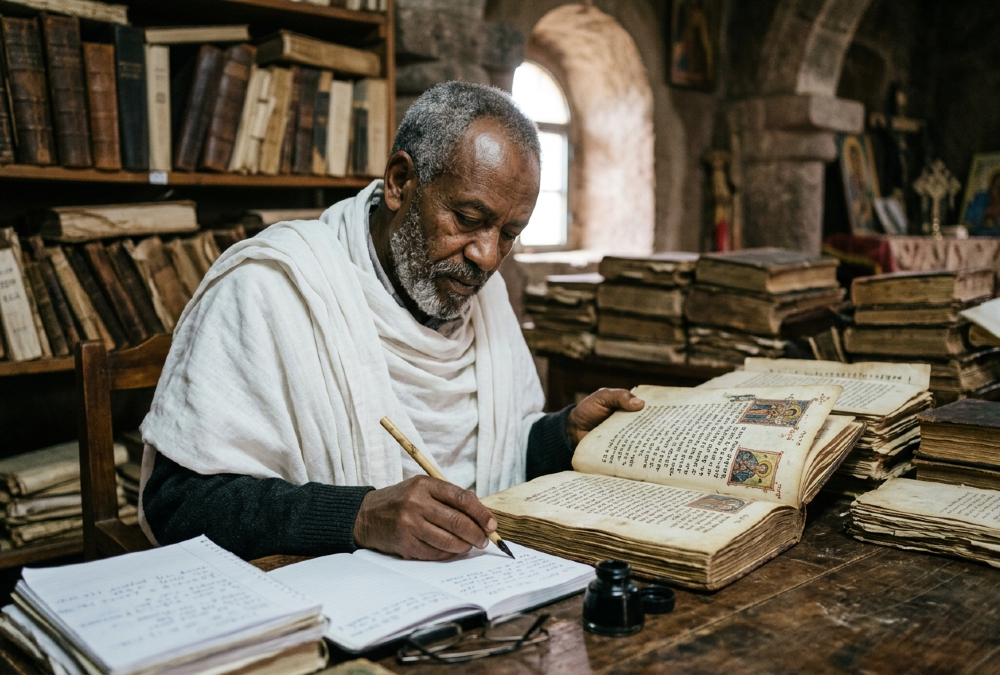
Scroll through social media long enough and the offer appears: the Ethiopian Bible, complete, in English, sometimes billed as the fullest version of Christianity there is. The packaging is confident. The number of books is usually impressive. The scholarship behind it, says Deacon Dr. Dawit Muluneh, is often missing.
“This question frustrates me,” Muluneh told The Habari Network, “because there is a great deal of misinformation surrounding it.” His objection is not to curiosity about Africa. It is to what happens when curiosity meets a market.
The Fashion for Africa
Africa, Muluneh observes, has become fashionable in many places. People want African clothing and African food. They learn an African word. African history feels new and exciting. All of this is welcome as far as it goes. But “fascination with Africa,” he says, “is not necessarily the same thing as genuinely trying to understand Africa or correct historical narratives about Africa.”
And where there is fascination, there is a market. In that market a “complete Ethiopian Bible” is a handsome product. The difficulty is that, as Muluneh puts it, there has not been a complete scholarly translation of the entire Gəʿəz biblical tradition into English in the way some advertisements suggest.
Four Chapters, Several Years
To grasp why, consider the Book of Jonah. It runs to four chapters. A colleague of Muluneh’s, a scholar deeply versed in Gəʿəz and Ethiopian textual traditions, made it the subject of his dissertation. It took him years. He compared more than one hundred manuscripts.
That is not pedantry. It is the job. Serious translation means weighing different textual witnesses, because the Gəʿəz tradition stretches across more than a millennium. Language changes. Manuscripts vary. A scholar must understand the historical forms of the language before claiming that an English rendering represents the tradition at all.
So when someone announces, “I have translated the Ethiopian Bible,” the proper replies come in a volley. Which version? Which manuscripts? Which period? Which textual tradition? What variants were considered? A seller who cannot answer has not translated a tradition. He has translated a text, and perhaps a single, convenient one. Muluneh’s verdict is blunt: marketing the whole as simply and authoritatively rendered is “misleading.”
The Mirror Test
Ryan Elcock, one of the interviewers, pressed the larger point. Translation, he noted, is not swapping one word for another, and meaning drains away when the translator does not understand the culture behind the language. So who is translating, why, and what story about Ethiopia are they building for future readers?
Muluneh answered with a thought experiment worth repeating. Suppose he announced that he had translated the entire English Bible into Amharic. The first question would be: which English Bible? Suppose he had used the King James Version and rendered its archaic English into equally archaic Amharic. Suppose he then told Ethiopians: “This is what English-speaking Christians believe. This is how they speak. This is how they understand Christ.”
He could build an entire narrative about English-speaking Christians from that one translation. It would misrepresent a much broader tradition. “The same problem exists with Gəʿəz,” he says. Depending on the sample you choose, “you could tell an entirely different story about the people.” That could distort their history and philosophy.
It is a neat reversal, and an uncomfortable one. Few Westerners would tolerate being understood through a single archaic text selected by a foreigner. Ethiopia is routinely asked to.
Words Carry Culture
The deeper difficulty is that translation concerns concepts rather than words. Muluneh offers a plain example. Translate “What’s up?” literally into another language and you may produce nonsense. To translate it properly you must recognize that it is a greeting, then find the greeting that does the same work. That is cultural translation, and religious texts demand it at every turn.
Elcock added a second example. In modern English, “That’s bad” can mean something is terrible or that something is impressive, depending on who is speaking. A future translator armed with a dictionary but not the culture could miss the meaning entirely. If that can happen with contemporary English, imagine what is possible with a text carried through an ancient language and civilization.
Here Muluneh turns to a fashionable assumption: that artificial intelligence can now simply translate ancient texts. AI can be useful, he allows. But translation at this level requires human understanding, of the manuscripts, the culture, the theology and the historical context. “The word you choose matters,” he says, and if the conceptual world behind a word is misunderstood, the result can misrepresent the people who produced it.
The danger compounds because of what happens next. “Words carry culture,” Muluneh says. “Once a translation becomes authoritative, people who cannot read the original language begin depending entirely on that translation.” The translator, in other words, holds a responsibility far greater than the job title suggests.
Who Owns the Story?
This is the point at which a publishing quibble becomes a political question. Elcock noted that narratives about Africa have repeatedly been interpreted through outside frameworks. When major achievements emerge from the continent, there can be a reflex to look elsewhere for the explanation, whether foreign influence or something fantastical. Could the same thing happen to Ethiopian Christianity, with future generations imagining Ethiopia through someone else’s lens rather than the lens of the people who preserved the tradition?
Muluneh does not respond with a demand for gatekeeping. “There is nothing wrong with people outside Ethiopia studying Ethiopia,” he says. “That is not the issue.” The issue is whether the tradition is being understood seriously. His test comes as a short list of questions. Are the languages being studied? Are the manuscripts being examined? Are Ethiopian scholars involved? Are people learning how Ethiopian Christians themselves understand their tradition? Or are people “taking something that looks exotic, packaging it and selling a story”?
Those are two very different enterprises, he says, and the public is not always in a position to tell them apart. That is exactly why the first kind deserves protection.
The Curse that was Never Pronounced
If this seems a rarefied worry, history offers a grim counterexample. Elcock raised the so-called Curse of Ham, long used to justify the enslavement of Black people. A reading of Genesis shows that the curse is pronounced on Canaan, not on Ham. Yet the misreading hardened into something close to accepted truth and underwrote an enormous injustice.
Muluneh draws the moral. Slavery has existed in many societies. The form imposed on Black people through the Atlantic system, however, became deeply racialized and permanent, and a system like that needs a moral framework that lets its participants believe they are doing nothing wrong. Religion can be bent to supply one. “You can say, ‘These people are cursed.’ You can say, ‘We are doing God’s work.’” Later, other intellectual systems can be recruited to reinforce the same hierarchy.
“This is why interpretation matters,” he says. “It is not simply an academic exercise. Ideas can have real consequences.”
A Question of Authority
Read in this light, the “complete Ethiopian Bible” is a small case of a large problem. A mistranslated Jonah will not enslave anyone. But the habit it represents, of letting a market or an outsider fix the meaning of someone else’s civilization, is the habit that made the Curse of Ham possible. The cure is neither suspicion of foreigners nor nostalgia for purity. It is the dull, difficult, unglamorous work of reading the manuscripts in the original language, in company with the people whose tradition it is.
That tradition is not only an intellectual inheritance. It belongs to a living Church, in a living country, and both are under strain. The pressures there are the subject of the final part.
Next in the series, Part 3: A Church under pressure, and an emperor the world still argues about.
