
Opinion
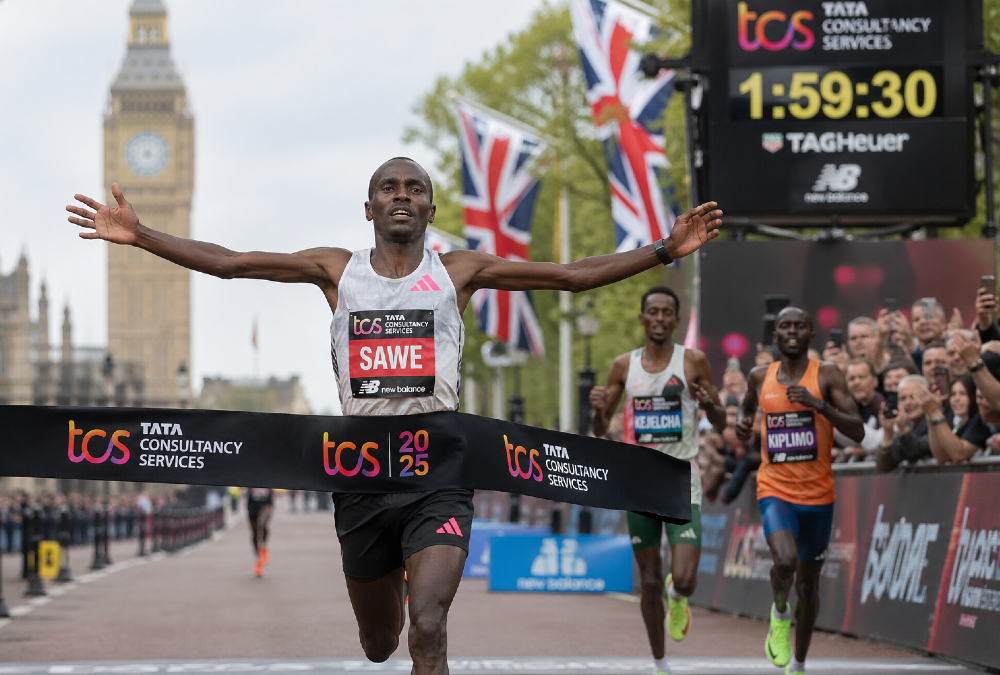
Sabastian Sawe Breaks Two-Hour Marathon Barrier, Credits London Crowds

By Mark-Anthony Johnson
On a cool Sunday morning in London, the last great frontier in distance running ceased to exist. Sebastian Sawe of Kenya crossed the finish line of the London Marathon in 1 hour, 59 minutes, and 30 seconds – becoming the first athlete in history to break the two-hour barrier in a fully ratified, open-competition marathon.
The achievement rewrites the record books. But according to Sawe himself, it was the roar of the crowd that pushed him through.
A Race for the Ages
Sawe entered the final miles locked in a fierce duel with Ethiopia’s Yomif Kejelcha, the two men having separated from a lead pack of six at the halfway mark – reached in a breathtaking 1:00:29. For mile after mile, they ran stride for stride, neither willing to yield. Then, in the closing stages, Sawe surged. The Kenyan kicked decisively for home, and history followed.
Kejelcha was no footnote. He, too, finished under two hours, clocking 1:59:41 – a time that would itself have constituted a world record just days prior.
Uganda’s Jacob Kiplimo completed a remarkable top three in 2:00:28, meaning all three podium finishers obliterated the previous men’s world record of 2:00:35, set in Chicago in 2023 by the late Kelvin Kiptum.
The Ghost of Kipchoge
The two-hour marathon has haunted the sport for decades – a round number so psychologically totemic that its pursuit has bordered on obsession. In October 2019, Kenya’s Eliud Kipchoge ran 1:59:40 in a controlled attempt that captivated the world. Yet that effort was never ratified as an official world record: Kipchoge wore prototype footwear, pacing and fluid-station protocols deviated from standard competition rules, and the event was not open to other competitors.
Sunday’s performance in London suffered from none of those caveats. It was, in every respect, the real thing.
The Technology Behind the Record
Sawe competed in Adidas’s new Pro Evo 3 “supershoe” – a featherweight marvel tipping the scales at under 100 grams. Sawe had flagged his ambitions openly before the race, telling reporters that a course record, or even a world record, was firmly in his sights.
That confidence was not bravado. It was a statement of intent.
The supershoe debate will inevitably follow this record, as it has followed every major marathon milestone in recent years. But the rules permit the technology, the competition was fair, and the performance was verified. The record stands.
What This Moment Means
Breaking a barrier of this magnitude is rarely the work of one athlete on one day. It is the convergence of training, talent, technology, and – as Sawe was quick to acknowledge – atmosphere.
The London Marathon crowd, famously one of the most electric in the sport, played its part.
For decades, coaches, physiologists, and athletes debated whether sub-two was even biologically possible in a legitimate race setting. The answer, delivered on a London street, is an unambiguous yes.
The question now is how quickly the record falls again.
Mark-Anthony Johnson is the founder and CEO of JIC Holdings, a global asset and investment management firm founded in 2009. With over 30 years of experience and strong ties to Africa, his investments span mining, infrastructure, power, shipping, commodities, agriculture, and fisheries. He is currently focused on developing farms across Africa, aiming to position the continent as the world’s breadbasket.
