
Owusu on Africa
Alliance of Sahel States Moves Forward, Redefining Regional Power Dynamics

By Fidel Amakye Owusu
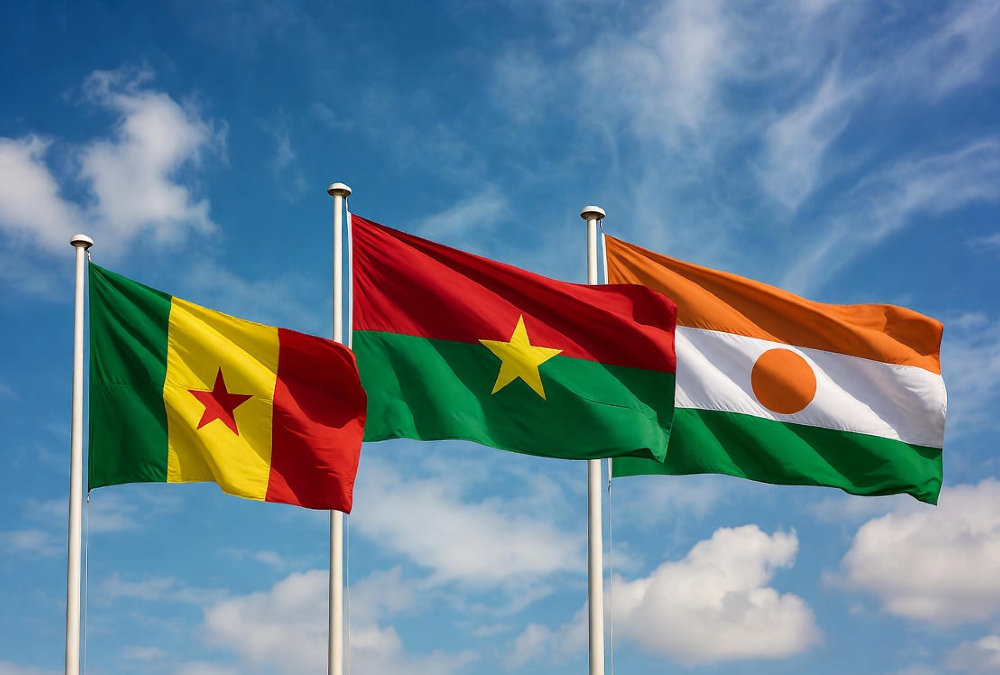
The Alliance of Sahel States has finally operationalized its founding ambition, but the implications extend far beyond military posturing. What began as a defensive reaction to regional intervention has evolved into a geopolitical realignment that could reshape West African security for decades.
The Origins of Secession
The catalyst for the Sahel states’ definitive rupture with the Economic Community of West African States (ECOWAS) emerged in 2023, when the regional bloc threatened military intervention to restore democratic governance in Niger following a coup. That threat proved to be the tipping point in what had been a simmering confrontation between military regimes and their democratic neighbors.
Mali and Burkina Faso, though already under ECOWAS sanctions at the time, had not yet moved to abandon an organization they had belonged to since 1975. Their calculations changed when Niger’s junta faced potential forcible removal.
For military leaders in Bamako and Ouagadougou, any successful ECOWAS intervention in Niamey would establish a dangerous precedent that could threaten their own tenuous grip on power.
Their unified defiance, combined with ECOWAS’s ultimate decision to back down, fundamentally altered the regional balance of power. The three nations announced a comprehensive political, economic, and military alliance binding together their landlocked territories in collective resistance.
A Force With Strategic Symbolism
The Alliance of Sahel States (AES) has now unveiled the military component of its confederation: a 5,000-strong joint force.
Given that the alliance was forged in defiance and sustained by threats of armed resistance against external interference, this launch represents a watershed moment in the coalition’s brief existence.
What distinguishes this development is the deliberate symbolism embedded in the force’s structure. Every aspect of the arrangement reflects careful attention to balance among the three member states, signaling that this alliance aspires to something more than mere convenience.
The inaugural ceremony took place in Mali under the stewardship of the alliance’s de facto leader, Colonel Assimi Goïta. Yet operational command has been entrusted to a Burkinabè general, Dauda Traoré, ensuring that Mali’s prominence doesn’t translate into dominance.
Meanwhile, the force will establish its headquarters in Niger – the alliance’s largest member by territory and the nation that shares a border with Nigeria, ECOWAS’s predominant military power. This geographic choice carries unmistakable significance.
Nigeria spearheaded the original intervention threat against the AES, and stationing the headquarters in Niger sends an unambiguous message about the alliance’s readiness to defend its most vulnerable member.
Competing Military Visions
The timing of the AES force’s establishment coincides with ECOWAS’s own announcement of plans for a 260,000-strong counterterrorism force. The regional bloc has indicated that this massive deployment would focus on frontline states in the fight against violent extremism – which means substantial troop concentrations in the northern regions of coastal nations, and in Senegal’s eastern territories, proximate to AES borders.
While no overt military confrontation has materialized between the two camps, recent incidents suggest latent tensions with potential military dimensions. Benin recently thwarted an attempted coup, and Niger seized a Nigerian military aircraft along with its crew.
These episodes, though contained, hint at the fragility of the current standoff.
The Paradox of Division Amid Common Threats
Herein lies West Africa’s most troubling contradiction. The region’s genuine adversary is not competing forms of governance – democracy versus military rule – but rather the relentless advance of violent extremism that has metastasized throughout the Sahel and now threatens to engulf coastal states.
Jihadist networks have exploited state fragility and international discord to expand their territorial control and operational capacity. As West African nations divide themselves into opposing blocs, each forming separate military structures, the extremists gain the strategic advantage that fragmentation inevitably provides to asymmetric actors.
What the region desperately requires is coordination, not competition. Military cooperation should be directed toward the shared existential threat of terrorism, not toward preparations for potential conflicts between neighboring states that share common security challenges, intertwined economies, and centuries of cultural exchange.
The AES’s new force may represent a milestone for the alliance, but it also represents a missed opportunity for regional unity. Until West African leaders – whether military or civilian – recognize that their survival depends on collective action against jihadism rather than mutual suspicion, the true enemy will continue to advance.
The question is not whether ECOWAS or the AES will prevail in their institutional rivalry, but whether either will remain standing if violent extremism continues its unchecked expansion while they focus on each other.
Fidel Amakye Owusu is an International Relations and Security Analyst. He is an Associate at the Conflict Research Consortium for Africa and has previously hosted an International Affairs program with the Ghana Broadcasting Corporation (GBC). He is passionate about Diplomacy and realizing Africa’s global potential and how the continent should be viewed as part of the global collective.
