
A Diaspora View of Africa
Foreign Actors Worsen Sudan Conflict

By Gregory Simpkins
The Sudan war that started April 2023 between the Sudanese Armed Forces (SAF) led by General Abdel Fattah al-Burhan and the Rapid Support Forces (RSF) led by Muhammad Hamdan Dagalo Musa (commonly known as Hemedti) is not just a domestic fight. Analysts call Sudan a “marketplace of violence” because so many foreign actors are involved.
The conflict began when tensions between the two former allies, who were meant to oversee a democratic transition after a 2019 uprising, boiled over into violence. The RSF and the SAF disagreed on integrating the RSF into the SAF and control of key military and political institutions. This disagreement escalated into a full-blown conflict, with both sides committing human rights abuses and atrocities.
The RSF originated as the Janjaweed militia, used by the Sudanese government to suppress rebels in Darfur. It had been particularly brutal in the Darfur conflict. The group was later formalized as the RSF in 2013.
The conflict also is linked to Sudan’s failed transition to democracy after the ouster of President Omar al-Bashir in 2019. A power-sharing agreement between military and civilian factions unraveled, leading to a military coup in October 2021.
A Humanitarian Catastrophe
Based on UN, US Congress and NGO reporting through 2025, in more than two years the war has killed and displaced more people than any conflict in Africa since the Darfur fighting in 2003. Exact numbers are not possible to verify due to ongoing fighting, but estimates are in the tens of thousands. El Fasher, Khartoum and West Darfur have seen the worst massacres. An estimated 12 million people have been displaced inside Sudan along with 3.5 million refugees in Chad, Egypt, South Sudan, Ethiopia, Libya and the Central African Republic as of February 2025. There are at least 25 million people – more than half the population – who require humanitarian assistance.
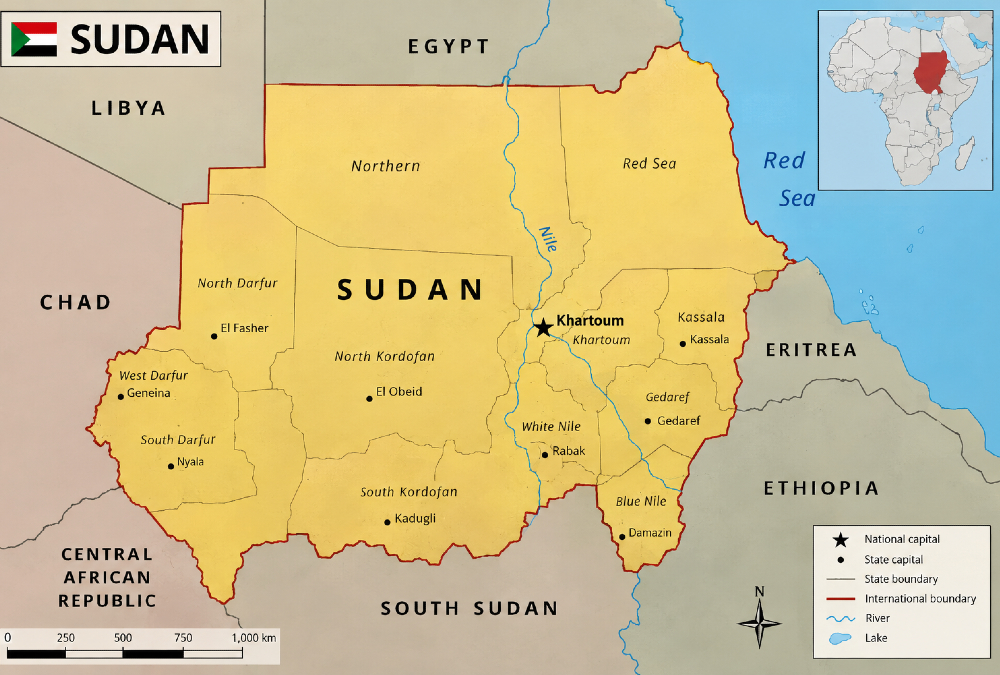
Khartoum, the capital city, and Omdurman have been largely destroyed. Hospitals, universities and museums have been looted or bombed. Both the SAF and the RSF accuse each other of using civilian areas. The RSF and allied militias have been accused of ethnic cleansing in West Darfur. El Fasher in North Darfur is the last SAF holdout and is under siege. Kordofan, Gezira and Sennar the new frontlines in 2024-2025. There is massive famine risk as farming collapses.
An estimated 70 percent of hospitals in conflict areas are out of service. There have been disease outbreaks, including cholera, dengue and measles. At least 19 million children are out of school.
War Economy and a Fragmenting Nation
The war economy now runs on gold, livestock, gum Arabic, sesame and smuggling. Gold smuggling to Egypt, the United Arab Emirates and Russia is funding both sides.
Port Sudan is SAF-controlled and now the only real lifeline for aid and imports. The country is splitting into zones of control: the SAF in the north and east, including Port Sudan, and the RSF in west and south Darfur and parts of Kordofan. Other armed groups hold areas in Darfur and Kordofan. In February 2025, some civilian and military figures announced a “Peace and Unity Government” in RSF areas.
Analysts say Sudan is moving away from hopes of a civilian-led democracy toward fragmented, militarized rule. Observers now describe Sudan as at risk of becoming a failed state and a forgotten crisis.
Of course, the SAF and RSF shoulder much of the blame for this crisis, but foreign actors have exacerbated this tragic situation.
Who Is Contributing to the Current Crisis?
Taking sides has helped to prolong this conflict and expanded its negative consequences.
Supporting the SAF are:
- Egypt: Arms, diplomatic backing;
- Iran: Drones, weapons;
- Türkiye:Bayraktar (thermal and infrared) drones, TB2 Unmanned Combat Aerial Vehicles, training;
- Qatar: Unspecified reported support;
- Saudi Arabia: Diplomatic support, hosted Jeddah talks;
- Russia: Wagner Group after previously supplying missiles to RSF, now is reportedly negotiating with SAF, and
- Ukraine: Purportedly providing some support to SAF, special forces vs RSF/Russians.
Supporting the RSF are:
- United Arab Emirates: Arms via Chad, airport for drone ops, Colombian mercenaries;
- Libya (Haftar forces): Used by UAE for transit;
- Chad: Permitted transit route for UAE arms, and
- Russia (Wagner Group): Supplied surface-to-air missiles to RSF in 2023.
Efforts to end the Sudan are complicated by regional issues and interests. Sudan sits at the confluence of the Horn of Africa, North Africa, the Sahel and Arabian Gulf. Russia wants a naval base. Turkey, UAE, Iran and Saudi all want Red Sea influence. In a gold rush worth billions of dollars, the RSF controls gold supply chains selling to UAE. Russia benefits from smuggled gold to circumvent Ukraine sanctions. The SAF taxes Port Sudan exports.
UAE competes with Qatar, while Egypt competes with the UAE. Saudi Arabia is trying to keep up with its regional competition. Egypt is concerned about Nile River security. The Gulf states also are worried about East African instability spilling over.
Experts warn this is not a simple proxy war. The SAF and RSF fight for their own interests. Foreign actors are fueling the conflict, but the war is driven domestically by competition for gold, cities and ports.
Of course, not all international actors are aiding and abetting conflict. The 2025 UN humanitarian appeal received US$4.2 billion in pledges, but only 13 percent has been funded thus far. The United States has been the largest individual donor, giving US$1 billion in FY2024, but no new pledges were announced for 2025.
There are various international peace efforts as well, but both sides say they will fight “until the last rebel is eliminated.” The Jeddah peace talks – led by Saudi Arabia and the US since May 2023 – haven’t produced a lasting ceasefire. They have only managed short humanitarian truces that collapsed within hours or days.
Here are the main reasons why:
- Both the SAF and RSF think they can still win militarily. As of late 2023-2024, SAF was gaining ground in the north and east and RSF in Darfur/Kordofan;
- Analysts say Burhan and Hemedti opted for a “war of attrition” hoping for better concessions later, and
- A Khartoum think tank head put it bluntly: “They are not yet done. Despite rhetoric by (the army) and RSF, neither care about the human costs of waging this war.”
The Jeddah talks focused on “confidence-building” and humanitarian access, not a political settlement. There were more than nine temporary ceasefires agreed to in 2023 alone. All failed because there was no way to monitor or punish violations. Mediators themselves said: “The parties need to demonstrate that they can implement their commitments”.
The biggest deadlock is the SAF demand that the RSF withdraw from Khartoum to specific bases. The RSF countered with leaving civilian homes but setting up checkpoints. Neither would budge, so talks adjourned with that matter unresolved.
The Jeddah process was led by the US and Saudi Arabia, but other powers involved were arming the sides at the same time. Clearly, so long as supporters of the combatants are at the table for peace talks, those efforts will not succeed.
SAF leaders have said “Our enemies should not be designated as mediators. They should accompany the RSF as a joint entity.”
They have a valid point that must be addressed if any international peace process is to succeed.
Gregory Simpkins, a longtime specialist in African policy development, is the Principal of 21st Century Solutions. He consults with organizations on African policy issues generally, especially in relating to the U.S. Government. He further acts as a consultant to the African Merchants Association, where he advises the Association in its efforts to stimulate an increase in trade between several hundred African Diaspora small and medium enterprises and their African partners.
