
Owusu on Africa
IGAD at a Breaking Point: The Horn of Africa Cannot Afford to Look Away
One regional bloc is facing a war, a famine-scale emergency, shaky elections and a contested sea lane all at once.

By Fidel Amakye Owusu
When soldiers seized power in Niger in mid-2023, the Economic Community of West African States (ECOWAS) entered the gravest crisis in its history. The bloc had held together since 1975, bar Mauritania’s quiet departure in 2000. Now it faced the prospect of its junta-run, landlocked members walking out. Critics pinned much of the blame on ECOWAS, even though it had largely followed its own rules. The military governments left anyway and formed the Alliance of Sahel States (AES). Leaders from the coastal states still shuttle between capitals, hoping to coax them back. A shared enemy, in the form of jihadist violence, is the main reason they keep trying.
It is a cautionary tale. It is also, in one respect, the easy case.
A Burden Unlike Any Other
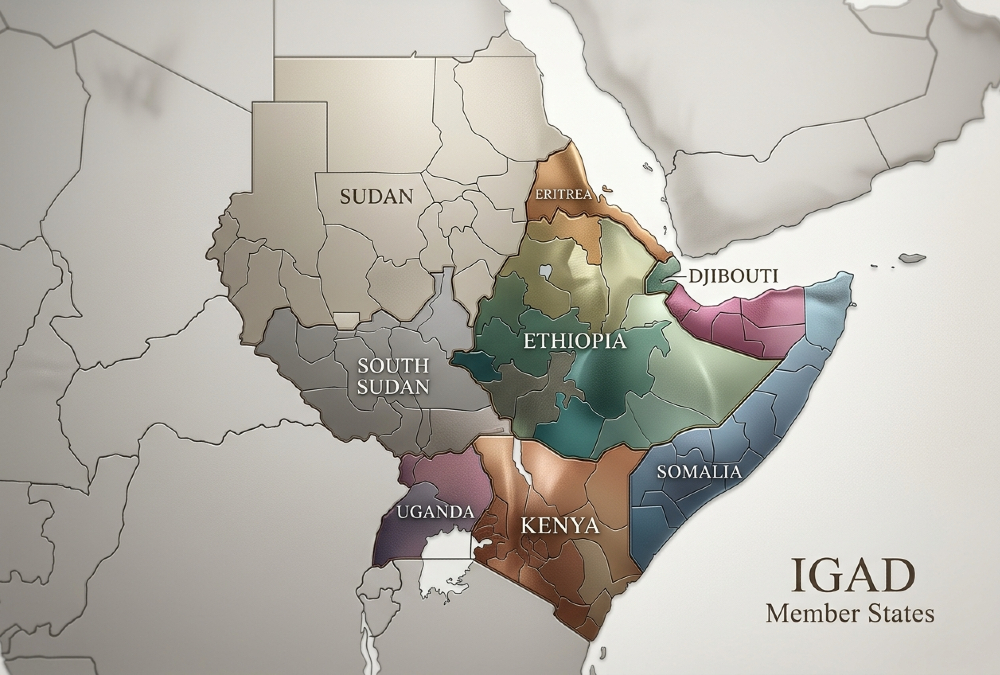
Africa’s regional bodies are all struggling. The Economic Community of Central African States (ECCAS), the Southern African Development Community (SADC) and the East African Community (EAC) each have troubles of their own. But none carries a load quite like that of the Intergovernmental Authority on Development (IGAD), the eight-nation club covering the Horn of Africa and its surroundings. Where other blocs wrestle with one dominant problem, IGAD must juggle many at once.
Sudan’s War on the Doorstep
Start with Sudan, home to one of the world’s worst humanitarian disasters. The war that erupted in 2023 has scattered millions and strained every neighbor. It has also exposed IGAD’s limits. Mediation efforts have run aground on rival agendas, and several member states have been pulled into the conflict themselves. An arbiter that is also a party is no arbiter at all.
Somalia’s Fragile Progress
Somalia, meanwhile, had spent years clawing its way out of decades of chaos. Now political feuding at home threatens those gains. It hands extremists an opening and complicates the country’s deeper integration into the region. IGAD cannot ignore it.
Ethiopia, the Region’s Anchor Under Strain
Ethiopia, the region’s demographic heavyweight, is generating worrying headlines. Domestic tensions could ignite a broader conflagration. Even more troubling are the accusations flying across borders with neighboring states. When the anchor of a region wobbles, its neighbors feel it.
The Sea Lanes and the Refugees
The trouble is not confined to land. Piracy has resurfaced in the Gulf of Aden, and the wider Red Sea corridor, a artery for global trade, is under threat. Tiny Djibouti, a key host of that traffic, has also become a haven for thousands fleeing the war in Yemen.
The Forgotten Members
Then there are the members that rarely make the front page. South Sudan is a core IGAD state, yet it is often an afterthought in talk of the Horn. Its elections, scheduled for December, are approaching amid mounting unease about where the country is heading. Kenya, among the region’s steadier democracies, votes next year under intense scrutiny. Uganda, another pillar of the bloc, has its own political and governance headaches.
What is at Stake
Add it up and the picture is sobering: war, humanitarian catastrophe, political fragility, maritime insecurity, mass displacement and tension between states, all within a single organization. ECOWAS’s ordeal showed how quickly a regional club can fracture under pressure. IGAD faces far more pressure from far more directions.
Whether it can rise to the moment will say much about whether Africa’s regional institutions can deliver security and stability at all. If they cannot, the continent’s neighborhoods will be left to manage their crises alone, and the cost will be counted in lives.
Fidel Amakye Owusu is an International Relations and Security Analyst. He is an Associate at the Conflict Research Consortium for Africa and has previously hosted an International Affairs program with the Ghana Broadcasting Corporation (GBC). He is passionate about Diplomacy and realizing Africa’s global potential and how the continent should be viewed as part of the global collective.
