
Owusu on Africa
Africa’s Neglected Regions Return to Global Focus
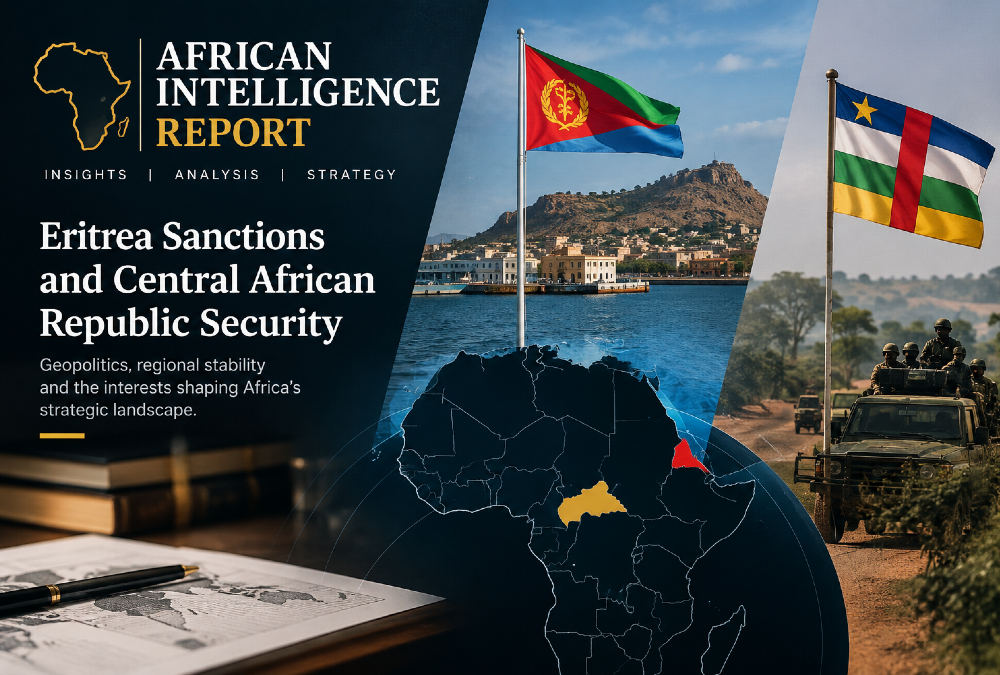

By Fidel Amakye Owusu
For decades, two African states have occupied a peculiar category in the minds of diplomats and investors alike: too poor to prioritize, too remote to ignore, and too opaque to fully understand. Eritrea, often dubbed the “North Korea of Africa,” has spent a generation cultivating isolation as a governing philosophy.
The Central African Republic (CAR), meanwhile, has languished as a byword for state fragility, its wealth of natural resources overshadowed by cycles of militia violence. Yet in the span of a single week, both countries forced their way back onto the international agenda – and the reasons why should concern anyone tracking the Red Sea corridor, the Sahel, or the future of great-power competition on the continent.
Asmara’s Thaw, and Washington’s Calculus
The Trump administration’s decision last week to lift sanctions on Eritrea – penalties originally imposed over Asmara’s role in Ethiopia’s brutal Tigray war between 2020 and 2022 – is not a minor bureaucratic footnote. It is a signal. Eritrea has spent years distancing itself from regional diplomacy, most recently withdrawing from the Intergovernmental Authority on Development (IGAD) in December 2025, the Horn of Africa’s principal multilateral body. Its leadership has remained remarkably stable and remarkably unaccountable since independence, presiding over a well-documented human rights record and one of the continent’s largest political exile populations.
So why the sudden American interest? The answer lies less in ideology than in geography. Eritrea’s coastline commands a stretch of the Red Sea – arguably the world’s most contested maritime chokepoint, sitting astride the Bab-el-Mandeb Strait through which a significant share of global trade and energy shipments pass. As Houthi attacks, Chinese naval ambitions, and Gulf state rivalries continue to reshape the security architecture of the Horn, Washington has evident incentive to court a government it once sanctioned. The open questions now are whether this thaw represents genuine strategic realignment or transactional expedience, whether Gulf and regional powers will view American overtures with alarm, and – most critically for ordinary Eritreans – whether any of this translates into economic liberalization or merely reinforces a regime with little appetite for reform.
The Central African Republic’s Long Shadow
Nearly 3,000 miles away, a very different institution delivered its own reminder that history in fragile states rarely stays buried. Last Wednesday, the International Criminal Court convicted a former commander of a predominantly Islamist militia that seized control of swaths of the Central African Republic between 2012 and 2013, finding him guilty of crimes against humanity. The verdict closes one chapter of a conflict that displaced hundreds of thousands and shattered the country’s already fragile institutions – but it opens a far more urgent set of questions about the present.
The CAR is not a peripheral concern. It is a geographic hinge connecting West Africa to the Horn, linking North Africa to the Central African rainforest belt via Chad, and bridging the Sahel to Central Africa’s resource-rich interior. Major smuggling networks – trafficking arms, minerals, and people – thread through its territory, with tentacles reaching as far as Somalia and the western Sahel. It shares borders with six countries, including Sudan, Chad, and the Democratic Republic of Congo, placing it squarely within the blast radius of Sudan’s ongoing civil war. And beneath its poverty lies a wealth of underexploited natural resources that has long attracted opportunistic external actors, most notably Russian private military interests.
The ICC’s conviction, then, is less a resolution than a prompt. Who is actually providing security in the CAR today, and on whose behalf? Is the current political settlement durable, or merely a pause between crises? And as Sudan’s war spills across borders, displacing populations and arming factions, how much longer can the CAR’s fragile equilibrium hold?
The Common Thread
What links Eritrea and the Central African Republic is not proximity but pattern. Both are states the international community found easy to overlook – until strategic necessity, or historical reckoning, dragged them back into view. Both sit at geographic pressure points where regional conflicts, smuggling economies, and great-power interests intersect. And both pose the same underlying question to policymakers, investors, and security analysts: what happens when neglected states suddenly become relevant again?
History suggests the answer is rarely tidy. Renewed attention can catalyze reform, or it can simply hand entrenched elites new patrons and fresh legitimacy. For Eritrea and the CAR alike, the coming months will reveal which path this moment of reawakened interest actually takes – and the world would do well to watch closely rather than assume it already knows the answer.
Fidel Amakye Owusu is an International Relations and Security Analyst. He is an Associate at the Conflict Research Consortium for Africa and has previously hosted an International Affairs program with the Ghana Broadcasting Corporation (GBC). He is passionate about Diplomacy and realizing Africa’s global potential and how the continent should be viewed as part of the global collective.
