
Business
Africa’s Landlocked Markets: The Cost of the Last Mile
Exporters who price only to the port are quietly giving away their margin on the last leg.

By John Kourkoutas
Not every river reaches the sea.
The yellow areas on this map represent endorheic basins – places where rivers flow inland and eventually disappear without reaching an ocean. The Okavango is the most famous example. It flows into a vast delta in the Kalahari and ends there.
Lake Chad. Lake Turkana. Lake Rukwa. The Sahara. Much of Central Asia.
When I look at this map, I see freight.
Sixteen African countries are landlocked: Zambia, Zimbabwe, Botswana, Malawi, Uganda, Rwanda, Burundi, Mali, Niger, Burkina Faso, Chad, the Central African Republic, South Sudan, Ethiopia, Eswatini, and Lesotho.
Their cargo faces a problem remarkably similar to those rivers. It may reach the coast, but its commercial journey does not end at the port. It must continue hundreds or thousands of kilometers inland, through borders, customs posts, corridors and transport networks, before reaching its actual market.
The Cost Hidden Beyond the Port
That final stretch is where exporters often lose their margin – and where too many fail to price the transaction properly.
A quote to Durban is not a quote to Lusaka.
Between the two are roughly 1,600 kilometers (1,000 miles) of transport, border crossings such as Beitbridge or Chirundu, transit bonds, customs procedures, potential delays and a trucking market whose costs can move with fuel prices and corridor conditions. By the time a shipment reaches Ndola, its landed cost can be substantially higher than the figure that initially appeared competitive at the port.
This is where inexperienced exporters get caught.
They quote CIF to a coastal port, treat the sale as essentially complete, and leave the buyer to work out the inland logistics. The buyer discovers the additional cost only after committing to the purchase.
That is not a logistics strategy. It is a margin transfer to someone else.
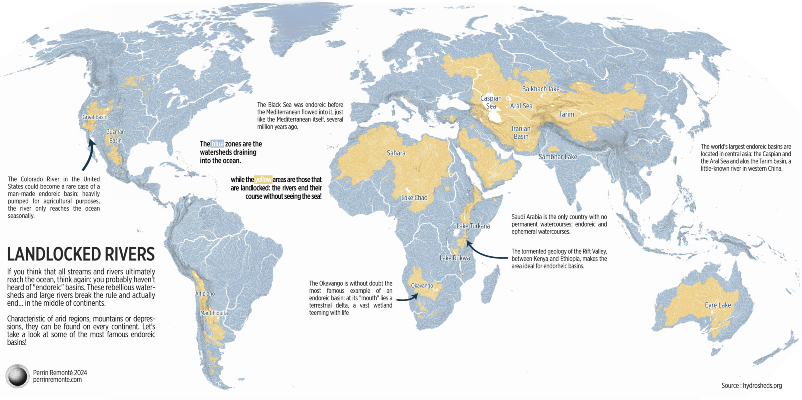
World map showing endorheic basins in yellow, where rivers end inland without reaching the sea
Winning the Corridor, Not Just the Order
The exporters that understand African markets differently start with the customer’s actual destination. They price the shipment to the door. They understand the corridor their goods will use. They know the border crossings, transit requirements, trucking economics and, critically, whether the route is functioning reliably.
Because African trade corridors are not static.
Routes can become congested, disrupted or politically constrained. Niger’s traditional trade routes through Benin and the Port of Cotonou have demonstrated how quickly a corridor problem can become a commercial problem. For an exporter, the question is not simply whether a port is open. It is whether the entire route from factory to customer is viable.
This matters even more as the African Continental Free Trade Area expands intra-African commerce. Lowering tariffs can make a product theoretically competitive while leaving the economics of getting that product to the customer unchanged.
A tariff advantage cannot compensate indefinitely for an inefficient corridor.
Africa’s landlocked economies are therefore not simply markets without seaports. They are tests of whether exporters understand the continent as a logistics system rather than a collection of ports and national borders.
The commercial lesson is straightforward.
Ports are not destinations. They are the point at which your costs stop being predictable.
Price the entire journey – or someone else will. And they will do it after you have already won the order.
John Kourkoutas is business development expert that specializes in helping companies, export teams, and business leaders succeed in Africa’s dynamic and emerging markets.
