
A Diaspora View of Africa
Nigeria’s Complex Ethno-Religious Situation

By Gregory Simpkins
I recently spoke on a panel concerning the persecution of Christians in Nigeria, which made clear that while Americans have historically experienced ethnic cleavages ourselves, somehow we don’t seem to understand the role ethnicity plays in Africa, sometimes overlaying religious disputes.
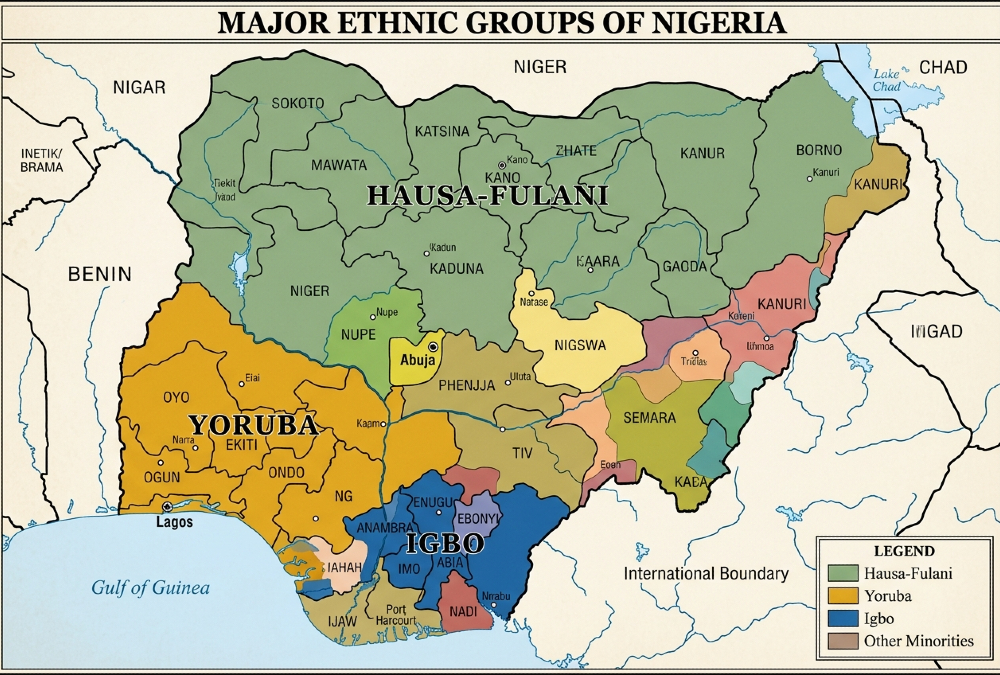
Nigeria has more than 250 ethnic groups and more than 244 million people – the largest population in Africa. The three largest ethnic groups are the Hausa-Fulani in the north, the Yoruba in the southwest and the Igbo in the southeast. There are other ethnic groups that are involved in Nigeria’s unrest: the Kanuri, the Ogoni, the Ijaw, the Itsikeri and many others. Most unrest isn’t “random violence.” The complexity of Nigeria is tied to history, resources, politics and religion layered on top of ethnicity. That means we must not see Nigeria merely as Muslim versus Christian, even though this is tragically the case there. While that aspect is prevalent certainly, it cannot be the sole focus of examination of Nigeria’s multitude of crises.
When the British combined the Northern and Southern Protectorates in 1914, they worked in the North through Muslim emirs and sultans, who were generally Fulani. The Kanuri to the East felt they were traditionally supposed to be Islamic leaders in Nigeria, and for a long time, Boko Haram, a Kanuri creation, opposed the official Fulani leaders in the Northwest until more recently when factions on both sides collaborated against the central government and its foreign allies. The Islamic extremists not only unabashedly attack Christians but also more conventional Muslims they consider insufficiently adherent to the reportedly distorted version of Islam they champion, though nowhere near the numbers of Christians slaughtered.
A January 1966 coup by Christian Igbo officers killed Muslim northern leaders. A July 1966 counter-coup killed Igbo officers. The initial coup was ostensibly not for religious reasons; it was a response to corruption and inefficiency in government. However, there were certainly suspicions in the North that the almost completely Christian Igbo society wanted to seize power in the country for their religion. The Igbo-based Biafra War of secession in 1967-70, though ethnic in nature, had a religious overlay that continues to this day. The Indigenous People of Biafra, or IPOB, largely Igbo, wants an independent Biafra. Their grievance over marginalization post-civil war, security crackdowns, economic exclusion and memories of 1967-70 fuels this drive for independence. Not only have Igbo elders taught their children about the horrors of the Biafra war, but young and old see anti-Igbo bias played out today.
Land, Resources and the Roots of Rural Conflict
We hear a lot about Middle Belt violence, and it is largely due to a variety of factors. Aside from desertification pushing herders south and land shrinking, over the years, boundary changes have altered the path of grazing cattle coming down from Niger. The meat, milk and hides have an ongoing value, but grazing cattle can destroy farms. Successive Nigerian governments created physical obstacles they did not care to remove. Thus the clash of Muslim herders and largely Christian farmers over resources carries an ethnic angle absent elsewhere on the continent.
Even proposed solutions, such as facilitating ranches for Fulani cattle herders, creates ethno-religious suspicions and poses potential dangers. Observers say the land being proposed for these ranches is too often land owned by non-Muslims that was vacated due to conflict. The former residents were moved to IDP camps but have not been returned to their land. The concern then is that this land will be taken from them and perhaps become bases for further Fulani expansion due to increased castle herding.
The largely Christian Ijaw, Ogoni, Itsikeri and other Delta groups have watched oil in their land profit mostly Northern Muslim interests while poverty, pollution and joblessness continues in the South despite the natural resources present. This is the “resource curse” that has plagued many African nations, that is, the feeling that the federal government and foreign companies steal wealth. In this case, Christian southerners blame northern Muslims for their ongoing depredations. Violence and oil bunkering in the region are abetted by the sale of weapons to local groups by military elements. This would cause further resentment by Christians against a federal government controlled by Muslims.
The Southwest is split almost 50-50 between Christians and Muslims, but the Yoruba are largely Christian. Oodua Nation groups in the Southwest push for Yoruba independence. These groups are seen as responsible, as well as criminal bandits in the Northwest in Zamfara, Katsina and Sokoto, for the widespread banditry in the area. There is ethnically mixed Fulani and Hausa kidnapping-for-ransom and cattle rustling. This is not merely ideological but is facilitated by a weak federal and state government security apparatus and the proliferation of small arms. Ethnic and religious tensions rise when Muslim Northerners are accused of crimes affecting Christians in the Southwest even if Christians themselves are involved in banditry.
An estimated US$6 million in ransoms have been paid to kidnappers in recent years, which include groups affiliated with al-Qaeda and ISWAP. Although non-extremist elements are involved in the kidnapping schemes, the ransom paid by local people and allegedly by some in government through back door mechanisms has become a fundraising tool for various groups. Competition by the kidnapping groups only exacerbates the problem and increases resentment against government. Mass kidnappings are increasing nationwide; it is estimated that hundreds of people were kidnapped from Niger State alone in late August. There are available international assistance programs to combat kidnapping, but there is doubt about their efficacy should the federal and state governments continue to fail to do their part to safeguard their citizens.
The Shia-Sunni Divide and Its Spillover Effects
Finally, the Shia-Sunni conflict in northern Nigeria has impacts far beyond Muslims. The main Islamic divide there is about 90 percent Sunni, including Izala/Salafi groups and Sufi orders like Qadiriyya and Tijaniyya, backed by Saudis. The Shia comprise about 3-5 percent of Nigerian Muslims. Mostly followers of Sheikh Ibrahim Zakzaky and the Islamic Movement of Nigeria (IMN) they are backed by Iranians. The conflict isn’t a full “sectarian war” like Iraq or Syria, but it spills over.
When IMN protests or clashes with security forces happen in Kaduna, Kano and Zaria, there are often curfews, roadblocks and retaliatory violence. Christians get caught in shutdowns. Churches have been attacked during periods of high tension because mobs do not always distinguish between those attacked. Some Sunni extremist groups like Boko Haram frame all opponents, including Shia and Christians, as targets. During 2014-2016, Boko Haram bombed markets and churches in areas where IMN also was active. In Kaduna and Plateau states, mixed Christian-Muslim towns see increased migration when Shia-Sunni clashes spike. People leave due to fear, not because they are Shia.
US Has Backed Nigeria’s Counter‑Extremism Push
During the period of US anti-extremist assistance to Nigeria, I was part of congressional delegations and staff missions to oversee such programming and spoke first-hand with US and Nigerian officials involved in such programming.
The US has been a major intelligence and training partner for Nigeria’s fight against Boko Haram/ISWAP, but not a ground combat partner. Collaboration peaked in 2017-2021 with the A-29 Super Tucano aircraft sale and significant intelligence, surveillance and reconnaissance support. There was concern within Congress and human rights groups about the aircraft sale to Nigeria because of the 2017 bombing of an IDP camp by the Nigerian air force. Through House Africa Subcommittee Chairman Chris Smith, a Capitol Hill House-Senate meeting was arranged after the bombing to allow the Nigerians to answer questions about the 2017 incident and allay concerns about the aircraft sale, but the Nigerian defense ministry abruptly cancelled the meeting, apparently unwilling to explain themselves.
US assistance is limited by Nigerian sovereignty concerns, US human rights law and the fact that the US sees the solution as military + governance + development. The partnership is narrower than US collaboration in Iraq or Afghanistan, and broader than just arms sales. It’s mostly to “help Nigeria fight its own war.” The US contributed missile and drone attacks targeting ISIS in Sokoto State in December 2025 in a limited, one-off strike, but while there are US troops on the ground, they are currently advisers and trainers and not engaged in combat.
The US has provided drone/ISR support, and since 2013, the US has operated ISR flights out of Niger and Chad to monitor Boko Haram/ISWAP movements across the Lake Chad Basin. Data is shared with the Nigerian military. The US has provided satellite imagery and communications intercepts. The National Security Agency and AFRICOM provide intel to Nigerian headquarters in Maiduguri. Through the Joint Intelligence Fusion Center, US advisors help Nigerian intelligence combine data from multiple sources.
Training and Capacity-Building Programs
Through programs such as the Africa Contingency Operations Training & Assistance and the Global Peace Operations Initiative, the US has trained Nigerian battalions to counter improvised explosive devices, manage small unit tactics, navigate human rights laws and provide civilian protection. About 25,000 Nigerian troops have been trained since 2009.
The US has provided Special Operations training in which US Special Forces have done joint exercises with Nigerians through the Flintlock Exercise and bilateral drills. The focus is hostage rescue and raids.
Additionally, the US provided Countering Violent Extremism programming through the US Agency for International Development and the State Department, funding programs on deradicalization, community resilience and education in Borno, Yobe and Adamawa states. About US$1 billion in humanitarian/development aid has gone to the Northeast since 2015.
Unfortunately, what we found is that Nigerian agencies were more willing to work with American forces than their own. The military might know the area where an individual threat originated, while the police would know the name and address of a suspected terrorist, but they would rather share it with Americans before sharing with each other to allow for combined operations. This was largely due to the competition for credit and resulting financial resources, but as usual, there apparently were ethnic community loyalty/religious elements involved in their decisions as well.
So, there are several pressure points in Nigeria involving ethnicity and religion – any one of which would be considered an existential crisis by one community or another. The failure to recognize this duality of causation will cripple any solution presented to alleviate these crises. There has long been the contention among many in Nigeria that it is too large with a disparate population to be a single country. If federal and state authorities believe this is untrue and that Nigeria should continue to be a unified country, they must act to show that this is possible and fair for all Nigerians.
At the end of the day, it is up to the Nigerian federal and state governments to resolve the issues facing them. “African solutions to African problems” must not be just a slogan.
Gregory Simpkins, a longtime specialist in African policy development, is the Principal of 21st Century Solutions. He consults with organizations on African policy issues generally, especially in relating to the U.S. Government. He further acts as a consultant to the African Merchants Association, where he advises the Association in its efforts to stimulate an increase in trade between several hundred African Diaspora small and medium enterprises and their African partners.
