
Owusu on Africa
Power and Its Discontents: What Somalia Can Learn and Unlearn From Türkiye
As Somalia navigates a deep political crisis, its push to consolidate executive power mirrors Türkiye’s shift to a presidential system. But for a fragile, federal state, copying Ankara’s playbook is a dangerous gamble.

By Fidel Amakye Owusu
When Türkiye embarked on its transformation from a parliamentary democracy to a presidential republic, the move was never without controversy. Critics argued that dispersing executive authority between a ceremonial president and a prime minister was not merely a constitutional nicety but a safeguard against the concentration of power in a single pair of hands.
Others were more blunt: they suspected that Recep Tayyip Erdoğan, then serving as prime minister after more than a decade at the helm of government, was engineering a system tailored to his own political longevity.
In the end, the ruling party prevailed. Through constitutional processes – however contested – Türkiye became a presidential republic, and Mr. Erdoğan has remained its dominant figure ever since.
Whatever one makes of that outcome, Türkiye at least possessed the institutional musculature to absorb the transition. Somalia, which has embarked on a strikingly similar journey, does not.
A Familiar Script, a Far More Fragile Stage
The parallel is not merely academic. Türkiye is arguably Somalia’s most consequential foreign partner, deeply enmeshed in its security architecture, diplomatic affairs, and economic development.
Yet the two countries could hardly be more different in the conditions under which their respective consolidations of power have unfolded.
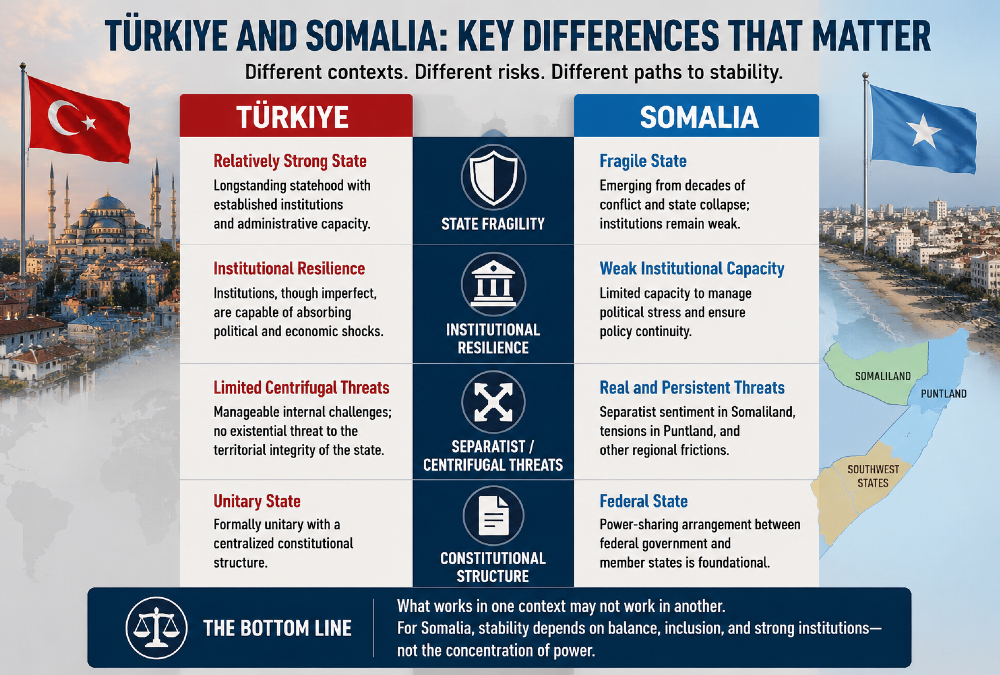
Somalia remains, by any serious measure, a fragile state. Its institutions – courts, legislatures, civil services – have not yet developed the resilience needed to absorb the kind of socio-political shocks that follow when power is drawn sharply toward the center.
In Türkiye, consolidation occurred within a state that, whatever its flaws, boasted decades of bureaucratic continuity, a functioning economy of considerable scale, and a degree of global standing that afforded it political shock absorbers. Somalia has none of these luxuries.
The centrifugal pressures facing the two countries are also of an entirely different order of magnitude. Türkiye contends with Kurdish nationalist sentiment in parts of its southeast – a serious challenge, but one that has been significantly, if not entirely, contained. Somalia, by contrast, is a state locked in a daily negotiation with its own dissolution.
Somaliland has long since declared independence, if not achieved international recognition. Puntland has repeatedly threatened to deepen its autonomy. More recently, at least one southern federal member state has raised the specter of outright departure from the federation. This is not a country that can afford the destabilizing turbulence of executive overreach.
Federalism Is Not a Detail – It Is the Architecture
Perhaps the most important distinction of all is structural. Türkiye, though significantly decentralized in practice, remains a formally unitary state: power ultimately resides in Ankara.
Somalia, by contrast, is constitutionally federal. The deliberate division of authority between the central government in Mogadishu and its constituent member states is not a bureaucratic footnote – it is the foundational bargain upon which Somalia’s post-conflict political order rests.
To pursue consolidation at the center, then, is not simply to import a governance model that worked elsewhere. It is to actively undermine the terms of a settlement that has, however imperfectly, kept the country from splintering entirely.
No democratic precedent – least of all Türkiye’s – provides cover for that gamble.
A Warning, Not a Template
None of this is to suggest that Somalia’s institutions must remain frozen, or that reform is inherently suspect. Countries have every right to reimagine their systems of government, and Somalia’s structures are in clear need of strengthening.
But strengthening institutions is a categorically different enterprise from concentrating authority within them. The former builds resilience; the latter merely shifts fragility upward.
As political rivalry continues to threaten stability – with federal and regional actors jockeying for position and legitimacy – Mogadishu’s leaders would do well to resist the temptation of the shortcut. Consolidation of power may be a coherent strategy for a state with deep institutional foundations and a secure national compact.
For Somalia, it is a risk the country cannot afford to take.
Fidel Amakye Owusu is an International Relations and Security Analyst. He is an Associate at the Conflict Research Consortium for Africa and has previously hosted an International Affairs program with the Ghana Broadcasting Corporation (GBC). He is passionate about Diplomacy and realizing Africa’s global potential and how the continent should be viewed as part of the global collective.
