
Owusu on Africa
Dagalo agrees to attend Switzerland ceasefire talks: that’s just one aspect of many

By Fidel Amakye Owusu
When the conflict in Sudan began in April 2023, it seemed like a minor skirmish that could be resolved quickly with a ceasefire. However, that expectation did not come to pass.
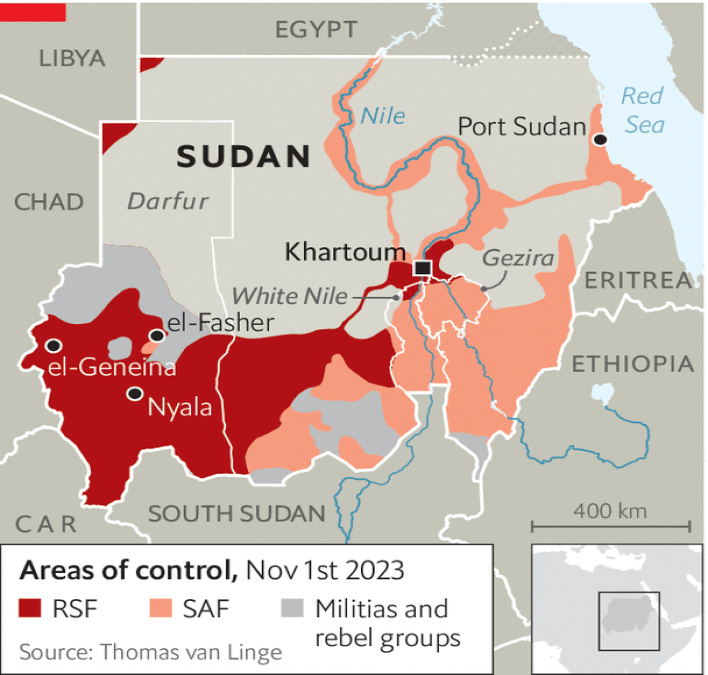
As days turned into weeks and weeks into months, the conflict evolved into a prolonged and complex struggle, making any hope of a ceasefire increasingly unlikely. The Rapid Support Forces (RSF) captured key locations and used civilian areas as shields, while the Sudanese Armed Forces (SAF) resorted to heavy aerial bombardments.
Early in the conflict, I suggested that since this was primarily an infantry-based civil war, the SAF’s strategy of aerial bombardment was ineffective and counterproductive. As the collateral damage grew, the military’s popularity waned, and Mohamed Hamdan Dagalo, the RSF leader, took advantage of this sentiment.
With various regional actors seemingly taking sides or being accused of doing so, finding a regional solution to the conflict became nearly impossible. This situation prompted the United States and Saudi Arabia to intervene in an effort to broker a ceasefire. Despite several attempts, reaching an agreement has proven difficult.
So, what does this mean?
On Tuesday, General Dagalo announced on X (formerly Twitter) that he would attend a new round of talks set to take place in Switzerland. In his brief post, he appeared to emphasize the importance of these discussions and acknowledged the “immense scale of suffering and destruction” in Sudan.
As of now, Gen. Abdel Fattah al-Burhan, the leader of the SAF, and his government have not confirmed their participation in the talks. For the SAF, deciding whether to attend could be a challenging choice.
Why is that?
Firstly, recent developments in the conflict appear to be working in favor of the RSF. The group has gained control over significant territories and continues to seize strategic positions, giving them a strong negotiating stance. Dagalo’s expression of empathy in his tweet seems to be a calculated move.
Additionally, the SAF appears to be firm in its preconditions for negotiations, particularly its demand for the RSF to withdraw from occupied territories and cities. This, combined with the stance of some hardliners who believe negotiations with the RSF are fundamentally unacceptable, puts Al-Burhan in a difficult position.
Furthermore, the talks being organized by the US and Saudi Arabia have generated less enthusiasm among both sides and other stakeholders. People are often intrigued by new approaches, and with previous talks hosted by these two powers failing to produce results, there is a risk that both parties may adopt a rigid stance from the outset—particularly the SAF.
The crisis in Sudan has reached a stage where, even though a ceasefire requires the factions to come to an agreement, the focus is no longer solely on them. It’s now about the millions of innocent people caught in the crossfire.
Fidel Amakye Owusu is an International Relations and Security Analyst. He is an Associate at the Conflict Research Consortium for Africa and has previously hosted an International Affairs program with the Ghana Broadcasting Corporation (GBC). He is passionate about Diplomacy and realizing Africa’s global potential and how the continent should be viewed as part of the global collective.
