
A Diaspora View of Africa
Is Mali Just the First West African Domino to Fall?

By Gregory Simpkins
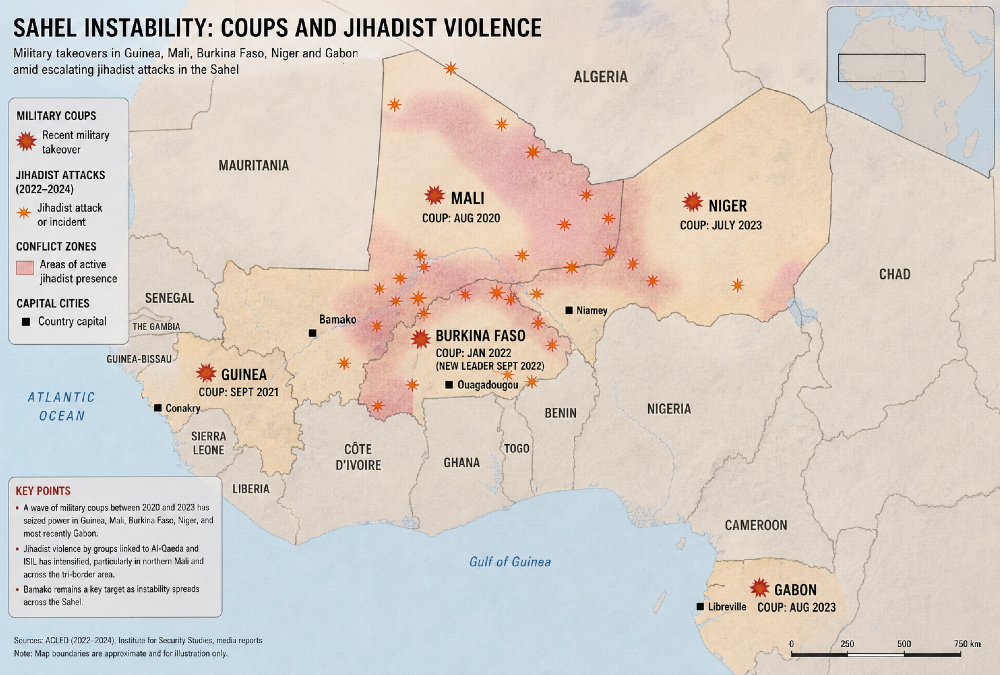
There has been a wave of coups across West Africa and the Sahel since 2020. The region is now widely called the “Coup Belt.” There have been 220 total coups across Africa historically, but the Sahel/West Africa is considered the current “epicenter.” From 2020 to 2025, there have been seven successful military coups in West/Central Africa, concentrated in the Sahel:
- Mali – August 2020: Colonel Assimi Goïta ousted President Ibrahim Boubacar Keïta.
- Mali – May 2021: Goïta led a second coup removing interim President Bah Ndaw.
- Guinea – September 2021: Mamady Doumbouya removed President Alpha Condé.
- Burkina Faso – January 2022: The military overthrew President Roch Marc Christian Kaboré; Paul-Henri Damiba took power.
- Burkina Faso – September 2022: Captain Ibrahim Traoré ousted Damiba.
- Niger – July 2023: The National Council for the Safeguard of the Homeland removed President Mohamed Bazoum, installing Abdourahamane Tchiani.
- Gabon – August 2023: Military officers seized power, placing President Ali Bongo under house arrest.
The common drivers of these coups are jihadist insurgency, governance failures, corruption, insecurity and public frustration with democracy’s delivery. All three Alliance of Sahel States members – Mali, Burkina Faso, Niger – have been ruled by military juntas.
That brings us to the current case of Mali.
Mali’s Governing Vulnerability
As reported on April 27 by the Africa Center for Strategic Studies, the coordinated attacks across Mali on April 25-26 are not an isolated escalation, but the latest manifestation of a steadily deteriorating security trajectory. Over the past several years, militant Islamist groups in Mali – particularly those comprising Jama’at Nusrat al Islam wal Muslimeen (JNIM) – have expanded their reach, increased operational coordination, and intensified pressure on key military, political, and economic centers.
The attacks – claimed by JNIM and conducted in coordination with Tuareg separatist forces from the Front de libération de l’Azawad (FLA) – targeted sites spanning from Bamako in the south to central and northern Mali. The scale and geographic spread of the attacks punctuate patterns that have been building over time and reflect the increasingly fragile security environment facing the ruling junta, which seized power from a popularly elected government in 2020.
Early on April 25, according to the Center report, armed groups launched near-simultaneous attacks against military installations and strategic sites across multiple regions of Mali. In Bamako and Kati – the latter a central hub of military power and the residence of junta leader Goïta and other high-level military officials just outside of Bamako – explosions and sustained gunfire were reported around military bases and the international airport.
JNIM claimed responsibility for these attacks in which Defense Minister Sadio Camara was killed. Camara was the regime’s “number two” and had resisted replacing the Russian Wagner Group with Africa Corps.
Junta leader Goïta survived, but the attack exposed serious internal fractures. Additional senior officials were injured or remain missing.
At the same time, attacks were reported in Gao in the north and Sévaré and Mopti in central Mali. These locations are strategically significant, linking northern conflict zones with the country’s economic and population centers in the south.
In the north, FLA forces have regained control of Kidal, a longstanding symbolic and strategic stronghold. Kidal has been at the center of repeated struggles for control between the Malian military and Tuareg separatist groups. Its loss would represent a major setback to the junta’s narrative of consolidating territorial authority.
The attacks on Bamako and Kati, the Center report states, are particularly significant. These locations represent the core of the junta’s political and military authority.
By targeting leadership compounds and high-value installations, the attacks send a clear message about the vulnerability of the country’s most secure zones. Even if temporary, such penetrations have outsized psychological and political effects, undermining confidence in the military’s ability to provide security.
As our colleague Fidel Amakye Owusu has pointed out in his writings, coups are often divisive because they are planned and staged by groups within militaries and not the whole institution. This means that the unity coup makers require to succeed in fighting terrorism is often non-existent in the security institutions.
Owusu says militaries of countries ruled by juntas are therefore bedeviled by factionalism that impedes the terror fight. Last September, the stand-off between leaders of a countercoup and the junta in Ouagadougou, Burkina Faso, depicted the internal discordant of the military. It took external actors to broker a peace deal that ushered in the current junta.
The Malian junta has experienced its counter coup attempts – albeit unsuccessful. The military is not adequately united behind it.
Apart from the difficulty in finding unity within the military and concentration on preventing countercoups, juntas often see the war on terror as requiring military solutions. This means little or no attention is paid to other socio-economic approaches to addressing the problem, divorcing itself from public support.
The juntas in Mali, Burkina Faso, and Niger have instead “turned inward and toward each other,” forming the Alliance of Sahel States rather than pursuing elections.
Other Vulnerable West African Governments
There also has been ongoing unrest in other coup-led countries in the region. In the Sahel/West Africa since 2020, most “counter-coups” have been successful military coups that ousted a previous junta rather than attempts to restore civilian rule.
The juntas in Mali, Burkina Faso, and Niger have instead “turned inward and toward each other,” forming the Alliance of Sahel States rather than pursuing elections. In fact, Burkina Faso’s Traoré has been lionized internationally for talking control of his country’s resources, ostensibly for the benefit of its citizens.
However, as Human Rights Watch reports, Burkina Faso’s military government is intensifying its sweeping crackdown on civil society through restrictive legislation, administrative pressure and punitive actions targeting domestic and international organizations – Human Rights Watch, the International Federation for Human Rights (FIDH), the World Organisation Against Torture within the Observatory for the Protection of Human Rights Defenders, and Observatoire.
On April 15, the minister of territorial administration and mobility announced the dissolution of 118 civil society organizations, many engaged in human rights work.
Traoré has outright rejected democracy, describing it as unsuitable for Burkina Faso and inherently violent.
He has stated that “democracy kills” and urged citizens to “forget about the issue of democracy,” citing Libya as an example where externally imposed democratic systems led to instability and bloodshed. Traoré frames his governance as a revolutionary project emphasizing sovereignty, patriotism and grassroots mobilization, without providing a detailed alternative political system.
Despite his progressive economic moves, Traoré’s suppression of freedom in Burkina Faso will most assuredly only intensify the dissent he is aiming to suppress, which could produce a counter-coup not led by other elements of the military and would certainly limit citizen defense of the regime against efforts to overthrow it.
Meanwhile, Niger’s military rulers have approved a “general mobilization” and officially authorized requisition of both people and goods as the country continues to fight armed groups across the West African nation, as reported by Al Jazeera. According to government statements, “people, property, and services may be requisitioned during general mobilization to contribute to the defense of the homeland.”
Officials also emphasized an expectation of swift submission should they be called to serve, arguing that the preservation of national territory and the protection of the country’s 28 million people were the ultimate goals.
As in Burkina Faso, limitations on citizen freedom – even in the cause of defending the country against extremists – will not endear the populace to a regime that dissolved the former republic’s governing institutions, restricts civil liberties and still faces the same security challenges the junta was supposed to handle.
Consequently, Mali may not be the last government in the region to find itself on the precipice of replacement – either through an extremist takeover or the less likely circumstance of a popular uprising.
Gregory Simpkins, a longtime specialist in African policy development, is the Principal of 21st Century Solutions. He consults with organizations on African policy issues generally, especially in relating to the U.S. Government. He further acts as a consultant to the African Merchants Association, where he advises the Association in its efforts to stimulate an increase in trade between several hundred African Diaspora small and medium enterprises and their African partners.
