
Owusu on Africa
Africa’s Fault Lines: The Three Transitional Zones Reshaping the Continent’s Geopolitics
Three transitional zones – rich in resources, poor in stability – are quietly redrawing Africa’s security map. Ignore them at the world’s peril.

By Fidel Amakye Owusu
Geography is rarely destiny, but in three corners of Africa it comes close. The Sahel, the Great Lakes region, and the Lake Chad Basin are not ordinary borderlands. They are seams – places where deserts meet savannah, where Central Africa shades into East Africa, where West Africa brushes against the Maghreb. Seams, by their nature, are where things tend to tear. And in all three zones, they are tearing badly.
These are not isolated trouble spots that happen to share a continent. They are interconnected pressure points where weak governance, abundant natural wealth, and porous borders combine into a uniquely volatile chemistry. Understanding why requires looking at each in turn.
The Sahel: A Desert’s Edge, A Continent’s Fault Line
The Sahel stretches in a broad belt from Senegal and Mauritania on the Atlantic coast all the way to the Red Sea, wedged between the Sahara to the north and Africa’s savannah lands to the south. Few regions on Earth connect so much: North Africa, West Africa, the Western and Eastern Maghreb, Central Africa, and even slices of East and Northwest Africa all converge here.
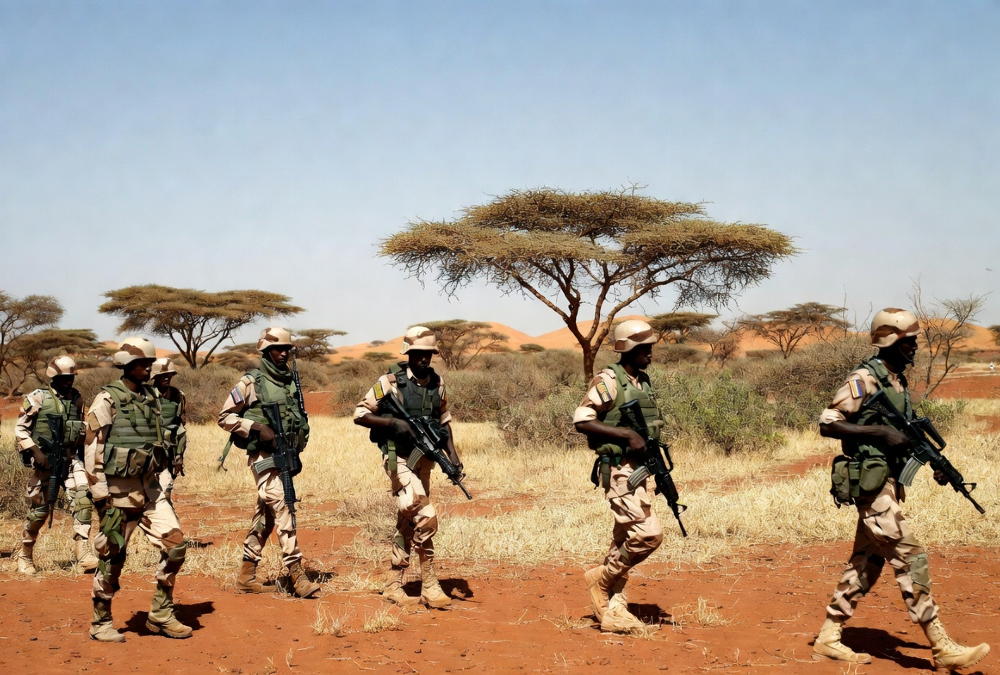
That connectivity has become a curse rather than an asset. Sudan, Niger, Chad, Mali, and Burkina Faso – all Sahelian states – are gripped by jihadist insurgencies, ethnic violence, and military takeovers that have become almost routine. Coups in Mali, Burkina Faso, and Niger in recent years were not isolated political accidents; they were symptoms of states too weak to control their own territory.
What makes the Sahel especially dangerous is the mismatch between its poverty and its wealth. Beneath the sand sit gold, uranium, oil, and a growing list of critical minerals the world’s clean-energy and defense industries badly want. Meanwhile, above ground, desertification and climate change are shrinking arable land and pushing herders and farmers into ever-sharper competition for what remains. Resource wealth without resource governance is a textbook recipe for conflict – and the Sahel is living proof.
The Great Lakes Region: Where Mineral Wealth Meets Mortal Risk
Move south and east, and the terrain changes, but the pattern repeats. The Great Lakes region sits at the junction of multiple regional security systems, linking Central Africa to East Africa, East Africa to Southern Africa, and both to the Horn of Africa. At its heart lies the Democratic Republic of the Congo, Sub-Saharan Africa’s largest country by land area and one of its most persistently destabilized.
The region’s name describes its geography but understates its importance. Beneath its lakes and forests lie rare earth elements and other critical minerals essential to smartphones, electric vehicles, and modern weapons systems – making the Great Lakes a magnet for armed groups, neighboring governments, and multinational interests alike. Rebellions, interethnic violence, and cross-border meddling have become semi-permanent features of the landscape, not temporary disruptions.
Layered on top is an environmental dimension too often overlooked: the region’s vast network of lakes and rivers, the literal lifeblood of millions, is increasingly strained by climate change. Water scarcity and shifting rainfall patterns are quietly adding fuel to conflicts that are usually described purely in ethnic or political terms.
The Lake Chad Basin: Africa’s Demographic Powder Keg
Finally, there is the Lake Chad Basin, a region stretching from the Sahel toward the Atlantic and spanning territory from Nigeria to the Central African Republic. It serves as a connective hinge linking West Africa to north-central Africa, Central Africa to the Horn, and northwestern Central Africa to North Africa itself.
This basin includes Nigeria, Africa’s most populous nation, and its demographic weight is matched by its instability. Violent extremism – most notoriously Boko Haram and its offshoots – along with banditry, insurgency, and separatist agitation have made parts of the region nearly ungovernable. Hydrocarbons and an expanding catalog of critical mineral deposits add an economic incentive for conflict actors to entrench rather than disarm.
Perhaps most troubling is the basin’s role as a logistics hub for organized crime: a sprawling network of illicit trade routes moves arms, narcotics, and other contraband across borders with little resistance. Combined with explosive population growth, the Lake Chad Basin is less a single crisis than a slow-motion compounding of several.
The Common Thread – and Why It Matters Beyond Africa
What ties these three regions together is not coincidence but structure. Each sits at the crossroads of multiple sub-regions, making coordinated governance exceptionally difficult – no single state or regional bloc has full authority, yet all are affected by what happens within them. Each holds resources the rest of the world wants badly enough to ignore the human cost of extracting them. And each is now a frontline in the global confrontation between formal governments and the criminal, extremist, or separatist networks eager to fill power vacuums.
This matters well beyond Africa’s borders. Instability in the Sahel feeds migration pressure toward Europe. Conflict minerals from the Great Lakes end up in consumer electronics worldwide. Trafficking routes through the Lake Chad Basin connect to global criminal markets. Policymakers in Washington, Brussels, and Beijing who treat these as remote, contained problems are misreading the map.
The Sahel, the Great Lakes, and the Lake Chad Basin are not peripheral footnotes to Africa’s story. They are its central fault lines – and how they are managed, or mismanaged, in the coming decade will shape security and resource politics far beyond the continent itself.
Fidel Amakye Owusu is an International Relations and Security Analyst. He is an Associate at the Conflict Research Consortium for Africa and has previously hosted an International Affairs program with the Ghana Broadcasting Corporation (GBC). He is passionate about Diplomacy and realizing Africa’s global potential and how the continent should be viewed as part of the global collective.
