
Opinion
Factories, Not Parliaments, Will Forge a United States of Africa
Why the continent’s unification will be forged on assembly lines and trade corridors, not in parliaments.

By JP Følsgaard Bak
For more than sixty years, the dream of a “United States of Africa” has hovered just out of reach – invoked by presidents, chanted by pan-Africanists, and enshrined, however loosely, in the founding charter of the African Union. And for just as long, skeptics have dismissed it as a romantic fantasy, doomed by the sheer scale of the continent’s diversity: 55 sovereign states, 55 armies, 55 constitutions, and a patchwork of colonial borders that Europe drew with little regard for the people living within them.
Both camps are missing the more interesting story. The politics of continental unification may indeed be stuck. But the economics is quietly moving in the opposite direction – and it may end up dragging the politics along behind it.
A Tale of Two Foundings
The comparison with the United States is instructive precisely because it reveals how singular America’s origin story was. The men who drafted the U.S. Constitution in Philadelphia in 1787 shared a common language, a common legal tradition inherited from Britain, and – crucially – a common enemy whose recent departure created a narrow, unrepeatable window for union. They were, quite literally, in the same room at the same time.
Africa’s founding fathers never had that luxury. When Kwame Nkrumah, Julius Nyerere, Jomo Kenyatta, and Haile Selassie gathered in Addis Ababa in May 1963 to establish the Organization of African Unity, they were reaching across decades of separate colonial experiences, dozens of languages, and borders that, however arbitrary at their creation, had already hardened into lived reality. The OAU produced solidarity and symbolism. It never produced a constitution.
Colonialism compounded the problem by design. Rather than uniting Africans against a shared oppressor, colonial administrations parceled the continent into separate territories, each with its own colonial master, its own grievances, and its own path to independence. There was no continental equivalent of the redcoats – no single adversary capable of forging a single revolutionary coalition.
Sovereignty Is a Hard Habit to Break
Even setting history aside, the mechanics of federation remain daunting. The U.S. Constitution handed Washington authority over defense, currency, foreign policy, and trade – precisely the powers that most African heads of state today regard as the essence of sovereignty itself. Asking 55 governments, elites, and militaries to voluntarily surrender those powers to a federal capital is, realistically, not a proposition that will find many takers at the ballot box or the negotiating table anytime soon.
This is where most commentary on African unification stalls out, and understandably so. But it also asks the wrong question. Political union has always been the wrong place to start looking for momentum.
It’s the Economy, Continent
Bill Clinton’s campaign strategists had a phrase for what ultimately moves nations: it’s the economy, stupid. Africa’s path to unity is likely to prove the same point, only at continental scale.
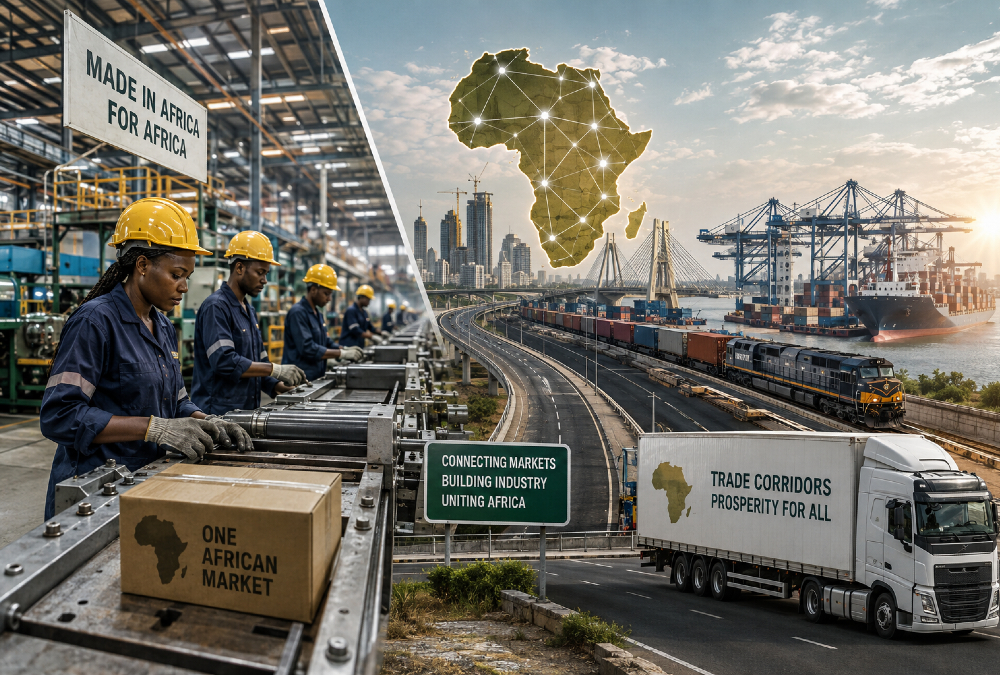
Consider what is already underway. The African Continental Free Trade Area (AfCFTA) – the largest free-trade zone in the world by number of participating countries – is steadily dismantling the tariff walls between African economies. What began as a framework for moving agricultural goods across borders is edging toward something far more ambitious: integrated manufacturing zones where capital, goods, and labor move as freely within Africa as they do within a single American state.
Industrialization, not diplomacy, is where the real unification is happening. Supply chains do not respect the borders drawn in Berlin in 1884. Factories built for continental, not national, markets need continental logistics – roads, rail, ports, and power grids that link Lagos to Nairobi to Johannesburg. As these corridors thicken, they will do more to erase Africa’s internal boundaries than any summit communiqué ever could.
The Middle Class as Midwife
The most important byproduct of industrialization won’t be the factories themselves – it will be the people they employ. A continental manufacturing base, if it materializes at the scale many economists project, will generate an African middle class with interests that increasingly transcend national borders: workers whose paychecks depend on regional supply chains, entrepreneurs whose customers live in a neighboring country, professionals who commute across what used to be hard boundaries.
That is the constituency that federation actually requires. Constitutions are not written by heads of state in isolation; they are demanded by populations who have already begun living as one economic unit and want their politics to catch up. The American colonists did not unite because Philadelphia lawyers found the idea elegant – they united because a shared economic and military reality made separateness untenable. Africa’s version of that reality is being built today, brick by brick, in industrial parks and free-trade corridors rather than constitutional conventions.
From Blurred Borders to a Federal Government
None of this guarantees a tidy outcome, or a fast one. Political union, if it comes, will likely trail economic integration by a generation or more, just as it did in Europe, where a common market preceded a common currency by decades and a common government.
But the direction of travel matters more than the timeline. As trade corridors deepen and borders become progressively less meaningful to the people and goods crossing them, the incentives facing African governments will shift. A federal government will stop looking like a threat to sovereignty and start looking like the only institution capable of managing an economy that has already, functionally, become continental.
That is the moment Africa will finally speak with one voice. And it is the moment the rest of the world will have no choice but to listen.
JP Følsgaard Bak, Esq., a former lawyer, is a dedicated international social entrepreneur and serial entrepreneur. He co-founded several technology companies, including EMX Group (a biomedical microchip manufacturer in California), Sûrtab S.A. (a tablet PC manufacturer in Haiti), and Bak USA. Currently, he serves as Chairman of Industry Five Group, with operations in the USA, Denmark, Uganda, Nigeria, Gabon, and Ethiopia.
