
Owusu on Africa
Abiy’s visit to Port Sudan: a watershed moment in the war in Sudan?

By Fidel Amakye Owusu
Despite Africa having 54 sovereign countries, each with multiple borders, the continent’s state evolution has not been marked by many full-scale interstate wars, unlike Europe. This is largely due to colonialism and the European powers’ demarcation of the continent, which led to the establishment of juridical sovereignties for independent states in the 1950s and 60s.
However, tensions between African states have often involved interference in each other’s internal affairs through proxies. For instance, Chad and Sudan have long accused each other of supporting rebellions within their borders, while the Democratic Republic of Congo (DR Congo) and Rwanda currently face similar accusations. Numerous other examples exist.
This context was evident when clashes began in 2023 between the Sudanese Armed Forces (SAF) and the Rapid Support Forces (RSF). The SAF accused Ethiopia of backing the RSF, while the RSF claimed Egypt was supporting the SAF. Given the significant roles of Egypt and Ethiopia as Sudan’s neighbors, these accusations heightened mistrust and complicated peace negotiations. Recently, the SAF criticized Addis Ababa for hosting General Mohammed Hamdan Dagalo of the RSF.
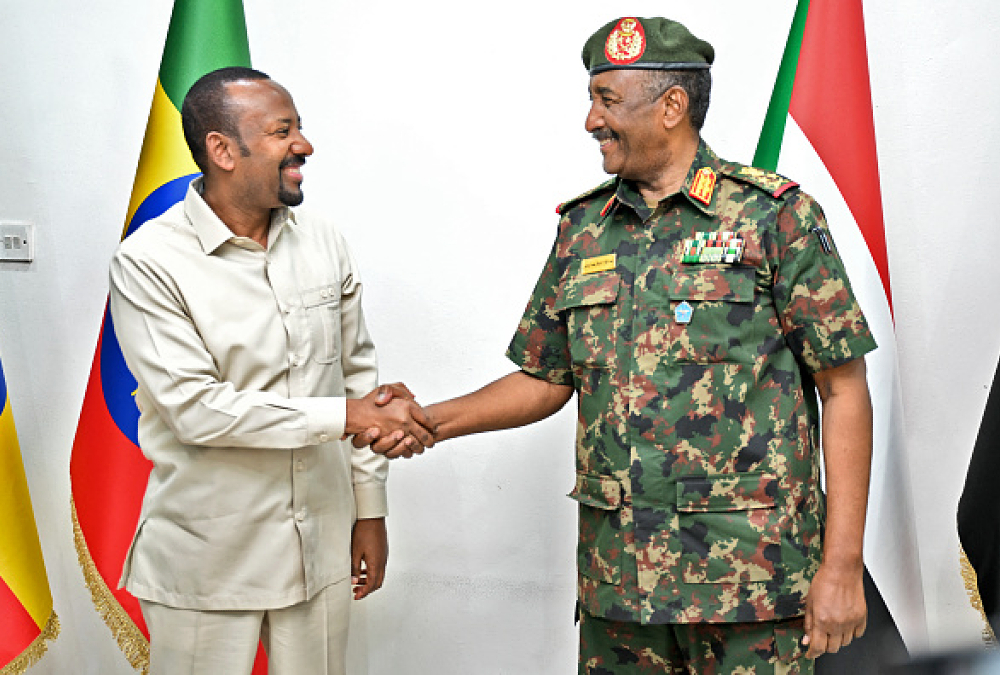
In light of this, the recent visit of Ethiopian Prime Minister Abiy Ahmed to Port Sudan, the current seat of the Sudanese government, is noteworthy. This visit suggests a potential avenue for Africa-led negotiations after several unsuccessful attempts by the United States and Saudi Arabia.
Ethiopia’s approach to the SAF might position it as a credible mediator, capable of engaging both sides and building the much-needed confidence for peace efforts. Additionally, Addis Ababa’s close ties with Abu Dhabi could be crucial, given the suspected UAE links to the RSF. Moreover, the recent advances by the RSF in southeast Sudan, near the Ethiopian border, make peace in Sudan critical for Ethiopia’s security.
Despite these positive signs, it is premature to place too much hope on a single visit. While the meeting between General Burhan and Prime Minister Abiy was cordial and encouraging, the Sudanese conflict remains complex.
Tensions over the Nile River between Ethiopia and Egypt could undermine these efforts. Although the focus of Nile-related tensions is usually on Ethiopia and Egypt, Sudan is a significant party to this issue. Achieving peace in Sudan will inevitably involve addressing regional water politics.
Nonetheless, a political solution to the conflict in Sudan is essential.
Fidel Amakye Owusu is an International Relations and Security Analyst. He is an Associate at the Conflict Research Consortium for Africa and has previously hosted an International Affairs program with the Ghana Broadcasting Corporation (GBC). He is passionate about Diplomacy and realizing Africa’s global potential and how the continent should be viewed as part of the global collective.
