
Opinion
Beyond Market Access: African Regional Integration as the Architecture of Resilience
How a conceptual shift in African trade thinking is reframing regionalism as a tool for governing shared risk – not merely expanding market.

By Danilo Desiderio
A quiet but consequential revolution is underway in how scholars and policymakers think about African integration. For decades, the dominant framework cast regional cooperation primarily as a trade liberalization project – a matter of tariff schedules, preferential agreements, and market access.
That framing is now giving way to something more ambitious and, arguably, more honest: African regionalism as a system of resilience governance.
The acceleration of this shift is no accident. The COVID-19 pandemic, Russia’s war in Ukraine, climate-driven supply disruptions, and escalating instability across the Middle East have each, in turn, exposed the structural fragility that fragmented markets, transit dependency, and externally anchored logistics chains impose on African economies.
The vulnerabilities were always there. The shocks simply made them impossible to ignore.
A recent United Nations study on African landlocked least-developed countries (LLDCs) captures this intellectual evolution with unusual clarity. Its most significant contribution is not any single policy recommendation, but rather the analytical framework it assembles: one that integrates regional value chains, trade facilitation, digital trade, corridor governance, and resilience strategies into a unified whole.
Where much conventional African Continental Free Trade Area (AfCFTA) literature treats these as parallel policy tracks, this report presents them as deeply interconnected dimensions of economic resilience and structural transformation.
Infrastructure Is Governance
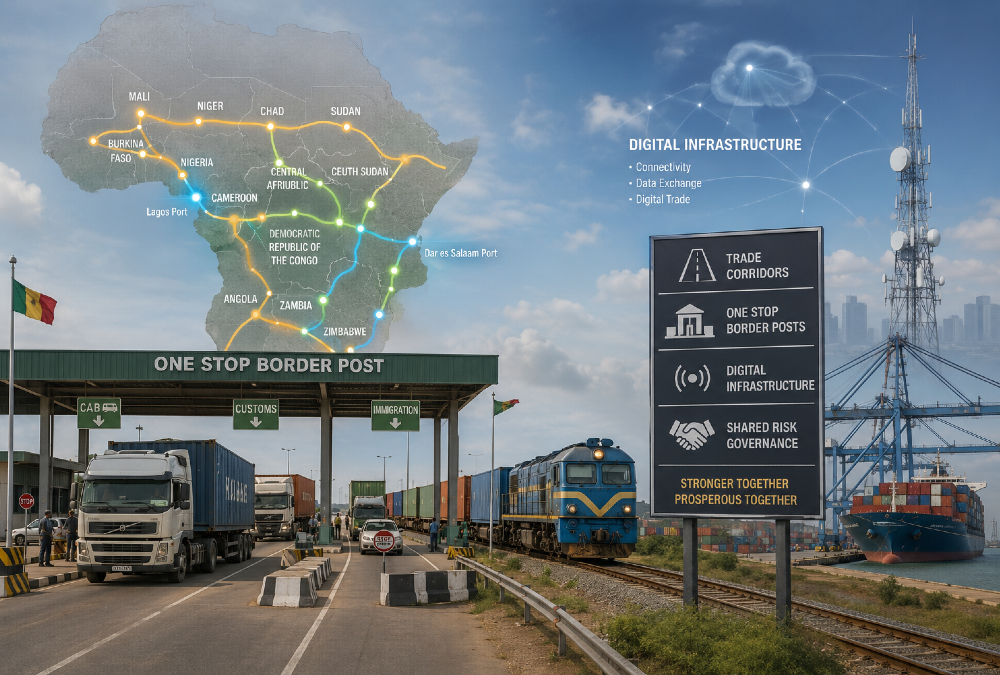
The study is notably more infrastructure- and corridor-oriented than most AfCFTA literature. One Stop Border Posts (OSBPs), transit agreements, paperless trade platforms, customs modernization, and digital trade facilitation are not presented as technical adjuncts to integration – they are framed as its operational core.
This reflects a broader and overdue shift in African trade policy thinking: infrastructure and logistics are increasingly understood not merely as enablers of commerce, but as governance systems that shape competitiveness, resilience, and regional interdependence.
For African LLDCs, this is a profoundly geopolitical reality. These economies are not merely trade-dependent in the conventional sense; they are structurally exposed to the domestic politics, regulatory instability, infrastructure failures, and security disruptions of their transit neighbors.
Their economic sovereignty is, in meaningful part, mediated through corridors they do not control.
The “sovereignty of corridors” is becoming nearly as consequential as territorial sovereignty itself. A disruption at a port, a border crossing, or along a transit route does not stay contained – it transmits inflationary pressure, food insecurity, industrial shortages, and fiscal stress across entire landlocked economies with alarming speed.
Functional Integration: Necessity as the Mother of Cooperation
This emerging resilience literature aligns with what might be called a “functional” theory of African integration – one in which regional cooperation advances not primarily through treaties and formal institutional commitments, but through the operational necessity of managing shared vulnerabilities within deeply interconnected systems.
Climate shocks, corridor disruptions, food insecurity, supply-chain fragmentation, and energy interdependence are generating systemic pressures that individual states can no longer absorb in isolation. In response, they are being pushed toward new forms of coordination: corridor management authorities, cross-border security arrangements, and broader institutional mechanisms that progressively expand their scope to encompass trade and deeper economic integration.
Resilience governance, in this sense, becomes a functional driver of integration in its own right. OSBPs, customs interoperability systems, regional power pools, and paperless trade platforms increasingly constitute the operational infrastructure through which African integration is actually materializing on the ground – not as a treaty obligation, but as a practical necessity.
The Problem Is Not Diagnosis – It’s Execution
And yet, for all its analytical sophistication, much of this literature’s substantive content is familiar. The study reiterates arguments that have been circulating in African integration debates for years: the persistence of non-tariff barriers, the underdevelopment of regional value chains, the drag imposed by infrastructure gaps, the promise of digital trade, and the imperative of effective AfCFTA implementation.
This repetition is not a flaw in the research. It is, in itself, a diagnosis.
Africa’s integration challenge is no longer about understanding the problem. The policy solutions are largely known, consistently restated, and broadly agreed upon.
What is missing is the governance machinery capable of translating these well-understood prescriptions into consistent, coordinated action across fragmented national systems. This is not merely a matter of political will – though will is frequently in short supply.
It reflects a deeper institutional gap: the absence of supranational governance structures with sufficient authority, capacity, and coordination tools to turn agreed reforms into effective practice.
A New Frame, If Not New Answers
The true significance of this emerging literature lies less in the prescriptions it generates than in the conceptual reframing it advances. African regional integration is decreasing in the project of market expansion and increasing as a practical system for governing shared risks, managing deep economic interdependence, and building resilience in a world defined by continuous shocks and structural uncertainty.
That is a more demanding vision than a free trade area. It is also, given the pressures African economies now face, a more realistic one. The continent does not need another diagnosis. It needs institutions equal to the task.
Danilo Desiderio serves as the CEO of Desiderio Consultants Ltd in Nairobi, Kenya, specializing in African customs, trade, and transport policies and is a senior associate to the Horn Economic and Social Policy Institute (HESPI).
