
Opinion
The Agri-Funding Mirage: Why a Record Budget Doesn’t Mean Food Security

By Juwon Akin-Olotu
₦2.2 trillion (US$1.6 billion) allocated for agriculture. Record budget figures. Renewed hope for food security.
These were the headlines that dominated Nigeria’s agricultural discourse last year – impressive numbers that seemed to signal a turning point in the nation’s commitment to feeding its 220 million citizens. Yet beneath the fanfare lies an uncomfortable truth that demands confronting: How much of this historic allocation actually materialized into tangible agricultural development?
The Illusion of Big Numbers
We have become conditioned to equate large budget figures with meaningful impact, as though the mere announcement of agricultural funding automatically translates into enhanced food security. This reflexive optimism represents a fundamental misunderstanding of how development actually works.
Through years of studying agricultural policy and working directly within the sector, I have observed a pattern that should alarm every stakeholder: Budgets rarely fail because they are insufficient. They fail because they never transition from bureaucratic documents into real-world action.
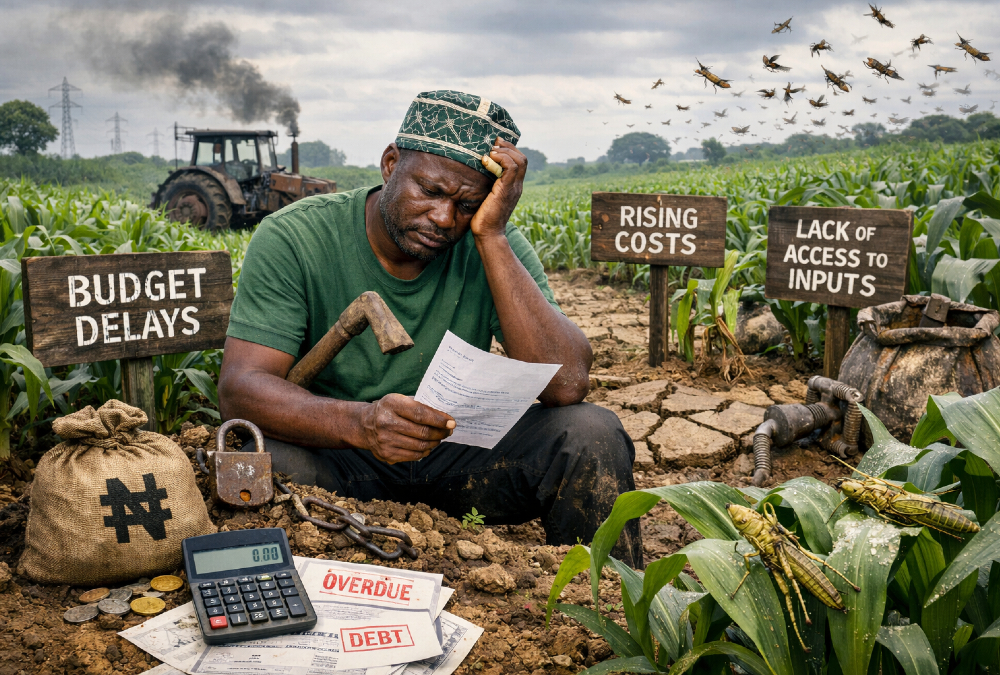
Consider Nigeria’s 2025 agricultural budget. On paper, the sector appeared robustly funded – a testament to governmental priorities and fiscal commitment. In practice, however, only a fraction of those allocated funds ever departed the treasury’s accounts.
The majority of capital expenditure was deferred, rolled forward into subsequent fiscal years, or simply postponed indefinitely.
This administrative sleight of hand has devastating consequences. Farms receive no inputs. Agricultural markets see no infrastructure improvements. Food prices continue their upward trajectory, unmoved by promises printed in budget documents.
The Execution Gap: Nigeria’s Achilles Heel
The crisis plaguing Nigerian agriculture is not fundamentally about allocation – it is about execution. This distinction matters profoundly.
When funding exists only in spreadsheets and policy papers, smallholder farmers continue struggling with the same constraints that have hampered productivity for decades. When budget releases lag months or years behind official announcements, agricultural policy degenerates into political theater.
When we celebrate appropriations rather than outcomes, the cycle of underperformance perpetuates itself.
This execution gap represents the true bottleneck in Nigeria’s quest for food security. It is the space where political will evaporates, where bureaucratic inertia triumphs over urgency, and where the difference between a nation that feeds itself and one that imports staple foods is decided.
Reframing the Agricultural Budget Conversation
Nigeria requires a fundamental reorientation in how it evaluates agricultural investment. The national conversation must shift from celebrating allocations to demanding accountability for implementation.
Instead of asking “How much was allocated to agriculture?” stakeholders should insist on answers to more revealing questions: How much was actually released from the treasury?
What percentage reached intended beneficiaries? Which projects were completed on schedule? What measurable outcomes resulted from the expenditure?
These questions may seem prosaic compared to the excitement of budget announcement ceremonies, but they capture the essence of what separates functional agricultural systems from dysfunctional ones.
Food security is not constructed through ministerial speeches or impressive budget figures. It emerges from cash-backed decisions, timely execution, and relentless accountability.
It requires transforming line items into functioning irrigation systems, subsidized inputs into farmers’ hands, and agricultural research budgets into improved crop varieties.
Beyond Recycled Disappointment
Nigeria cannot afford to perpetuate this cycle of budget announcements followed by implementation failures. Each year of deferred capital spending represents another harvest season lost, another cohort of young farmers discouraged, another opportunity for agricultural transformation squandered.
The path forward demands that agricultural policy be evaluated exclusively by what reaches the ground – not what appears in government gazettes. This standard applies equal pressure on political leadership, treasury officials, and implementing agencies to deliver measurable results rather than impressive rhetoric.
Big budgets, in isolation, feed no one. Implemented budgets – characterized by timely releases, effective deployment, and transparent monitoring – create the conditions for agricultural productivity to flourish.
Africa’s Agricultural Future Depends on Execution
The vision of Africa feeding Africa remains achievable, but it will never materialize through policy documents alone. It requires that allocated resources actually leave government coffers, that agricultural programs transition from approval to implementation, and that accountability mechanisms ensure funds reach their intended destinations.
Nigeria’s agricultural sector possesses enormous potential – fertile land, a vast labor force, and growing domestic demand. What it lacks is not financial allocation but the institutional capacity and political commitment to convert those allocations into operational reality.
Until Nigerian policymakers and citizens alike demand that agricultural budgets transition from paper to practice, food security will remain an elusive aspiration rather than an achieved outcome. The time for celebrating promises has passed. The era of demanding delivery must begin.
Juwon Akin-Olotu is the founder and CEO of Forthwith Global Limited, an agribusiness and consultancy advancing sustainable farming and modern agricultural solutions across Africa. A recognized voice in the continent’s agricultural sector, he champions technology adoption, human-capital development, and leadership grounded in service. Akin-Olotu is also a frequent speaker and moderator at international forums, where he addresses sustainable agriculture, agri-technology, and entrepreneurial education.
