
Opinion
Africa’s Electric-Vehicle Moment: Powering Mobility’s Future
The continent that fossil fuels built may be poised to leapfrog them – but only if governments, investors, and entrepreneurs move fast.

By Des H Rikhotso
Sub-Saharan Africa sits at a peculiar crossroads. It is a region where hundreds of millions of people have never owned a car, where electricity grids falter daily, and where fuel import bills quietly drain national treasuries.
It is also, increasingly, a region where electric buses are crossing continents and signing nine-figure export contracts.
The tension between those two realities defines the challenge – and the extraordinary promise – of scaling new energy vehicles (NEVs) across the continent.
The Barriers Are Real, But Not Insurmountable
The obstacles confronting EV adoption in Sub-Saharan Africa are well-documented and genuinely formidable. High import duties and steep sticker prices place battery electric vehicles (BEVs), hybrid electric vehicles (HEVs), and plug-in hybrid electric vehicles (PHEVs) firmly beyond the reach of most consumers.
With average household incomes far below those in Europe or East Asia, even modestly priced EVs represent a multi-year salary for the majority of Africans.
Infrastructure compounds the problem. Public charging stations – particularly fast chargers – remain vanishingly scarce across most of the continent, leaving Africa with the lowest electric vehicle transition rate in the world.
And even where charging points exist, an unreliable electricity grid undermines their utility. South Africa, the continent’s most industrialized economy, has endured years of rolling blackouts that cast a long shadow over any vehicle technology requiring a stable power supply.
Policy gaps close the circuit of dysfunction. Across much of the region, governments have yet to articulate coherent EV roadmaps, leaving manufacturers, fleet operators, and consumers with little certainty about incentives, safety standards, or long-term market direction.
The Opportunity Is Larger Still
Yet to catalog only the obstacles is to miss the structural forces working in Africa’s favor.
The continent’s extraordinary solar endowment offers a natural solution to the charging-infrastructure problem. Decentralized, solar-powered charging stations – untethered from fragile national grids – could enable EV adoption to proceed in parallel with, rather than dependent upon, broader grid modernization.
In sun-drenched markets from Kenya to Senegal, this is not a theoretical proposition; pilot projects are already operating.
Urbanization creates a second tailwind. African cities are among the fastest-growing in the world, and public transportation demand is surging accordingly.
Electric buses and minibus taxis represent a particularly compelling entry point: high utilization rates improve the economics of electrification dramatically, while centralized depot charging sidesteps the consumer infrastructure problem entirely.
The shift also carries macroeconomic logic. Sub-Saharan nations collectively spend billions of dollars each year importing petroleum products – a structural drain on foreign exchange reserves that EV adoption could meaningfully reduce.
Pair that with the growing pressure of international climate commitments, and the policy case for accelerating the transition becomes difficult to ignore.
Uganda Showed the World What Is Possible
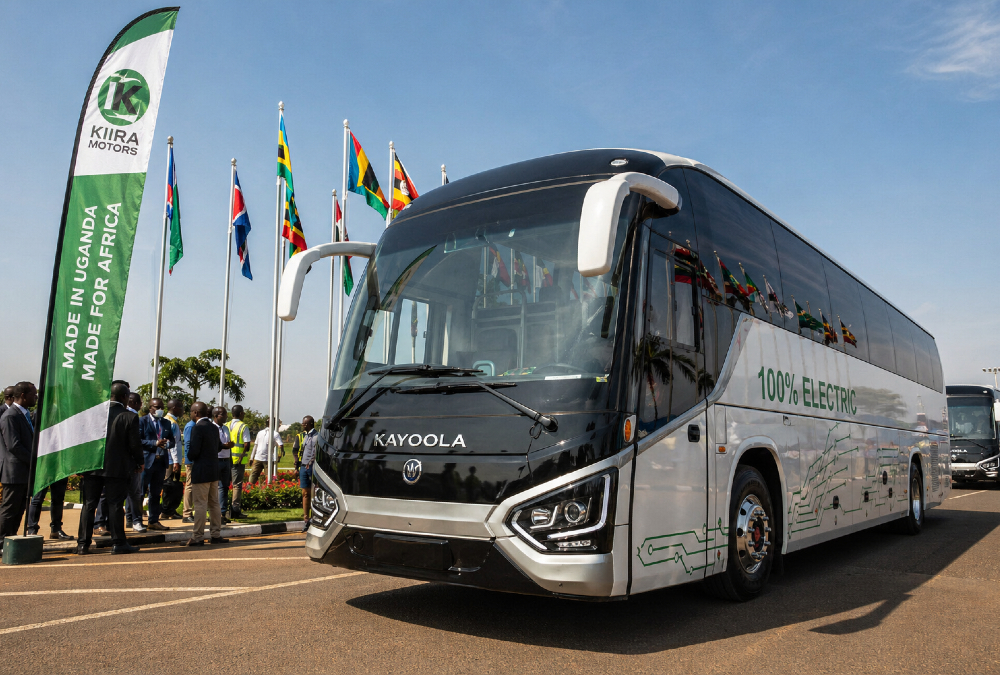
No story better illustrates Africa’s electric vehicle potential – and the scale of ambition required to realize it – than that of Uganda’s Kiira Motors Corporation.
In a journey that has already become something of a continental legend, Kiira loaded its flagship Kayoola Electric Coach onto what it called the Grand Trans-Africa Electric Expedition: a 13,700-kilometer (8,513-mile) odyssey spanning Uganda, Tanzania, Zambia, Botswana, Eswatini, and South Africa. The route was a formidable gauntlet – mountain passes, arid plains, congested urban corridors, and the full gamut of East and Southern African charging infrastructure, such as it is.
The bus did not merely survive the journey. It performed.
More importantly, it sold itself along the way. The commercial result was historic: a US$250 million export contract for 820 electric buses destined for South Africa – the largest deal in Kiira Motors’ history. Domestic transport operators have since signaled interest in thousands of additional units.
The Kayoola expedition is more than a compelling road story. It is a proof of concept for African-manufactured EVs operating across African conditions, and a rebuttal to the assumption that meaningful electric vehicle production on the continent must wait for richer-world technology transfers.
What Governments Must Do Now
The policy agenda is neither mysterious nor particularly complicated. Its execution, however, requires sustained political will.
Lower the cost of entry. Temporary, targeted reductions in import duties on electric vehicles and components – particularly for public transport operators – would accelerate fleet electrification without permanently distorting markets. The word “temporary” matters: well-designed incentives sunset as costs fall and markets mature.
Invest in infrastructure ahead of demand. The classic chicken-and-egg dilemma of EV adoption – consumers won’t buy EVs without chargers; investors won’t build chargers without EV owners – can only be resolved by deliberate public investment. Governments and development finance institutions must seed charging networks in high-traffic corridors before mass adoption arrives, not after.
Publish a roadmap. Investors, manufacturers, and fleet operators need regulatory certainty. Clear, coordinated government policies – covering emissions standards, import classifications, grid integration, and local content requirements – are a prerequisite for private capital to flow at the necessary scale.
The Window Is Open
Africa’s late entry into the automotive age, long framed as a disadvantage, may yet prove to be the opposite. A continent with limited legacy investment in internal combustion engine manufacturing, vast renewable energy resources, and rapidly growing urban transport demand is structurally well-positioned to electrify quickly – if the political and commercial conditions align.
Kiira Motors’ Kayoola did not cross thirteen thousand kilometers to make a point. It crossed them to close a deal.
Policymakers across Sub-Saharan Africa would do well to take the lesson: in the global race to electrify transportation, the continent is not merely a market to be served. It is a manufacturer, an exporter, and – with the right policy architecture – a leader in the making.
Des H Rikhotso is a seasoned C-Suite Multi-Industry (Automotive – OEM + Retail, Logistics, Oil & Gas, etc) business executive with 25+ years of Business Leadership Experience across the South, East and Western Sub-Sahara Africa Region. Based in Kampala, Uganda he serves as East Africa Region Country Director and Business Executive, driving Business Strategic Growth and Operational Excellence – contributing his Business Leadership Experience to the Region. Des has held Business Leadership roles at BMW Group Africa, Volkswagen Group Africa, Peugeot Motors South Africa, Toyota/Lexus South Africa, Lexus East Rand (Unitrans/CFAO), Nissan Group of Africa, G.U.D Holdings (Africa Exports Operations Division),The HDR Group of Companies and The Ezra Group of Companies (a Leading Uganda & East Africa Conglomerate). He holds Under-Graduate and Post-Graduate business degrees from the University of the Western Cape, Wits University (Wits Business School) and the University of South Africa.
