
Opinion
Africa’s Emerging Role in the Global Energy Map
The world’s energy markets are undergoing a quiet but consequential reallocation of supply risk – and most investors, policymakers, and energy executives are not yet pricing it correctly.

By Gregory September
For decades, Africa has been catalogued in the global energy lexicon as a resource base: vast, underexploited, and largely peripheral to the architecture of international energy security. That framing is now obsolete. What is emerging across the continent is not simply a new wave of production – it is a fundamental restructuring of how the world manages energy risk, diversifies supply routes, and assigns strategic value to geography.
The distinction matters enormously. Energy security in the 21st century is no longer purely a question of how much can be extracted from the ground. It is a question of who controls the routes, who absorbs the risk, and who captures the value along the chain.
On all three dimensions, Africa is moving – unevenly, but unmistakably – toward the center of the map.
Four Geographies, One Strategic Shift
The transformation is not continental in its uniformity; it is concentrated in four distinct geographies, each playing a different structural role in the emerging global energy order.
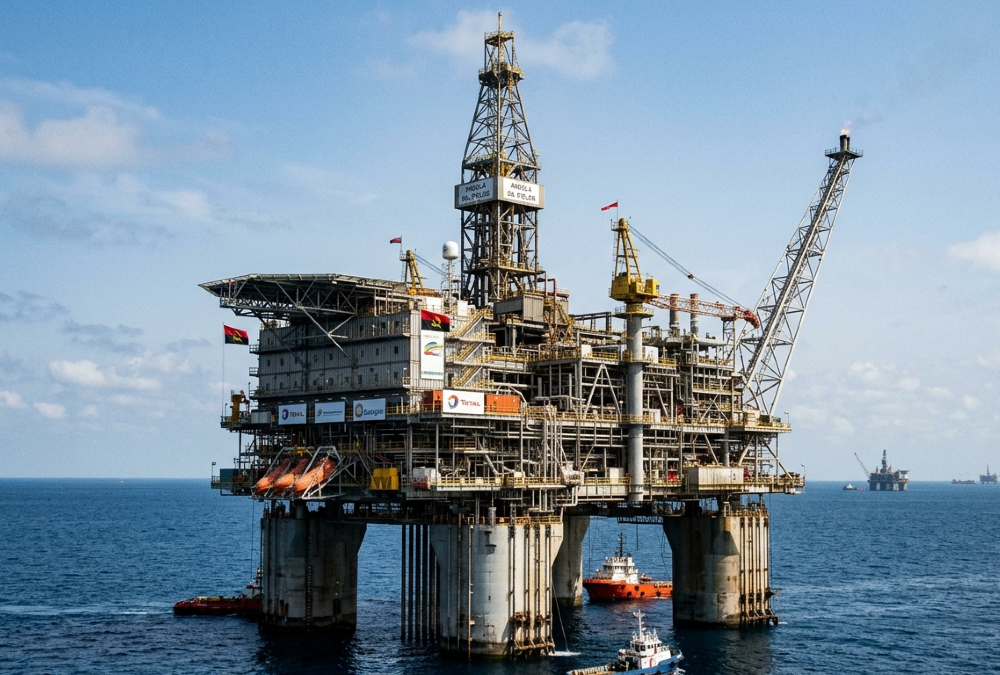
Angola’s deepwater offshore fields represent mature, large-scale production capacity that global oil majors are doubling down on precisely because above-ground risk is lower than in many competing basins. Algeria’s pipeline infrastructure into Southern Europe has been quietly repriced as a strategic asset since Russia’s invasion of Ukraine exposed the fragility of Europe’s gas dependency – Brussels is no longer treating Algerian gas as a commodity convenience but as a security necessity.
Nigeria’s refining transition, anchored by the long-awaited Dangote refinery, signals a potential pivot from crude exporter to refined products supplier, a shift that would alter both Africa’s terms of trade and the regional supply calculus for fuels. And Namibia’s Orange Basin – still in its frontier phase – has attracted the kind of capital and executive attention that typically precedes a decade-defining production cycle.
These are not parallel stories. They are interconnected chapters of the same structural narrative: Africa is being integrated into global energy system design, not merely harvested for its raw commodities.
The Reallocation of Supply Risk
It would be analytically lazy to frame this as “Africa replacing the Middle East.” The more precise and useful observation is that the world is in the midst of a deliberate reallocation of supply risk – driven by three structural forces that are likely to intensify, not abate.
The first is offshore exploration expansion. Technological advances in deepwater drilling, combined with a post-Ukraine urgency to identify non-Russian, non-Gulf-dependent supply, have accelerated exploration timelines across West and Southern Africa.
The second is Europe’s energy security pressure. The European Union’s scramble to diversify gas supply has elevated North and West African producers from the margins of energy diplomacy to its center. Long-term supply agreements that would have been negotiated over years are now being finalized in months.
The third – and most structurally significant over the long term – is the local value-chain shift occurring within Africa itself. The push to refine, process, and monetize energy domestically before export is not merely an economic aspiration; it is a renegotiation of the terms on which Africa participates in global energy markets.
Together, these forces are doing something that commodity cycles alone cannot achieve: they are repositioning Africa from a price-taking resource supplier to a participant in energy system architecture.
The SDG Dimension: Risk, Transition, and Partnership
The strategic energy shift across Africa does not exist in isolation from the broader sustainable development agenda – and the tension between the two deserves frank acknowledgment rather than diplomatic evasion.
SDG 7, which calls for universal access to affordable and clean energy, is directly implicated: Africa’s expanding role in global energy security must not come at the expense of the hundreds of millions of Africans who remain without reliable electricity access. Energy security is increasingly geographic in its logic – and Africa must be part of that stability equation both as a supplier to the world and as a recipient of energy access at home.
SDG 9 – industry, infrastructure, and innovation – is perhaps where the most decisive battles will be fought. Refining capacity, pipeline connectivity, and port infrastructure are not merely logistical assets. They are the mechanisms through which value is captured or surrendered. Countries and companies that control infrastructure control the terms of trade.
SDG 13 poses the sharpest contradiction. Fossil fuel expansion in Africa is accelerating at precisely the moment global climate commitments demand rapid decarbonization.
This is not hypocrisy on Africa’s part – it is the lived reality of a continent that contributed least to historical emissions yet faces the sharpest pressure to forgo the development pathway that industrialized the rest of the world. The international community has not yet resolved this tension honestly.
Finally, SDG 17 – partnerships for the goals – is perhaps the most operationally relevant for energy investors and policymakers. Energy flows across Africa increasingly depend on multilateral coordination: between African states themselves, between African governments and international capital, and between energy exporters and importing nations whose security now depends on African supply reliability.
The Pricing Question
Which brings us to the question that should be sitting at the top of every energy strategy desk: Is Africa being priced as a strategic energy map, or is it still being treated as a traditional commodity story?
The evidence suggests markets have not fully made the transition. African energy assets continue to attract risk premiums that reflect a governance and geopolitical discount rooted in historical assumptions – assumptions that are increasingly disconnected from the structural reality of what these assets now represent to global energy security.
When Europe pays a premium for Norwegian gas or Qatari LNG because of supply reliability, and simultaneously applies a discount to Algerian or Angolan supply, the differential is not purely a reflection of risk. It is also a reflection of analytical inertia.
The investors and policymakers who move first to close that analytical gap – to price Africa not as a collection of commodity assets but as a set of strategic positions within global energy system design – are likely to find the opportunity asymmetry substantial.
Africa is not asking to be treated differently. It is asking to be assessed accurately.
Gregory September is a South African academic, author, and geopolitical analyst with extensive experience in government and Parliament. He is the founder and CEO of SAUP (Sustainability Awareness and Upliftment Projects NPC), which focuses on sustainability education and community development. He previously served as Head of Research and Development for the Parliament of South Africa. His work centers on sustainability, African geopolitics, and economic development, and he regularly contributes to analysis of global political and economic affairs.
