
Opinion
Africa’s Real Food Crisis Is Not a Harvest Problem – It’s What Happens Next
The continent loses enough grain each year to feed 48 million people. The solution is hiding in plain sight.

By Kevine Otieno
A comment posted beneath a recent discussion of the European Union Deforestation Regulation cut straight to the point: “Is Europe starving?” The remark was sardonic, but it crystallized something important. Why, on a continent where food insecurity remains acute, are so many African farmers oriented toward feeding Europe rather than their own neighbors?
The short answer is that Africa does not have a food production problem. It has a post-harvest problem – and the distinction matters enormously.
A Hemorrhage Between Field and Fork
The World Bank has estimated that Sub-Saharan Africa loses roughly US$4 billion worth of grain annually between harvest and consumption – a figure almost certainly far higher today, given that the estimate is more than a decade old. The UN Food and Agriculture Organization puts total post-harvest food losses in the sub-region at approximately 37 percent of all production.
For perishables – fruits, vegetables, dairy, and fish – the losses are more severe still: between 30 percent and 50 percent in East Africa alone, with some high-temperature, high-humidity environments pushing beyond even that range.
These are not abstract statistics. They represent farmer incomes that never materialize, calories that never reach plates, and supply chains that cannot be trusted.
The Cold Chain Gap
At the center of this crisis sits a single, solvable infrastructure failure: refrigeration. Cold storage access for smallholder farmers in Kenya is, by most assessments, virtually nonexistent at the farm level – a striking fact given that smallholders account for 80–90 percent of the country’s horticultural output.
Across the continent, the pattern repeats.
Africa’s cold chain logistics market is estimated at US$15 billion in 2026 and growing. The investment interest is real. The gap is not primarily financial; it is one of deployment and access, particularly in rural and peri-urban zones where smallholders operate and where infrastructure is thinnest.
Where the Chain Breaks
Post-harvest loss does not happen in one place. It accumulates across every stage of the supply chain, each link compounding the damage done by the last.
At harvest, rough handling causes bruising and contamination. On-farm storage – where hermetic bags and cooling are rare – exposes produce to heat and humidity that accelerate spoilage within hours.
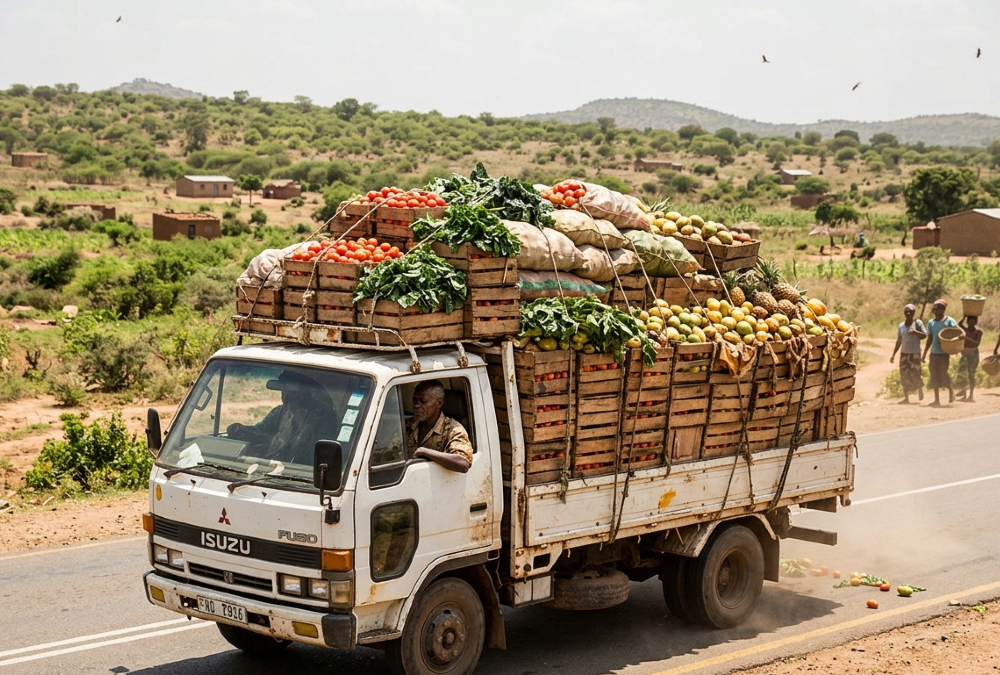
Transport compounds the problem: uncovered trucks, absent refrigeration, and poor roads extend transit times to the point of no return. By the time produce reaches wholesale or retail markets, cold display infrastructure is rarely available to slow the deterioration.
Cutting across all of these failure points is a subtler problem: the absence of visibility. Without real-time data on where produce is located, how long it has been in transit, and what temperature and humidity conditions it has encountered, losses become difficult to prevent and nearly impossible to attribute.
Operators cannot intervene when they cannot see.
This is the gap that traceability technology is designed to close. Companies such as Altinteg, which applies item-level RFID tracking, condition monitoring, and AI-driven supply chain analysis to food logistics, are building systems that give operators actionable data before spoilage occurs – not after.
The principle is straightforward: information, deployed early enough, is itself a form of cold storage.
The Highest-Leverage Interventions
A 2025 landscape review conducted jointly by the UK’s Foreign, Commonwealth and Development Office and Germany’s GIZ, alongside the World Bank’s agro-logistics analysis, identifies aggregation infrastructure and cold storage as the highest-leverage intervention points in the post-harvest chain. The investment case is compelling.
Every percentage point of post-harvest loss recovered translates directly into farmer income, food availability, and supply chain reliability – compounding benefits that extend from the rural smallholder to the urban consumer.
The constraint is not the argument for investment. It is execution at scale. Reaching smallholders in dispersed, underserved rural communities with refrigeration infrastructure, real-time tracking, and aggregation networks requires coordination between governments, development finance institutions, and private operators that has, so far, proven elusive.
A Continent Feeding Itself
The question posed beneath that social media post – “Is Europe starving?” – deserves a serious answer. No, Europe is not starving. Africa, however, is losing enough food each year to feed tens of millions of its own people, not because its farmers cannot grow enough, but because the systems to move, store, and protect what they grow remain profoundly inadequate.
Redirecting that policy attention, that capital, and that technological ingenuity toward the post-harvest chain is not a second-best option. It is the most direct path to food security that Africa’s farmers – and Africa’s consumers – actually have.
Kevine Otieno is a food scientist and systems thinker with more than a decade of experience in food safety, One Health, and sustainable agriculture across Africa. Having trained over 100,000 stakeholders, led disease outbreak crisis responses, and built digital platforms expanding access to agricultural science, he works to make food systems safer, more nutritious, and climate-resilient for Africa’s most vulnerable communities. He also mentors graduate students in food science and agri-food systems.
