
Opinion
The $12 Billion Question: Why Africa’s Borders Still Don’t Work
Record financing commitments are reshaping Africa’s trade architecture. Whether they reshape anything at the border is another matter entirely.

By Ziad Hamoui
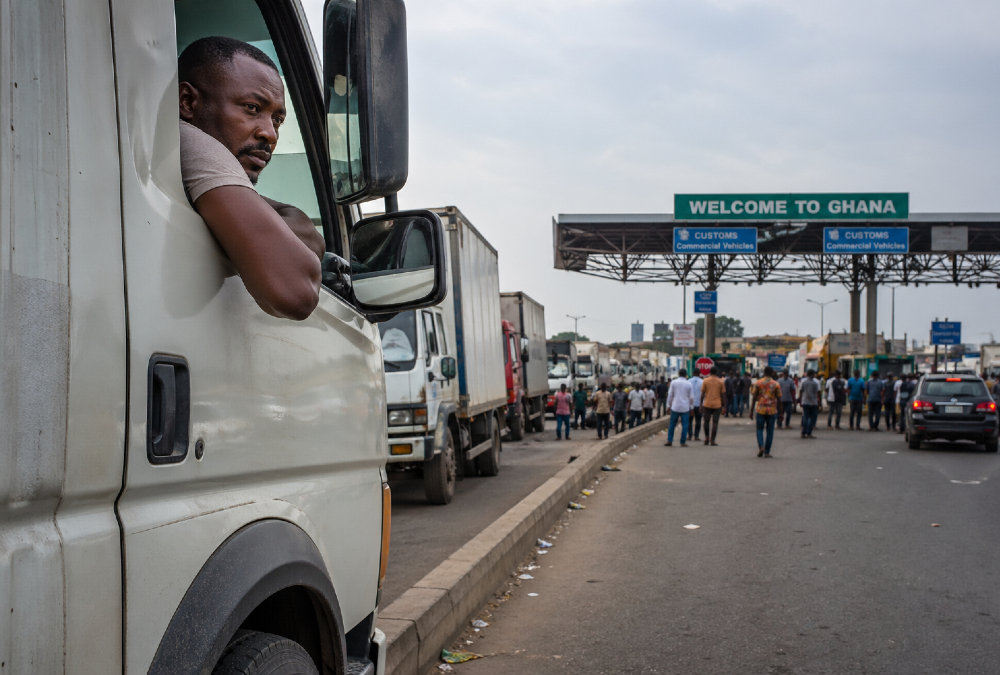
Five years into advancing Africa’s integration agenda, financing commitments are reaching unprecedented levels. Yet for the truck driver idling at the Akanu border crossing in Ghana – staring down another 48-hour wait, paperwork piling up on the dashboard – the operational reality is largely unchanged.
The gap between what is announced in conference rooms and what is experienced at border posts remains Africa’s most persistent and consequential trade problem.
That gap was thrown into sharp relief at the recent African Union dialogue held during the World Bank Group and International Monetary Fund Spring Meetings, where two announcements dominated conversation: a US$2 billion syndicated loan from the African Export-Import Bank (Afreximbank) – the largest of its kind – and a proposed US$10 billion crisis response facility. Taken together with earlier commitments, the total financing mobilized under Africa’s trade and integration agenda now stands at US$12 billion.
These are, by any measure, significant milestones. But milestones are not destinations. And in Africa’s trade story, the journey from headline to ground-level impact has a notoriously poor completion rate.
The Translation Gap
The fundamental challenge facing Africa’s trade agenda is not a shortage of ambition, nor, increasingly, a shortage of capital. It is what might be called the translation gap: the persistent failure to convert policy design into operational delivery.
Consider what trade facilitation actually means in practice. When policymakers speak of reducing non-tariff barriers, operators understand this as one concrete requirement: digitizing customs processes so that traders no longer carry physical documents across multiple jurisdictions.
When officials discuss corridor development, the expectation on the ground extends well beyond physical infrastructure to encompass risk-based inspection regimes, fast-track lanes for compliant traders, and the strengthening of the “soft systems” – the administrative and procedural frameworks – that make roads and ports actually usable.
And when leaders invoke regional integration, the concept becomes meaningful only when systems like the Pan-African Payment and Settlement System (PAPSS) settle transactions reliably, building the trust and liquidity that exporters need to operate efficiently across borders. The distance between those aspirations and today’s reality is precisely where Africa’s trade agenda is being won or lost.
PAPSS: A Brilliant Idea Still Searching for Operational Trust
Nowhere is the translation gap more visible than in the performance of PAPSS, the continent’s flagship cross-border payments infrastructure. Conceived to liberate intra-African trade from the costly detour through correspondent banking systems in London, Paris, or New York, PAPSS represents one of the most consequential financial architecture decisions Africa has made in a generation.
The policy framework is largely in place. The financial boost is substantial. The concept is, without question, sound.
Yet direct engagement with traders and economic operators who have used – or attempted to use – PAPSS reveals a stubborn gap between the system’s design and the daily needs of its intended users. The feedback is consistent and candid: PAPSS is a brilliant idea, but it is not yet the trusted, go-to tool for cross-border commerce, at least not to the degree that its architects had hoped.
The core challenge is a trust deficit rooted in operational friction. Traders frequently report settlement delays, a symptom of insufficient liquidity reserves in key currencies including the Nigerian naira, the Ghanaian cedi, and the CFA franc.
This is not a new observation – it has been raised in forums as far back as the Single Currency and Fintech Regional Forum in Dakar in 2021 – yet it persists as a structural constraint on the system’s ability to handle bulk trade. Beyond liquidity, PAPSS faces an access problem: most small and medium-sized enterprises cannot use the system through their existing commercial banks, because the necessary API integrations between PAPSS and banking and fintech platforms remain incomplete.
The lesson of M-Pesa’s extraordinary expansion across Africa is instructive here. Adoption followed reliability and ease of use, not top-level directives or institutional endorsements.
Traders expect instant, transparent foreign exchange rates – the kind they can see in informal markets. They expect a clear, user-friendly process for resolving disputes when funds appear delayed or stuck in the system.
Until PAPSS can deliver on those expectations consistently, it will remain a promising platform rather than a transformative one.
Where the $12 Billion Must Go
With record financing now committed, the question of deployment is not abstract – it is urgent. The priorities are clear enough, even if executing against them is not.
Scaling customs digital systems must be at the top of the agenda: reducing border crossing times from 72 hours to 24 is not a technical fantasy but an achievable operational target, provided investment follows intent. Strengthening PAPSS liquidity and driving adoption through commercial banking and fintech integration is equally essential.
So is expanding access to trade finance and working capital for the small traders and entrepreneurs who represent the vast majority of intra-African commerce, and who are currently shut out of formal instruments designed for larger operators. And investment in inclusive border infrastructure – facilities designed around the actual needs of actual users, rather than around bureaucratic convenience – is long overdue.
Success will not be measured by the size of financial commitments. It will be measured by reductions in time, cost, and uncertainty at Africa’s borders. That is where institutional trust is built or destroyed. That is where regional integration either becomes real or remains a slogan.
From Policy Design to Operational Execution
As Africa advances toward the targets of Agenda 2063, the continent has reached a pivotal inflection point. The era of policy design – of frameworks, protocols, and institutional architectures – has been substantially productive.
The AfCFTA, PAPSS, and the broader integration agenda represent genuine achievements of continental diplomacy and institution-building. But the era that must now begin is one of operational execution: of making the systems work for the trader, the entrepreneur, the hauler, the farmer.
The US$12 billion now on the table is not an end in itself. It is an opportunity to close the translation gap – to demonstrate, at last, that what is agreed in Addis Ababa and Abuja and Cairo can be felt in the freight yards of Tema, the markets of Kigali, and at the border posts that define the daily reality of African commerce.
The architecture is built. The financing is committed. What remains is the harder, less glamorous, and ultimately more important work: making it all function.
Ziad Hamoui is the Co-Founder and Past President of the Borderless Alliance, a leading private-sector advocacy group promoting economic integration and removing trade and transport barriers in West Africa. With extensive experience in Ghana’s road transport, logistics, and shipping sectors, he currently serves as Executive Director of Tarzan Enterprise Ltd., a long-established family business. He is a former Co-Chair of the Africa Food Trade Coalition, Co-Founder of the Trade Facilitation Coalition for Ghana, and serves on multiple high-level advisory committees on trade, transport, agriculture, and security. A Chartered Fellow of the Chartered Institute of Logistics and Transport (CILT) Ghana, he is also a former member of its Governing Council.
