
Opinion
Africa Is Growing Faster Than the World’s Story About It
The data from 2025 and 2026 tells a story of institutional resilience, sustained momentum, and a continent that the global narrative has persistently underestimated.

By Dishant Shah
The world in 2025 and 2026 has not been kind to emerging economies. Trade wars, interest rate volatility, commodity price swings, geopolitical fractures, and the lingering fiscal damage of a pandemic that rewrote government balance sheets across the globe – these were the conditions under which most economic forecasters expected Africa to struggle.
Many predicted stagnation. Several anticipated outright contraction in the continent’s more vulnerable economies.
They were wrong.
The Growth Numbers: Defying Global Expectations
Africa grew at 4.2 percent in 2025. It is forecast to grow at 4.3 percent in 2026.
African nations now collectively rank 12th among the world’s fastest-growing economic blocs. That is not a headline that fits the story most people carry about this continent – which is precisely why it deserves serious attention.
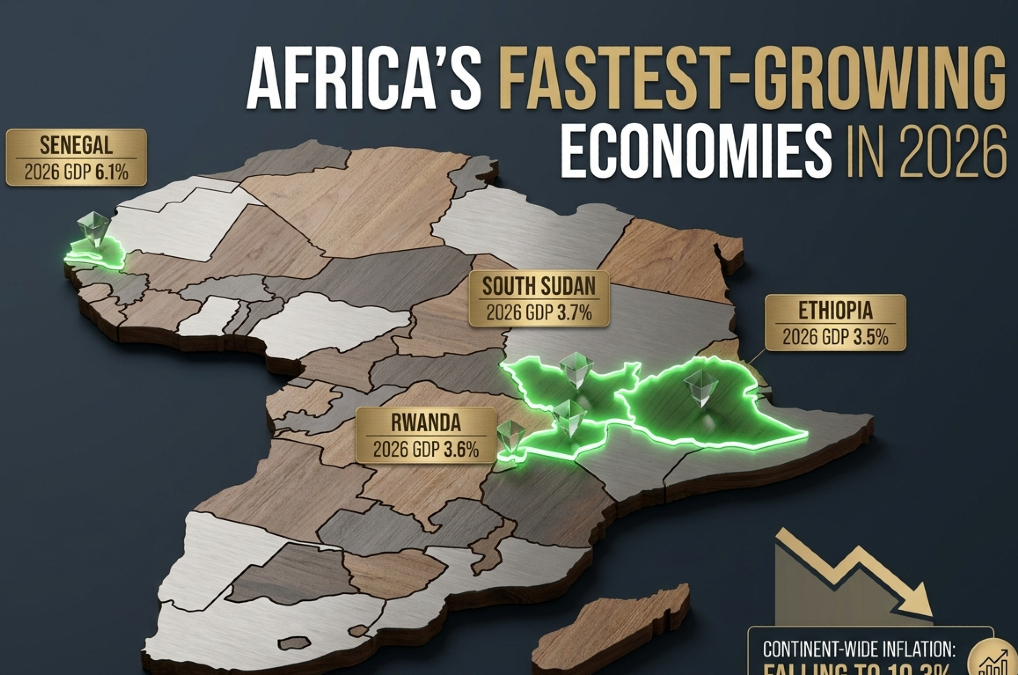
Look at the individual country numbers and the picture sharpens further. South Sudan’s projected growth of 34.4 percent is, admittedly, a post-conflict reconstruction story with its own specific dynamics.
But Ethiopia at 9.8 percent, Uganda at 7.2 percent, Rwanda at 7.1 percent, and Senegal at 8.6 percent are not outliers or one-off recoveries. These are economies that have been building momentum across consecutive years – through external shocks that flattened growth elsewhere.
| Country | 2025–26 Growth Rate | |
|---|---|---|
| South Sudan | 34.4% |
|
| Ethiopia | 9.8% |
|
| Senegal | 8.6% |
|
| Uganda | 7.2% |
|
| Rwanda | 7.1% |
|
Senegal’s number deserves particular attention. The country recently commenced oil and gas production for the first time, adding a new revenue layer to an economy that was already expanding through agriculture, services, and serious government investment in infrastructure.
The 8.6 percent figure is not a ceiling. It may prove to be a starting point.
These are economies that have been building momentum across consecutive years – through external shocks that flattened growth elsewhere.
The inflation picture is also moving in the right direction, though it warrants nuance. Continent-wide average inflation stood at 13.7 percent in 2025 and is expected to fall to 10.3 percent in 2026.
More notably, 35 African countries already have inflation below 5 percent. That represents considerably more monetary stability than the dominant narrative about African economies typically conveys.
The debt picture, however, carries a genuine caution that responsible analysis cannot omit. Total public debt across the continent stands at US$1.8 trillion, representing roughly 65–66 percent of GDP across 2023 and 2024.
That is a number that demands serious management and, in several countries, serious restructuring conversations. Growth financed by unsustainable borrowing is not a foundation – it is a deferral. The distinction matters.
But the broader story this data tells is one that African policymakers have been making the case for – and that the world has been slow to hear.
The continent is not a monolith of fragility. It is a collection of 54 diverse economies, many of which have built sufficient institutional capacity, domestic demand, and trade infrastructure to hold their growth trajectories even when the global environment turns hostile.
The shocks came. The growth continued.
Why the Narrative Lags Behind Reality
The narrative is not keeping pace with the numbers. It rarely does with Africa. But the numbers are there for anyone paying attention
That is not luck. That is the compounded result of decisions made over years – on investment frameworks, monetary policy, and regional integration – by governments that are far more often criticized than they are studied.
The African Continental Free Trade Area, gradual improvements in business environments across several markets, and more disciplined fiscal management in a number of capitals have not made headlines proportionate to their significance. They should.
The narrative has not kept pace with the numbers. It rarely does with Africa. But the numbers are there for anyone willing to pay attention – and the cost of continued inattention, whether to investors, policymakers, or multilateral institutions calibrating where to direct capital, is measured in missed opportunity at a scale that is becoming harder to justify.
Dishant Shah is a partner at Legion Exim, a company specializing in facilitating the export of high-quality engineering products directly sourced from manufacturers in India to Africa. His areas of expertise include new business development and business management.
