
Opinion
Africa’s Infrastructure Paradox: From Assets to Integrated Systems
The real barrier to African integration is no longer a shortage of roads and ports – it is the stubborn failure to stitch existing assets into a functioning whole.

By Danilo Desiderio
At the end of April 2026, the Africa Finance Corporation released its 2026 State of Africa’s Infrastructure Report – and it arrives with a provocation buried in its conclusions. This is not another inventory of missing roads or underfunded ports. It is something more unsettling: an argument that Africa’s development bottleneck has fundamentally changed in character, and that much of the policy world has yet to catch up.
The central claim is deceptively simple. The primary constraint on African economic integration is no longer the absence of infrastructure. It is the inability to connect what already exists into coherent, functioning networks.
If that diagnosis is correct – and the evidence marshaled in this report suggests it is – then an entire generation of development thinking needs to be retooled.
From Deficit to Fragmentation
For decades, the dominant narrative was one of scarcity. Too few roads, insufficient ports, inadequate power.
Billions of dollars flowed accordingly, directed at filling gaps in physical stock. That framing was not wrong, exactly – the gaps were real, and many persist – but the report argues it is now dangerously incomplete.
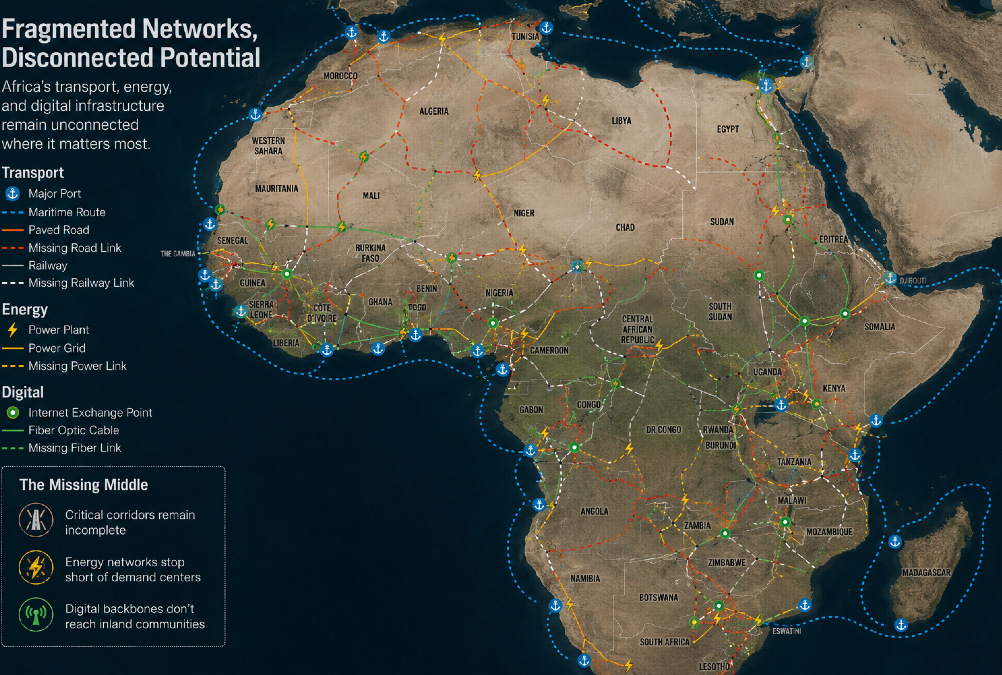
What Africa increasingly suffers from is not an absence of infrastructure, but its fragmentation. Assets exist across the continent in considerable number.
What they rarely do is function together. Ports are not seamlessly integrated with inland transport networks.
Border processes introduce delays that erode whatever efficiency the roads and rails behind them might offer. Logistics chains fracture along jurisdictional lines.
The result is a paradox that any shipper or trader on the continent will recognize immediately: infrastructure is present, yet it does not reliably translate into connectivity.
The geography of this problem has a distinctive shape. High-capacity infrastructure clusters along coastal export gateways.
Inland regions depend on a thin lattice of radial corridors threading outward to those ports. Between the main axes, vast territories remain weakly served or effectively outside the continental network altogether.
What emerges is not a continuous system but a coastalized patchwork – strong corridor-based links surrounded by weak connective tissue.
The Corridors That Don’t Quite Connect
This structural configuration explains one of the report’s more striking findings: even where major corridors exist, they remain discontinuous. The Lagos–Abidjan axis – one of the continent’s most economically consequential routes – still faces critical gaps.
Key rail systems across the Northern and North–South corridors require significant rehabilitation. These are not peripheral problems. They are the fracture lines that prevent the African Continental Free Trade Area (AfCFTA) from delivering on its considerable ambitions.
A free trade agreement is only as powerful as the infrastructure that makes trade physically possible.
Exporting Oil, Importing Fuel
Energy presents a particularly striking version of the same systemic dysfunction. Africa is a net exporter of crude oil, yet imports more than 70 percent of its refined fuel.
The continent sends its resources abroad to be processed, then buys them back at a premium – exposed in the process to external price volatility and supply disruptions that it has little capacity to manage. This is not merely an inefficiency. It reflects the absence of integrated industrial and energy ecosystems, and a structural pattern in which value creation consistently occurs elsewhere.
Regional power pools, such as the Southern African Power Pool and the Eastern Africa Power Pool, offer a partial remedy. Deepening their integration would allow countries to optimize shared resources, reduce costs, and improve reliability.
But the report is clear that energy integration alone is insufficient. The harder shift – from raw material exports toward domestic refining, fertilizer production, and mineral processing – is what would allow infrastructure investment to translate into genuine industrial transformation.
The Digital Middle That Is Missing
Digital connectivity tells a similar story, though with its own particular twist. Access is expanding rapidly across the continent, and the figures on mobile penetration are genuinely impressive. Yet a 64 percent “usage gap” persists – a chasm between the existence of connectivity and its productive deployment.
The report identifies a “missing middle”: the platforms, skills, and institutional linkages needed to convert access into economic activity. Fiber and spectrum are necessary, but they are not sufficient.
Without the accompanying ecosystem, digital infrastructure grows in isolation from the economic systems it is meant to serve.
The Financing Reckoning
The financing dimension of all this deserves particular attention. As external funding becomes less predictable – a euphemism for a geopolitical environment in which Western development finance is being actively reconsidered – the report calls for a decisive shift toward domestic resource mobilization.
Africa’s financial system holds an estimated US$4 trillion in capital. The problem is that most of it sits in short-term instruments, concentrated in government securities that offer liquidity but do little to fund long-duration infrastructure.
The challenge, then, is not capital mobilization in the abstract. It is the harder work of financial intermediation: redirecting existing capital toward long-term productive investment through regulatory reform and institutional innovation.
Building Systems, Not Projects
The report’s prescriptions follow logically from its diagnosis. If the problem is fragmentation, the solution is integration – and that demands a reorientation of policy from isolated projects toward coordinated, continent-wide architectures.
Aviation, for instance, is identified as an underexploited lever. Full implementation of the Single African Air Transport Market (SAATM) could generate millions of additional passenger trips and tens of thousands of jobs, accelerating market integration in ways that ground transport alone cannot achieve.
The digital agenda must evolve from connectivity targets to productivity systems, with platforms embedded in logistics, energy, and production networks rather than floating above them.
Across all of these domains, the report advances the same argument: what matters is no longer the existence of individual assets, but the degree to which they are functionally connected. Infrastructure that does not interoperate does not integrate. And integration, not construction, is now the central task.
A Conceptual Turning Point
The 2026 State of Africa’s Infrastructure Report is, at its most ambitious, a challenge to a development model that has long equated progress with physical stock. More roads, more ports, more megawatts – these are legible targets, easy to measure and easy to celebrate.
Systems thinking is harder. It demands coordination across jurisdictions, alignment across sectors, and patience for outcomes that do not lend themselves to ribbon-cutting ceremonies.
Yet the case made here is persuasive: Africa has built a great deal, and it is not yet working as it should. The gap between what exists and what functions is, at this point, the defining development challenge on the continent.
Closing that gap will require less concrete and more governance, less capital and more orchestration. Whether African institutions – and their international partners – are prepared to make that conceptual leap is the real question the report leaves open.
Danilo Desiderio serves as the CEO of Desiderio Consultants Ltd in Nairobi, Kenya, specializing in African customs, trade, and transport policies and is a senior associate to the Horn Economic and Social Policy Institute (HESPI).
