
Opinion
The Subsidy Trap: How Africa Keeps Mistaking a Tactic for a Strategy

By Juwon Akin-Olotu
In 2007, the world celebrated Malawi. A country that had posted a 43 percent food deficit in 2005 had engineered a 53 percent maize surplus within just two years.
It was feeding itself and exporting the remainder. Jeffrey Sachs wrote admiringly about it. Donor organizations that had actively opposed the program quietly reversed their positions.
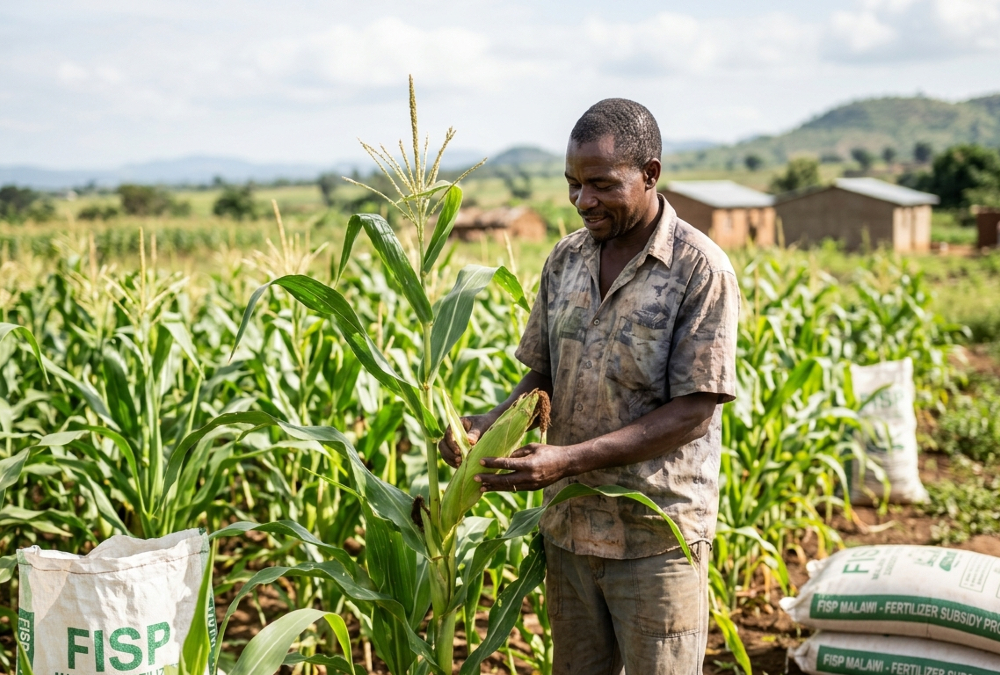
The mechanism was elegantly simple: the Farm Input Subsidy Programme, known as FISP. Issue poor farmers vouchers for subsidized fertilizer and hybrid seeds. Increase yields. End hunger.
It worked – brilliantly, visibly, and in a way that made for compelling international headlines. Until it did not.
Twenty Years of Subsidies. A Country Still Hungry.
By the 2023/24 agricultural season, Malawi was spending the equivalent of K117 billion (US$68 million) on FISP in a single year. That same year, 5.7 million Malawians required emergency food assistance.
The 2024/25 season produced 2.9 million metric tonnes of maize against a national requirement of 3.6 million metric tonnes. The government was forced to purchase maize from Zambia.
The numbers are worth sitting with. Not because they represent a policy failure – though they do – but because of what they reveal about a far more consequential intellectual failure: the confusion of a tactic with a strategy.
At its peak, FISP consumed 74 percent of Malawi’s entire Ministry of Agriculture budget. Three-quarters of every agricultural dollar funneled into a single program.
No investment in irrigation infrastructure. No soil science. No rural storage networks. No market development. No crop diversification. Season after season, year after year: fertilizer vouchers and hybrid seeds.
Who Actually Benefited?
The cruelest irony of FISP is that its primary beneficiaries were never Malawian farmers. They were the multinational seed and fertilizer companies whose products the vouchers were redeemed against.
One researcher described FISP as a reliable cash cow for foreign seed corporations. The subsidy did not catalyze a Malawian seed industry. It created a captive, publicly-funded export market for companies headquartered elsewhere.
This is not an argument against subsidies. Subsidies can work. They have worked, on every continent, in every era of modern agricultural development. The United States subsidizes its farmers. France subsidizes its farmers. The question is never whether to subsidize – it is what the subsidy is building toward.
A Bridge to Nowhere
Input access is a tactic. Food security is a systems outcome.
Malawi solved the tactic brilliantly in 2005 and then spent the next two decades confusing that single, hard-won victory for a complete and sufficient strategy. What should have followed those surplus years was a deliberate, sequenced investment in the surrounding system: irrigation to reduce rain-fed vulnerability, locally-owned seed companies to build sovereign agricultural capacity, rural storage facilities to reduce post-harvest losses, crop diversification to manage climate risk, and a credible graduation pathway to wean farmers off subsidy dependency and into commercial viability.
None of that happened – not because the ideas were unavailable, but because the program had become politically untouchable. Every politician who raised the question of reform faced a constituency that had been made dependent on it. What was designed as a temporary emergency measure calcified, over twenty years, into permanent structural dependency. The bridge was never completed, because completing it would have meant admitting it was always supposed to end.
The Pattern Is Continental
The most troubling aspect of Malawi’s story is that it is not uniquely Malawian.
Nigeria has run successive input intervention schemes with familiar architectures. Ghana launched its Planting for Food and Jobs program to considerable fanfare.
Kenya has sustained fertilizer subsidy mechanisms for years. Different names, different currencies, different press releases – but the same underlying logic: subsidize the input, announce the yield numbers, declare success, repeat annually, and never build the surrounding system that would make the subsidy unnecessary.
Africa is not short of agricultural ambition. It is short of agricultural patience – the institutional willingness to treat a subsidy as the first chapter of a longer story rather than the story itself.
The Question That Is Almost Never Asked
Before any input subsidy program is launched, one question should be required: A bridge to where, exactly?
Not in the abstract. Not in the language of donor frameworks and strategy documents. Concretely: What does the exit look like? What is the measurable condition under which this program will be declared complete? What institutions, markets, and infrastructure must exist before the vouchers stop?
If that question cannot be answered clearly before the program begins, the program is not a strategy. It is a recurring budget line dressed in the language of transformation.
Africa will feed Africa. That future is real, and it is achievable. The continent has the arable land, the labor force, the rainfall, and the accumulated agricultural knowledge to become a net food exporter to the world. But it will not get there by building the same bridge to the same nowhere, twenty years at a time.
The lesson of Malawi is not that subsidies fail. It is that solutions without destinations are not solutions at all.
Juwon Akin-Olotu is the founder and CEO of Forthwith Global Limited, an agribusiness and consultancy advancing sustainable farming and modern agricultural solutions across Africa. A recognized voice in the continent’s agricultural sector, he champions technology adoption, human-capital development, and leadership grounded in service. Akin-Olotu is also a frequent speaker and moderator at international forums, where he addresses sustainable agriculture, agri-technology, and entrepreneurial education.
