
Opinion
Africa’s $1.3 Trillion Mobile-Money Revolution Is Not the Future – It Is the Present
Western executives are still asking the wrong questions about how Africans pay for things. Here is the answer, in hard numbers.

By John Kourkoutas
When Western executives ask me how people pay for things in Africa, I have learned to pause before answering. Not because the question is difficult, but because the data that answers it tends to be humbling.
According to the GSMA’s 2025 figures, East Africa alone hosts 193 million active mobile-money accounts that processed 61 billion transactions worth US$806 billion in a single year. West Africa adds another 104 million accounts, 22 billion transactions, and US$498 billion in value.
Combined, nearly 300 million people are moving more than US$1.3 trillion annually through their phones – a figure that exceeds the GDP of most European economies. Not through banks. Not through credit cards or wire transfers. Through phones.
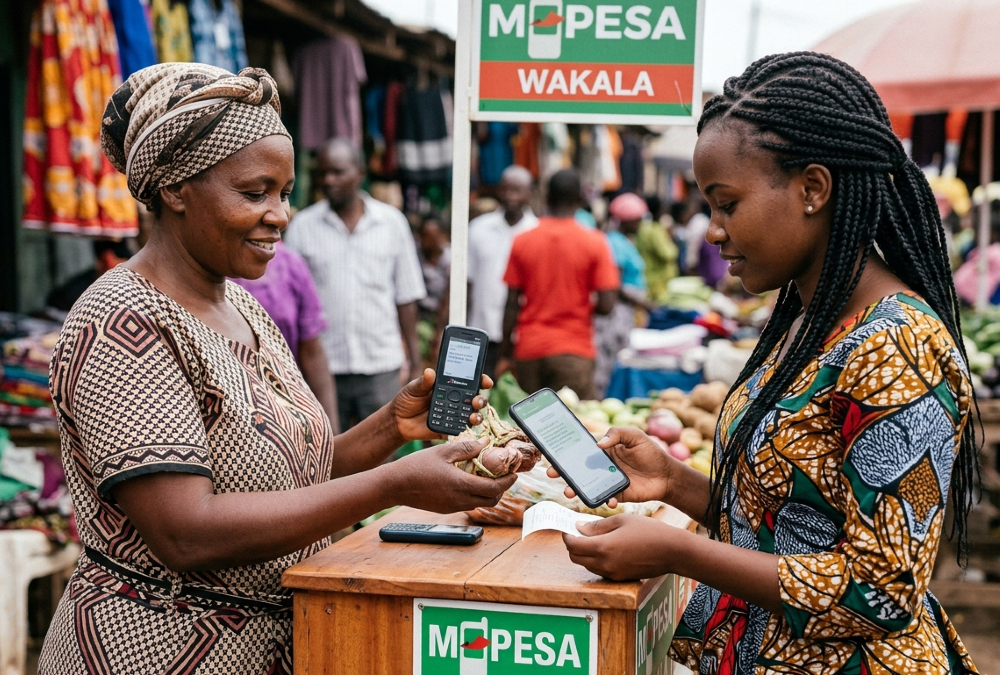
I split my time between Athens and Lusaka, which gives me an unusually direct view of this contrast. In Athens, I still carry a bank card for everyday purchases. Many Greek small businesses only recently began accepting card payments; some still prefer cash. In Lusaka, the woman selling tomatoes at a roadside market has a mobile-money number scrawled on a piece of cardboard. A customer sends payment from their phone; she confirms; the transaction is complete – no card reader, no terminal, no bank branch required.
Africa did not wait for the banking infrastructure the West spent two centuries building. It skipped it entirely.
The Gaps Are Just as Instructive as the Heights
Yet the data also reveals where the mobile-money wave has not yet arrived. Southern Africa accounts for just 5 million active accounts and US$8 billion in value – a small fraction of East Africa’s volumes.
The explanation is largely structural: South Africa’s traditional banking system is sufficiently developed that mobile money never needed to fill the same void. The rest of the region, Zambia included, is still catching up.
North Africa tells a similar story, with approximately 6 million accounts. There, a combination of entrenched traditional banking systems and regulatory friction has slowed adoption considerably.
These gaps are not signs of failure. They are signals of where the next wave is forming.
What This Means for Business
The strategic implications of this data are direct and should not require interpretation.
For companies entering East or West African markets, a mobile-money-first payment strategy is not a feature to be added later – it is the baseline. If a product or service cannot be paid for via M-Pesa, Airtel Money, MTN MoMo, or Orange Money, it is effectively invisible to hundreds of millions of potential customers.
“Also available via mobile money” is no longer sufficient positioning. It must be the default.
For companies eyeing Southern or Central Africa, the opportunity is different in kind. Mobile-money adoption in these markets is growing rapidly but has not yet reached saturation.
The businesses that build mobile-money-integrated solutions now – before the inflection point – will hold structural advantages when adoption catches up to East Africa’s levels. Early infrastructure tends to become permanent infrastructure.
Thirteen Dollars at a Time
One figure in the data deserves particular attention: the average transfer value in East Africa is US$13. Thirteen dollars. These are not large remittances or corporate payments. They are micro-transactions – small amounts, moving at very high frequency, millions of times each day. This is not supplemental payment infrastructure for people who lack bank accounts. It is the primary economic plumbing for a vast and growing population.
The US$1.3 trillion figure is not a projection or a forecast. It is not a pilot program or a proof of concept. It is last year’s transaction volume. This is finance in Africa as it exists today.
Executives who are still asking how people pay for things in Africa are asking a question that has already been answered, at scale, by hundreds of millions of consumers who did not wait for the Western financial system to arrive. Companies that take the data seriously and build accordingly will find themselves with an enormous addressable market. Those that do not will find themselves irrelevant to it.
The infrastructure already exists. The question now is whether foreign businesses will adapt to it, or continue designing for a financial reality that no longer applies.
John Kourkoutas is business development expert that specializes in helping companies, export teams, and business leaders succeed in Africa’s dynamic and emerging markets.
