
Opinion
“Africa Is Open for Business” – But What Does That Actually Mean?
The continent’s most repeated investment pitch needs more than poetry. It needs proof.

By JP Følsgaard Bak
How many times must we say “Africa is open for business” before someone demands a definition?
Few phrases circulate more freely in global boardrooms, diplomatic forums, and investment summits. Heads of state invoke it. Institutional investors echo it. Media commentators repeat it like a refrain. And yet, each time it lands, the same question rises, quietly but persistently: what does it actually mean in practice?
Does it mean capital can enter with confidence? Does it mean contracts will be honored? Does it mean that foreign and local investors alike can rely on predictable regulation, transparent bureaucracy, and credible dispute resolution – not as aspirations, but as operational realities?
Or has the phrase, however well-intentioned, become a sophisticated piece of branding that too often substitutes for the harder, slower, less glamorous work of institution-building?
That is where the real conversation must begin.
The Opportunity Is Undeniable – and That Is Precisely the Problem
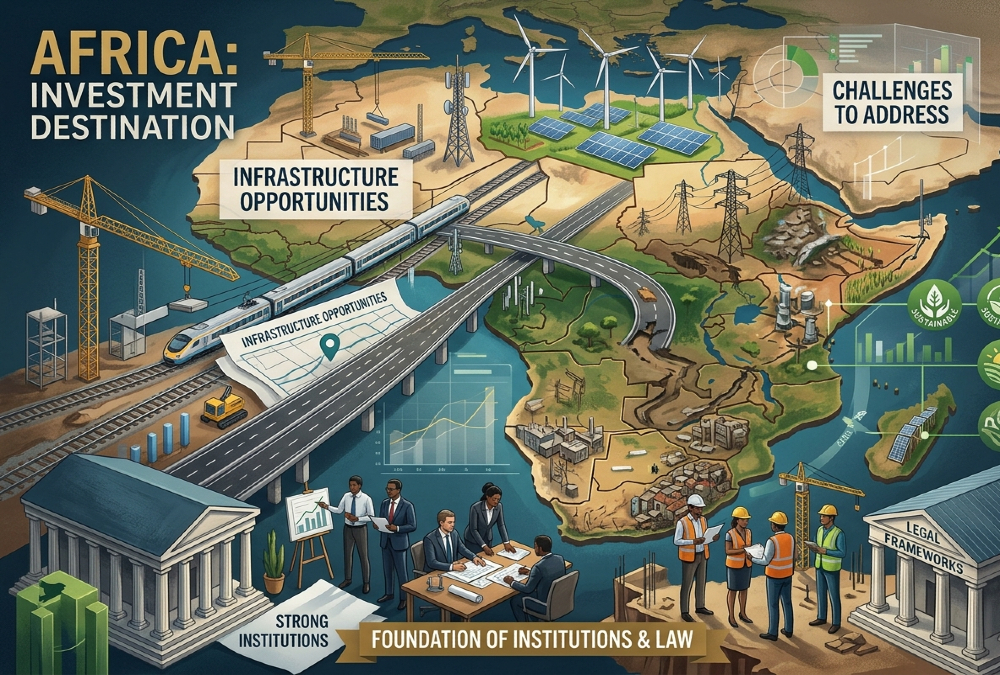
Africa’s growth case is not in dispute. The demographics are extraordinary. The entrepreneurial energy is palpable. The natural resource base remains among the most significant on earth. The continent’s capacity for digital leapfrogging – bypassing legacy infrastructure entirely – has already produced some of the most innovative fintech and mobile ecosystems in the world.
All of it is real. All of it matters.
But opportunity, however compelling, does not by itself create sustainable investment. Trust does. And trust is not built on narratives – it is built on systems.
Rule of law. Administrative clarity. Contract certainty. Functional arbitration mechanisms. Institutional accountability.
Without these foundations, even the most powerful investment story becomes structurally fragile. Capital may arrive once, drawn in by the pitch. But it rarely returns when expectations and lived experience diverge. And in today’s global investment environment, where capital is mobile and institutional memory is long, the cost of that divergence compounds.
The Phrase Must Not Be Abandoned – It Must Be Earned
This is not an argument for retiring the slogan. Quite the opposite.
“Africa is open for business” is one of the most potent economic narratives of our era. It carries ambition, agency, and an invitation. Used well, it signals a continent asserting its place in the global economy on its own terms. That matters enormously – culturally, diplomatically, and commercially.
But the phrase now requires substance proportionate to its promise. Rhetoric and reality must close the gap, or the narrative will eventually hollow out – not in global summits, where it will continue to be applauded, but in the allocation decisions of institutional investors who operate on evidence, not enthusiasm.
A Proposal Worth Considering
The African Union, in partnership with regional economic communities and national governments, should seriously consider establishing minimum institutional standards that give the “open for business” label genuine and verifiable meaning.
If this phrase is to remain Africa’s defining economic pitch to the world, it should signal something specific: legal reliability, regulatory predictability, and the credible protection of investor rights – for domestic and international stakeholders alike. It should be a standard that can be measured, improved upon, and held to account.
Investors do not allocate capital to slogans. They allocate it to trust. And trust, ultimately, is institutional.
The Framework Must Keep Pace with the Promise
Africa does not need less ambition. It has ambition in abundance. What it needs are stronger, more resilient systems to match its extraordinary potential – institutions that outlast election cycles, governance reforms that compound rather than reset, and a business environment where the rules are not just written, but consistently applied.
The opportunity is immense. The narrative is powerful. The question now is whether the institutional framework is keeping pace – and whether those with the authority to close that gap have the will to do so.
The phrase is ready. The world is listening. The work is what remains.
JP Følsgaard Bak, Esq., a former lawyer, is a dedicated international social entrepreneur and serial entrepreneur. He co-founded several technology companies, including EMX Group (a biomedical microchip manufacturer in California), Sûrtab S.A. (a tablet PC manufacturer in Haiti), and Bak USA. Currently, he serves as Chairman of Industry Five Group, with operations in the USA, Denmark, Uganda, Nigeria, Gabon, and Ethiopia.
