
Opinion
The Hum of Resilience: How Nigeria Built a Shadow Grid

By Dishant Shah
Every Nigerian knows the sound.
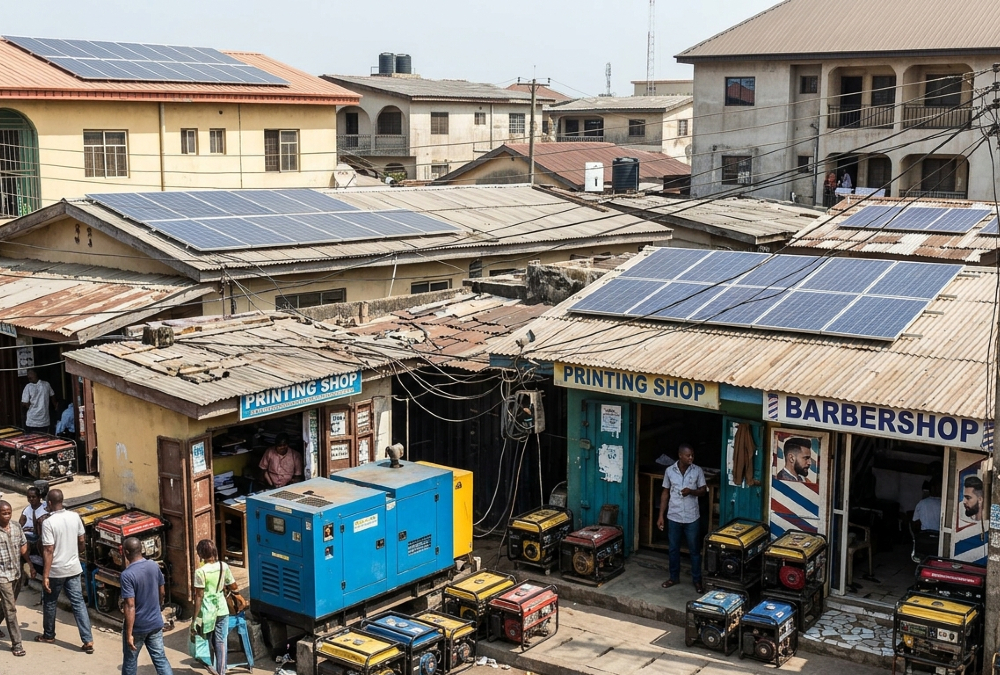
A low hum rises somewhere down the street. Then another joins it, and another, until an entire neighborhood pulses with the collective effort of a nation that has quietly decided, without legislation or fanfare, to build its own electricity grid – one generator at a time.
The term load shedding has a clinical ring to it. What unfolds in Nigeria is something else entirely.
The national grid collapses. It is restored. It collapses again. And in the gap between those two states, roughly 240 million people have constructed a sprawling parallel economy dedicated to one primal purpose: keeping the lights on.
Nigeria is the world’s largest generator market. Estimates place annual spending on generator fuel alone somewhere between US$14 billion and US$22 billion – and that figure excludes the machines themselves, their maintenance, and the long-term health toll on millions of people breathing exhaust fumes in poorly ventilated spaces.
Small businesses budget for diesel the way they budget for rent. Hospitals run critical equipment off backup generators. Cold chains for vaccines and perishable food depend on them. Entire residential developments have wired themselves to communal generators, with residents paying monthly subscriptions simply to avoid darkness.
The irony is punishing. Nigeria sits atop some of the largest natural gas reserves on the planet – gas that is routinely flared into the atmosphere at oil production sites because the infrastructure to capture and distribute it does not exist.
Meanwhile, a generator repair technician in Lagos’s Alaba market is turning away business, because the country’s failure to solve one infrastructure problem has spawned a thriving informal economy around its consequences.
A Economy Built on Breakdown
That informal economy deserves serious examination. Generator mechanics, fuel retailers, electrical technicians, spare parts traders, and importers of Chinese-manufactured machines: an entire ecosystem of livelihoods built not on prosperity, but on the persistence of dysfunction.
Nigeria did not invent this phenomenon, but it has industrialized it at a scale that is genuinely staggering.
The cost to productivity is difficult to quantify and impossible to ignore. A business running eight hours of generator power daily carries an overhead burden that its counterpart in Nairobi or Accra simply does not.
That cost compounds across every sector – manufacturing, retail, fintech, healthcare – quietly suppressing what Nigerian enterprises can achieve on price and margin in regional and global markets. It is a structural disadvantage baked into the operating environment, invisible in headline growth figures but corrosive in everything they obscure.
The Solar Insurgency
What is beginning to shift – slowly, and without any coordinating hand – is the solar layer accumulating on top of all of this. Lagos rooftops are increasingly bristling with panels.
Startups such as Lumos Nigeria and Yellow are distributing solar home systems to customers who have simply stopped waiting for the grid to arrive. They are not optimists. They are pragmatists who have run the numbers and concluded that the sun is more reliable than the state.
The generator will not disappear overnight. Its grip on Nigerian daily life is too deep, its supply chains too entrenched, and the grid’s recovery – if it comes – too uncertain in its timing. But for the first time, its dominance is facing a credible challenger.
Nigeria’s energy story is not, at its core, a story of failure. It is a story of extraordinary adaptation to failure – of a people who, denied a functioning system, built their own.
That is worth acknowledging. It is also worth asking how much further Nigeria might go if it did not have to.
Dishant Shah is a partner at Legion Exim, a company specializing in facilitating the export of high-quality engineering products directly sourced from manufacturers in India to Africa. His areas of expertise include new business development and business management.
