
Opinion
AfCFTA’s $450 Billion Moment: Why Africa’s Trade Pact Cannot Wait


By Mark-Anthony Johnson
Africa stands at an inflection point. For decades, the continent’s economies have been locked into a colonial-era pattern – exporting raw commodities to foreign manufacturers and importing the finished goods back at a premium.
The African Continental Free Trade Area (AfCFTA), now ratified by 49 of the continent’s 55 nations, offers a credible and historic escape route. The question is no longer whether Africa will integrate its markets, but how quickly it can do so – and whether the political will exists to match the ambition.
The economic stakes are formidable. The World Bank estimates that full implementation of the AfCFTA could boost regional income by as much as US$450 billion, or roughly 7 percent, by 2035, while lifting 30 million people out of extreme poverty.
Intra-African trade, currently a paltry 15 to 16 percent of the continent’s total commerce – compared to approximately 70 percent within Europe and 60 percent within Asia – could increase by as much as 81 percent. By 2026 alone, the agreement is projected to push that figure to US$230 billion.
These are not aspirational numbers dressed up in diplomatic language; they are conservative estimates grounded in decades of trade-integration research.
Breaking the Commodity Trap
The case for acceleration rests on several converging imperatives. The most structurally significant is industrialization.
The AfCFTA’s tariff-reduction architecture creates the conditions for genuine regional value chains – the kind that allow lithium-rich nations such as the Democratic Republic of Congo and Zambia to manufacture battery components rather than simply shipping unprocessed ore to Asia or Europe.
The difference between exporting a raw mineral and exporting a processed good is not merely one of price; it is one of jobs, technology transfer, and long-term economic sovereignty. Acceleration compresses the timeline for that transition.
The second imperative is resilience. The COVID-19 pandemic and Russia’s invasion of Ukraine administered painful lessons to developing economies about the dangers of over-reliance on external supply chains.
Africa’s dependence on imported food, medicine, and industrial inputs exposed its vulnerability with brutal clarity. A more integrated internal market is, in this sense, not only an economic strategy but a national-security one.
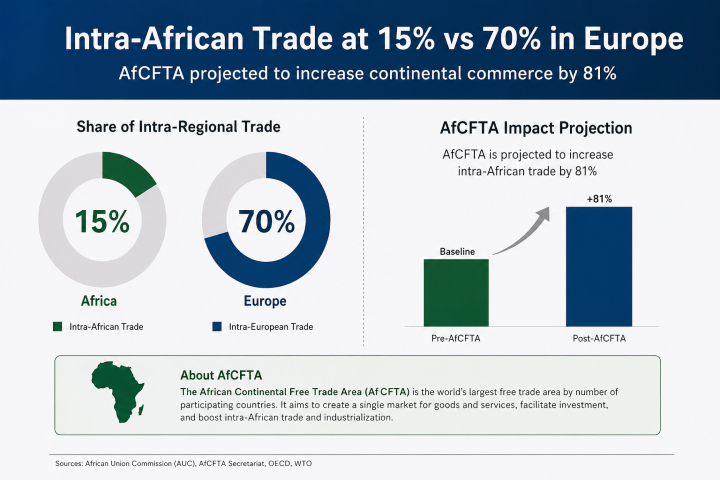
Chart showing intra-African trade at 15% versus 70% in Europe, with AfCFTA projected to increase continental commerce by 81%
Jobs, Investment, and the Digital Frontier
Investment and employment reinforce the argument further. The AfCFTA is expected to increase foreign direct investment by between 111 percent and 159 percent, with much of the new activity concentrated in manufacturing and agro-processing – sectors well-suited to absorbing the continent’s rapidly expanding youth population.
Digital trade provisions, meanwhile, could streamline customs procedures dramatically, cutting border delays by up to 50 percent through harmonized standards and digitized clearance systems. For small cross-border traders – the majority of whom are women – that reduction in friction is transformative.
Ratification Is Not Enough
Yet acceleration requires more than goodwill. Implementation has been uneven. Although 49 signatories have deposited instruments of ratification with the African Union Commission, operationalizing the agreement’s more complex provisions – rules of origin, dispute settlement, investment protocols, and intellectual property frameworks – demands sustained institutional capacity that many member states have yet to build.
The gap between ratification and genuine implementation remains wide in several cases.
None of this makes the AfCFTA’s promise illusory. It makes urgency the operative word.
A unified market of 1.5 billion people is not an abstraction; it is the most powerful lever Africa has to reposition itself in a fragmenting global economy. The architecture exists.
The ratifications are accruing. What remains is the harder work of turning a historic agreement into a functioning economic reality – before the window of demographic dividend begins to close.
Mark-Anthony Johnson is the founder and CEO of JIC Holdings, a global asset and investment management firm founded in 2009. With over 30 years of experience and strong ties to Africa, his investments span mining, infrastructure, power, shipping, commodities, agriculture, and fisheries. He is currently focused on developing farms across Africa, aiming to position the continent as the world’s breadbasket.
