
Opinion
Industrialization Without Illusion
The continent’s manufacturing ambitions will remain unfulfilled until rhetoric yields to the hard discipline of structural reform.
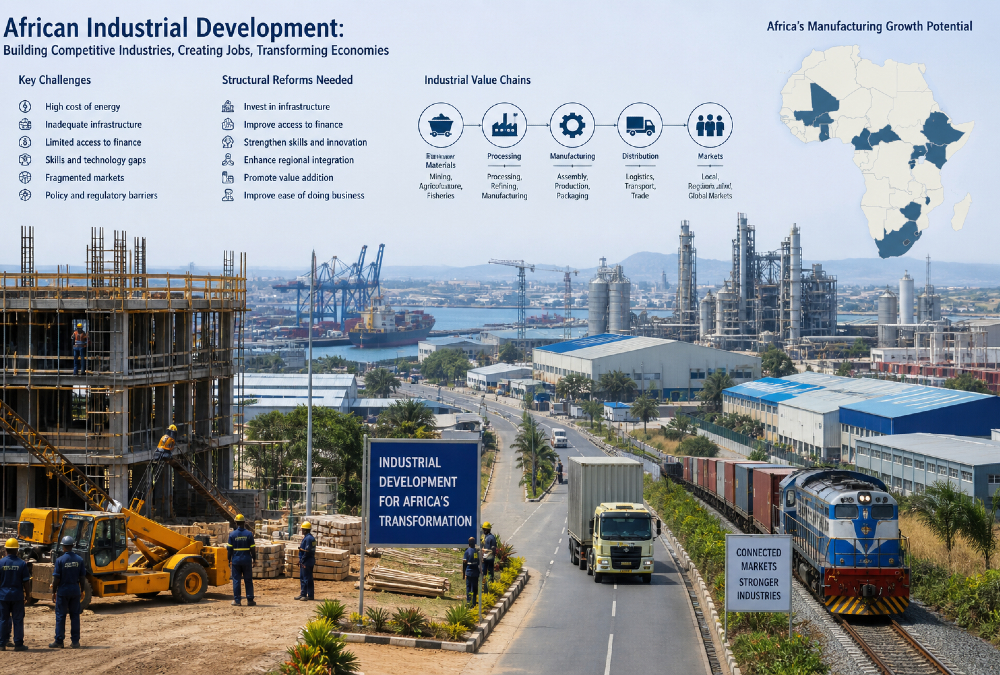

By Daki Nkanyane
There is a particular brand of African optimism that has grown economically perilous. It is the optimism that mistakes announcements for factories, special economic zones for industrial ecosystems, startup energy for productive depth, and trade agreements for manufacturing competitiveness.
It is the optimism that allows a continent to speak like a builder while continuing to operate like a supplier of unfinished value. That optimism must now be confronted.
In 2024, Africa accounted for just 2.0 percent of global manufacturing value added, despite representing 3.2 percent of global GDP. That gap is not a statistical curiosity. It is a warning.
It signals that Africa remains materially present in the global economy yet dangerously thin in the layer where productive power solidifies. Manufacturing matters not because every nation must romanticize the factory floor, but because industrial capability is among the clearest indicators that an economy can transform raw inputs into complexity.
It is how countries deepen skills, standardize quality, build supplier networks, learn by doing, raise productivity, reduce import dependence, and ascend value chains. Without that deepening, growth stays vulnerable, employment remains fragile, and sovereignty becomes performative.
Africa does not need more industrialization rhetoric. It needs industrialization without illusion.
That means beginning with an uncomfortable truth: the continent cannot manufacture its way into strength unless it becomes brutally honest about what manufacturing actually requires.
Industry is not built by declaring ambition. It is built through reliable electricity, efficient ports, streamlined customs, connected roads and rail, finance that understands working capital, standards systems that certify quality, technical education that produces real competence, and governments capable of holding policy direction long enough for firms to invest with confidence.
Industrialization is not a moment of inspiration. It is a long discipline of coordination.
The Ceremony of Words
This is where the African conversation too often becomes ceremonial. The language of beneficiation, localization, regional value chains, and industrial corridors is celebrated.
Forums are convened, communiqués issued, potential unlocked in speech if not in structure. But industry does not grow because a phrase became fashionable. It grows because constraints are removed in the right sequence.
On that front, Africa still confronts severe structural barriers. The African Development Bank’s 2025 outlook describes the continent’s growth as resilient but still constrained by global headwinds and domestic structural weaknesses, arguing that deeper, properly sequenced reforms are essential if Africa is to mobilize its strengths at scale.
That phrase deserves emphasis: properly sequenced reforms.
One of the recurring African mistakes is to pursue industrial outcomes without industrial sequencing: competitive manufacturing before reliable power, export-ready firms before standards readiness, continental value chains before border efficiency, productive ecosystems before supplier development, industrial finance without industrial discipline.
The top of the staircase is coveted without building the middle steps. That is not strategy. That is impatience dressed as vision.
Africa’s industrial challenge is not simply a shortage of factories. It is a shortage of the invisible scaffolding that makes factories durable.
A government can open an industrial park, cut a ribbon, and still fail to create an industrial system. It can announce a manufacturing push and still leave firms to battle power outages, logistics breakdowns, policy reversals, import bottlenecks, weak quality infrastructure, and expensive finance entirely on their own.
In such an environment, industry becomes an act of endurance rather than a pathway to scale.
Energy, Trade, and the Limits of Legal Access
No continent can industrialize at speed while treating electricity instability as an unfortunate background condition. The African Development Bank’s long-term strategy places power and energy access at the center of transformation for good reason: without dependable electricity, productive capability is capped, investment appetite weakens, and manufacturing costs rise in ways that quietly kill competitiveness before firms even reach the market.
The same logic applies to trade infrastructure. The African Continental Free Trade Area has opened historic legal and institutional space, and that achievement should not be underestimated.
Africa’s total merchandise trade recovered strongly in 2024, with intra-African trade rising to US$220.3 billion. Yet Afreximbank has made clear that the continent must move beyond commodity dependence and accelerate industrialization if it wants stronger integration into global and regional value chains.
A market can be open on paper and inaccessible in practice. A region can be integrated in legal theory and still fragmented in productive capability.
Africa cannot trade its way into industrial strength unless it also produces its way into trade relevance. Otherwise, AfCFTA risks becoming a larger space through which unfinished goods, imported products, and unevenly competitive firms circulate without sufficient structural upgrading.
Strategy, Not Sympathy
Industrialization without illusion must also mean industrialization without romance. Not every country will become everything. Not every sector deserves pursuit everywhere. Not every ambition merits public money.
The continent must become more selective, more regional, and more strategic. Industrial policy in Africa cannot be a wish list. It must be a theory of comparative buildability – asking where inputs, market access, labor pools, energy pathways, logistics potential, and learning capability already exist, and where regional value chains can distribute functions intelligently across countries rather than compelling each state to replicate the same industrial aspiration.
Recent work from the UN Industrial Development Organization underlines precisely this point: competitive industrialization on the continent depends on strengthening standards, quality infrastructure, logistics, and small-business participation within regional ecosystems, not on imagining isolated national leaps.
The sectors that matter are not always glamorous. Agro-processing, pharmaceuticals, building materials, textiles, automotive components, minerals processing, fertilizer value chains, and energy-linked manufacturing may lack the drama of Silicon Savannah narratives, but glamour is not the metric. Capability is.
Africa has spent too long admiring the image of industrialization. It must now commit to the mechanics of it – vocational systems, maintenance ecosystems, warehousing, machine uptime, technical regulators, export certification, functional industrial parks, public procurement that supports domestic capability without collapsing into patronage, and finance structures that sustain firms through the valley between setup and scale.
These are not things that dominate headlines. But they determine whether manufacturing survives after the launch event.
The Political Price of Seriousness
Industrialization requires a political class willing to think beyond transaction and spectacle. A leadership that sees industry merely as a public-relations theme will never build it.
A bureaucracy that cannot coordinate across ministries will perpetually delay it. A financial sector that prefers passive instruments over productive risk-sharing will starve it.
A society that normalizes import dependence while speaking proudly of transformation will indefinitely postpone it. Industry does not fail only because markets are hard. It fails because seriousness is rare.
There are, nonetheless, signs of possibility. UNIDO’s quarterly manufacturing reports show that Africa led regional manufacturing growth in the third quarter of 2025, suggesting that pockets of genuine industrial momentum exist.
But momentum is not transformation, and episodic growth does not resolve the deeper questions of scale, diversification, and sustained competitiveness. The continent remains too exposed to commodity cycles, too weak in manufacturing weight, and too uneven in infrastructure, policy coherence, and productive depth to indulge in self-congratulation.
The world is reorganizing around supply chains, energy systems, strategic minerals, digital infrastructure, and geopolitical competition. In such a world, a continent that fails to industrialize seriously does not merely miss growth.
It surrenders leverage. It remains useful but not powerful, present but not decisive, resource-rich but capability-poor.
Aspiration Is Not Architecture
The real industrial question before Africa is not whether the continent believes in industrialization – almost everyone now claims to. The real question is whether Africa is prepared to pay the price of industrial seriousness: disciplined coordination, selective prioritization, infrastructure execution, technical competence, policy consistency, and the humility to build the unglamorous middle.
Industrialization is slow before it is visible. It is cumulative before it is celebrated. It asks societies to invest in systems whose rewards arrive later than election cycles, later than keynote speeches, later than the emotional demand for immediate applause. That is precisely why so many governments prefer the theater of transformation to the discipline of it.
Africa will not manufacture its future by admiring factories from a distance or by speaking the language of industrial ambition more fluently than before. It will manufacture its future only when industry stops being treated as a slogan and starts being treated as a system – when power supply, logistics, standards, finance, skills, and regional coordination are understood not as ancillary concerns but as industrial policy itself.
Only then will industrialization become more than a recurring African promise. Only then will the continent stop asking whether it can industrialize, and begin demonstrating to the world that it already is.
Daki Nkanyane is a South African – born Pan-African thought leader, entrepreneur, keynote speaker, and strategist with over 25 years of experience driving innovation, identity, and development across Africa. He is the Founder & CEO of Interflex Capital, AfrisoftLive, QonnectedAfrica, and iThinkAfrica, where he focuses on youth empowerment, entrepreneurial ecosystems, and Africa’s economic and ideological renewal. His work spans technology, digital transformation, major international events, and strategic advisory for future-ready African institutions. As a contributing writer for The Habari Network, Daki covers African innovation, leadership, human capital, economics, entrepreneurship, and Africa–Caribbean relations through cultural, philosophical, and developmental perspectives. His mission is to help shape a new African consciousness rooted in pride, possibility, and self-determination for Africans on the continent and in the diaspora. He can also be reached on Facebook and X.
