
Opinion
AI Won’t Save African Agriculture – But It Can Help
The technology industry’s favorite fix for food insecurity misses the point. A pilot program with 5,000 smallholder farmers shows what actually works.

By Sheena Raikundalia
AI is not going to fix agriculture in Africa. Yet walk into any development finance conference, scroll through any agri-tech publication, or sit through any pitch at Davos, and you would be forgiven for believing otherwise.
Artificial intelligence has become the miracle cure that the global development community reaches for instinctively – a solution in search of problems, deployed with confidence and remarkably little scrutiny.
There is a version of AI built for agriculture that has become almost inescapable. It is sleek, frictionless, and impressive in a demonstration room.
It was designed in San Francisco, refined in Mountain View, and showcased in the Swiss Alps. There is another version – the one that might actually function across sub-Saharan Africa.
It is messier, more communal, and stubbornly, irreducibly human.
The Silicon Valley Hypothesis
Consider the most seductive idea currently circulating in agri-tech circles: what if every smallholder farmer had access to AI-powered advisory services – personalized guidance on what to grow, when to plant, and how to manage inputs? The pitch is compelling. It sounds like democratized expertise at scale.
Except that even granting the most optimistic assumptions – perfect agronomic data, universal smartphone penetration, reliable rural connectivity – a fundamental question goes conspicuously unasked: what problem does this actually solve? And, perhaps more pressingly, who is going to pay for it?
The environmental cost of powering large language models at continental scale has, conveniently, remained outside the frame of discussion entirely.
These are not pedantic objections. They are the difference between a technology that transforms livelihoods and one that generates compelling impact reports while leaving structural poverty intact.
What the Data Actually Showed
At Kuza One (Kuza Biashara), we spent the past year testing AI-powered agricultural advisory with 5,000 women poultry farmers across Kenya. The findings were instructive – not because AI performed as promised, but because of the precise ways in which it fell short, and the unexpected ways in which it added value.
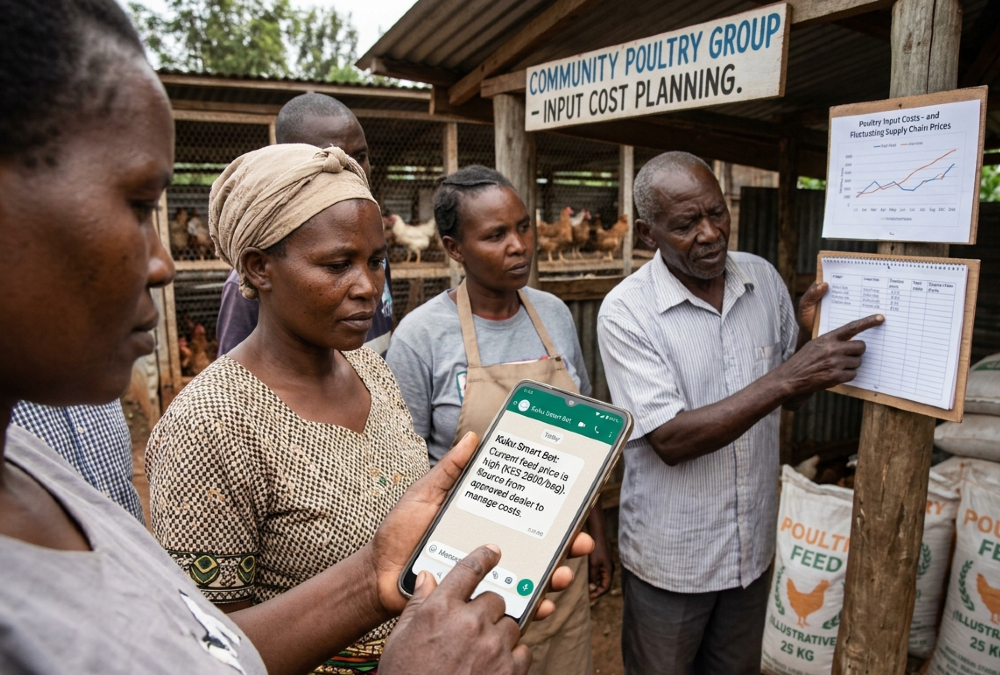
On the positive side, adoption exceeded expectations. Farmers engaged meaningfully with a WhatsApp-based AI chatbot. Shared smartphones, it turned out, were not the access barrier that most models assumed. Usage was real, not performative.
But the behavioral data told a more complicated story. Farmers did not use the tool individually. Decisions were made collectively, in groups, through a process of communal deliberation that the platform had not anticipated and could not accommodate.
Trust, moreover, did not transfer to the algorithm. It remained anchored in human relationships – with a local agripreneur, a group champion, a trusted peer. No chatbot, however well-designed, inherited that social capital.
Most revealingly, AI ran headlong into what might be called the Input Wall. Feed accounts for roughly 70 percent of poultry production costs in the markets where these farmers operate.
No volume of optimized digital advisory manifests cheaper grain from thin air. A farmer can internalize every best practice the model recommends and still operate an unviable business, because the constraint is not knowledge – it is the structural cost of inputs.
The Value That Was Actually Created
Here is what AI did accomplish, and it is worth taking seriously: it made the invisible visible.
Individually, each of these 5,000 farmers was too small to register as a meaningful counterpart in negotiations with major feed suppliers. Aggregated, they represent a substantial, predictable, high-value market.
AI helped surface that collective demand signal in a way that manual coordination could not have achieved efficiently.
That revelation unlocks a different set of conversations entirely. Could these farmers negotiate bulk feed discounts through a formalized purchasing cooperative?
Could aggregated demand lower logistics costs across the supply chain? Could a local entrepreneur now justify building a regional feed mill, with a proven, data-backed market guarantee reducing the investment risk?
These are not hypothetical questions. They are live commercial opportunities, made legible by technology – but executable only through human institutions, human trust networks, and human entrepreneurship.
Rethinking the Role of AI in Development
The lesson here is not that AI is useless in African agriculture. It is that the use case matters enormously, and that the use cases attracting the most attention and investment are frequently the wrong ones.
AI as individualized advisory, delivered directly to isolated smallholders, addresses a secondary constraint while leaving primary ones untouched. AI as a mechanism for aggregating collective market power, surfacing latent demand, and reducing the information asymmetries that keep smallholders structurally disadvantaged – that is a different proposition entirely, and a considerably more promising one.
The technology industry would do well to sit with that distinction before the next conference season begins.
In the meantime, the more urgent question is a practical one. Who among feed suppliers is willing to explore bulk discount structures for organized farmer cooperatives? Who is actively seeking reliable, large-scale markets for eggs and live birds? Who has ideas – tested ones, not theoretical ones – for materially reducing feed costs at the farm level?
AI surfaced the opportunity. It will take people to act on it.
Sheena Raikundalia is an accomplished entrepreneur, former lawyer, government policy advisor, and angel investor with deep expertise across the legal, financial services, and impact investment sectors in Europe and Africa. She has played a pivotal role in advancing Africa’s technology and innovation ecosystems, leveraging a career that spans top-tier London law firms, leadership as Country Director of the UK-Kenya Tech Hub for the UK Foreign, Commonwealth & Development Office (FCDO), and her current position as Chief Growth Officer at agri-tech company Kuza One. Sheena is recognized for her strategic vision, commitment to fostering innovation, and strong advocacy for Africa’s growth potential in technology, entrepreneurship, and impact investment.
