
A Diaspora View of Africa
Immigration Is High on the List for the Next Congress

By Gregory Simpkins
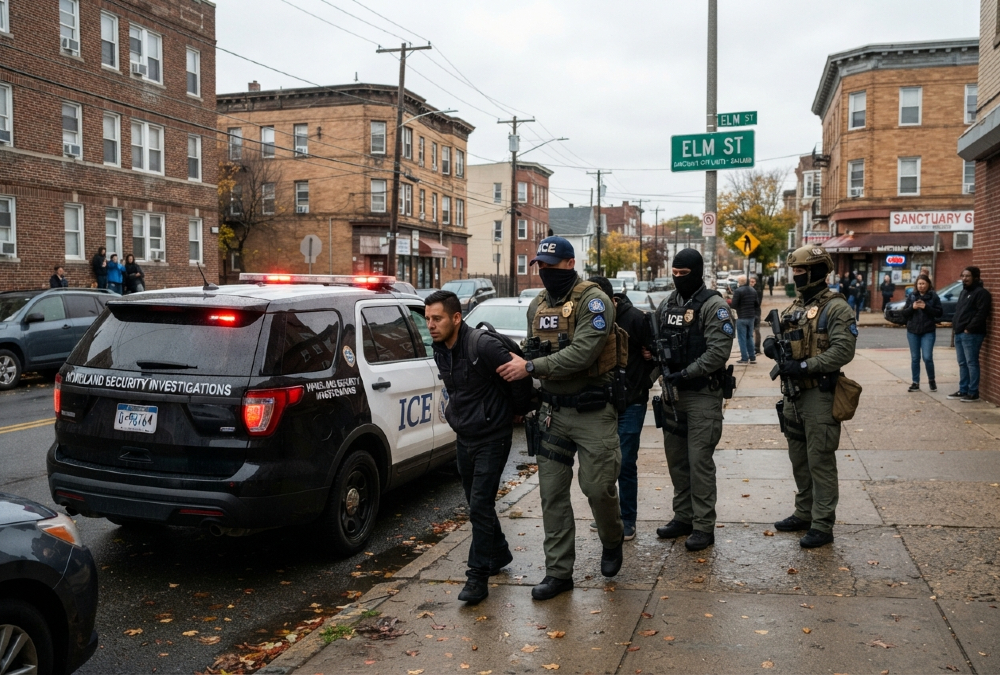
Members of the incoming Democratic-controlled Congress say they want to overturn policies implemented by President Trump in the first half of his second term. None, though, is as eagerly targeted as his aggressive immigration policies. While his second term has not removed as many people as some previous administrations did, the Homeland Security efforts have been deemed unduly harsh even by other Republicans.
Trump officials say their initial focus has been criminal aliens. In sanctuary states and cities, however, officials have refused to cooperate with detainer orders for targeted prisoners being released. The officials say this forced officers to seek these criminals in communities, where they then come across illegal immigrants who are not being sought for violent crimes but who have violated immigration law. Resistance has led to violent confrontations that have at times resulted in the deaths of targeted aliens and of citizens attempting to block arrests.
In addition to the allegations of overly aggressive enforcement of immigration law, opponents of the Immigration and Customs Enforcement (ICE) efforts accuse Trump officials of setting high targets of 3,000 undocumented immigrant removals a day, which would exceed the number of violent criminals in the country. However, there is disagreement about the number of undocumented immigrants at the heart of the matter, with conservatives claiming as many as 20 million crossed the border under President Joe Biden’s administration.
Counting the Biden-Era Border Crossings
There is no single official count of undocumented immigrants under Biden because the government counts events, not people. Three different numbers must be separated:
According to Customs and Border Protection (CBP) nationwide encounters, a total of 10,825,387 undocumented immigrants were recorded in FY2021-FY2024. The Southwest border alone accounted for more than 8.7 million of them.
Gotaways add an estimated 1.5 to 2.0 million people who were detected on sensors or cameras but not apprehended. Former Border Patrol Chief Raul Ortiz testified that the gotaway figure could be underreported by 20 percent.
It is important to note that an encounter is not necessarily a different person. One person who is expelled under Title 42 and tries again three times is counted as three encounters. CBP also counts people turned away at ports of entry, people expelled, and people paroled in.
According to the Department of Homeland Security/FactCheck analysis of initial processing, about 2.8 million undocumented immigrants were removed or expelled, approximately 2.5 to 3.6 million were released into the US to await court proceedings, and the rest were transferred to ICE or Health and Human Services, or detained.
For that released population, the top nationalities were Venezuela (773,000), Cuba (539,000), Mexico (404,000), Honduras (388,000) and Colombia (354,000).
An Associated Press analysis of government data released in 2025 looked at 4.5 million people apprehended by Border Patrol and permitted to remain temporarily from October 2018 through July 2025; most of that period was under Biden. Their stated destinations were Florida first, then Texas, California and New York. That is different from total encounters. Venezuelans and Cubans were far more likely to be released because the US could not easily deport them to Venezuela or Cuba, while Mexicans were far more likely to be quickly expelled because that government was more cooperative.
As the best measure of how many undocumented immigrants were living here, the Pew Research Center, using revised Census data from August 2025, estimated that there were 10.5 million undocumented immigrants in 2021, but by 2023 that number had grown to 14 million.
Pew estimates that growth continued into early 2024, slowed sharply in late 2024 after Biden’s June 2024 asylum restrictions and parole pauses, and began falling in 2025. Other researchers (the Migration Policy Institute and the Center for Migration Studies) put the 2023 figure at 13.7 million to 14.6 million: the same trend, but a different method.
Race and Nationality of Undocumented Immigrants
CBP does not collect race. It collects citizenship and nationality, so race has to be estimated by researchers from Census surveys.
Because most unauthorized immigrants are from Latin America, researchers estimate that the unauthorized population is overwhelmingly Hispanic/Latino (of any race), roughly three-quarters in older estimates, with that share falling as the Asian and Black shares rose.
Pew’s 2023 breakdown for all immigrants showed the following by race:
- Hispanic immigrants: 41 percent undocumented;
- Black immigrants: 21 percent unauthorized (about 1.2 million Black undocumented immigrants, mostly Haitian, Jamaican, Nigerian and Ethiopian);
- Asian immigrants: a much lower unauthorized share, although India and China drove growth.
In other words, the Biden-era surge was not primarily Mexican. It was a hemispheric surge led by Venezuela, Cuba, Central America, Colombia and Haiti, plus a smaller but fast-growing Asian and African component. There was also a European component, but it was minimal.
Trump’s Words on Immigrants
Trump cannot credibly deny having made statements that indicate an aversion to the entry of people from developing countries into the country, except, of course, for the recent welcoming of whites from South Africa.
Comments he has made over many years indicate his suspicion that people of color coming across the border are detrimental to the United States.
Critics point to a pattern of remarks by Trump himself, by senior officials like Stephen Miller, Kristi Noem and Vice President JD Vance, and by allied conservative commentators, all focused specifically on unauthorized entry. The administration and its supporters say the remarks are about illegal status, crime and vetting, not race. Critics say the language targets people of color from specific countries.
Here are the most-cited examples of Trump’s comments in chronological order:
2015 campaign launch – Mexico:
““When Mexico sends its people, they’re not sending their best… They’re bringing drugs. They’re bringing crime. They’re rapists. And some, I assume, are good people.”
January 2018 – Oval Office meeting on Haiti, El Salvador and Africa:
“Why are we having all these people from shithole countries come here?” He was referring to Haiti and African nations, and he then asked why the U.S. couldn’t have more people from places like Norway.
Trump denied using that exact word, but multiple senators in the room confirmed it. He has since repeated the sentiment.
December 2023 – New Hampshire / Iowa, repeated in 2024:
“They’re poisoning the blood of our country… They’ve poisoned mental institutions and prisons all over the world. Not just in South America, not just the three or four countries that we think about, but all over the world they’re coming into our country from Africa, from Asia.”
Trump defended it: “I never read ‘Mein Kampf,’” “I have no idea what Hitler said,” and said he meant fentanyl deaths and crime, not race. Vance defended it the same way.
September 2024 – Pennsylvania rally, repeated in 2025-2026:
“Why can’t we have some people from Norway, Sweden? Send us some nice people, do you mind? But we always take people from Somalia, places that are a disaster, right? Filthy, dirty, disgusting, ridden with crime.”
In November 2025, he called Somali immigrants, including US citizens, “garbage” and “trash,” and led “send her back” chants about Representative Ilhan Omar, a Somali-American citizen.
Clearly, culture, if not race alone, has played a role in the anti-immigrant sentiment of this administration. But was the Trump effort to expel large numbers of undocumented immigrants merely race-based, or were other factors involved? I examine that further in Part 2.
Gregory Simpkins, a longtime specialist in African policy development, is the Principal of 21st Century Solutions. He consults with organizations on African policy issues generally, especially in relating to the U.S. Government. He is Editor-in-Chief of The Habari Network, the premier African Diaspora news website and moderates the Network’s podcast: Real Talk Habari.
