
A Diaspora View of Africa
Belligerent Words and Actions Undermine US Diplomacy in Nigeria

By Gregory Simpkins
As I have stated recently, the United States, which strode the world stage as a political and economic colossus after World War II, no longer has the cache to continue to push other nations to do its bidding even if that bidding is thought to be for that other nation’s good. President Donald Trump has always had a fashion of exaggeration and even belligerence in his public comments ostensibly to force action from other nations.
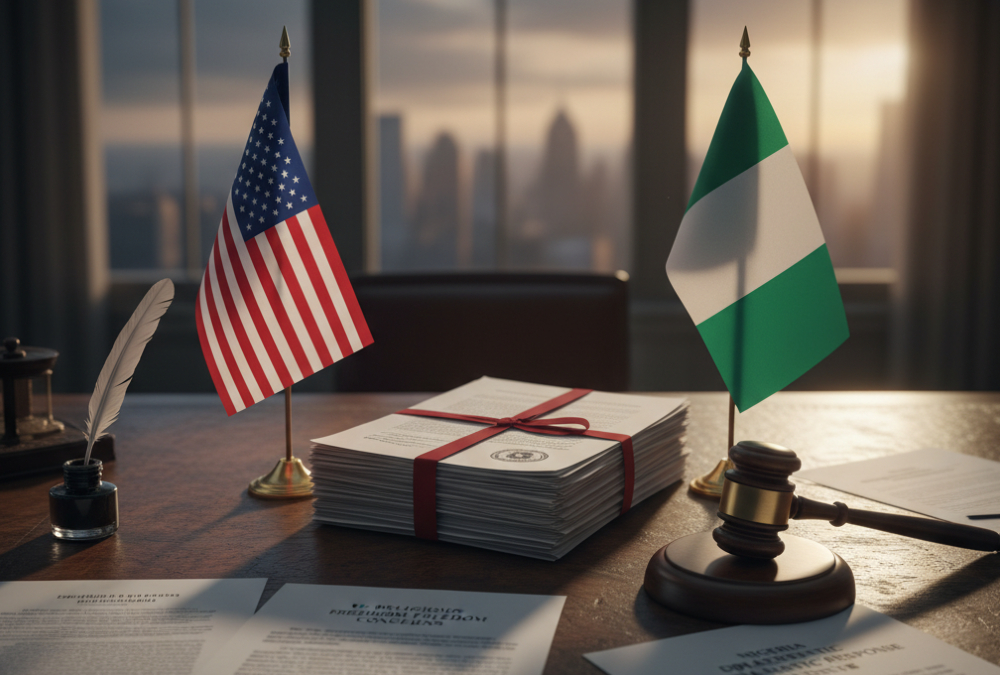
This is why he has designated Nigeria as a Country of Particular Concern (CPC) for religious persecution.
“Christianity is facing an existential threat in Nigeria. Thousands of Christians are being killed. Radical Islamists are responsible for this mass slaughter,” Trump said on his Truth Social platform.
The CPC list identifies countries that engage in or tolerate “systematic, ongoing, and egregious violations of religious freedom.” Countries on the CPC list can face U.S. sanctions or diplomatic pressure to improve religious freedom conditions.
In 2020, the U.S. Department of State designated Nigeria as a CPC for the first time due to religious freedom violations. But in 2021, the designation was removed due to an evaluation that stated the violence was not religiously motivated.
Actually, it was believed to have been done to smooth the way for a visit to Nigeria by then-Secretary of State Antony Blinken.
Firsthand Evidence vs. Political Rhetoric
As I stated in an earlier post, there is indeed observable mass killings of Christians in Nigeria who refuse to convert to Islam. As part of House Africa Subcommittee Chairman Chris Smith’s team, I saw firsthand the results of extremist attacks on Christians and Muslims who refused to accept Boko Haram’s aberrant theology.
That is the result of direct examination in hearings in the House of Representatives and in Nigeria in meetings with Christian and Muslim leaders. I don’t know to what extent these records have been examined and considered by Trump administration advisers, but they could and should discuss these matters with Chairman Smith, who was the instigator of those hearings and meetings.
Smith could explain his first-hand knowledge that there are indeed multiple targets of Islamic extremists in Nigeria. In addition to religious-based attacks, there are clashes between largely Christian farmers and largely Muslim herders, conflicts concerning dwindling resources, communal rivalries, secessionist actions and ethnic clashes.
While Christians are among those targeted, analysts say the majority of victims of armed groups are Muslims in Nigeria’s Muslim-majority north, where most attacks occur. Still, that does not diminish the scale of Christian killings in Nigeria since the majority of Nigeria Christians live outside the north.
Chairman Smith also could explain the long-term US efforts to work with the Nigerian government to overcome Boko Haram and its offshoots who threaten the lives of those who do not comply with the aberrant views on Islam. Perhaps that would temper the bold proclamations coming out of the White House.
Escalating Rhetoric and the Specter of Military Intervention
“I am hereby instructing the Department of War to prepare for possible action,” Trump said on the Truth Social platform.
His call for direct US military action in Nigeria is consistent with what many see as recklessness in foreign policy. Among those who despise Trump, this is seen as threatening a sovereign nation with an unauthorized invasion.
However, any genuine preparations for military action would soon uncover the longstanding collaboration – however faltered – by both governments on this issue, and I strongly believe direct US military action is not a real possibility – just words to provoke a quick, effective Nigerian response.
The Nigeria government is growing uneasy as Republican lawmakers bring the issue into Washington’s mainstream. US Senator Ted Cruz last month introduced the Nigeria Religious Freedom Accountability Act of 2025 to “protect Christians and other religious minorities” by imposing sanctions on Nigerian officials accused of “facilitating” jihadist violence.
Representative Riley Moore introduced House Resolution 866, calling for Nigeria to be redesignated as a CPC over religious repression.
Both pieces of legislation have been fulfilled at least in part by Trump’s CPC designation. Apparently, comedian Bill Maher’s recent statement on Christian genocide in Nigeria seems to have increased attention on this matter in government, much to the chagrin of the Nigerian government.
Nigeria’s lack of a senior diplomatic presence in Washington under President Bola Tinubu, and an absence of lobbyist support, has left it vulnerable to Trump’s threat of military action over alleged Christian persecution in Africa’s most populous country.
Nigeria’s Diplomatic Vacuum in Washington
This debate has precedent. In 2018, during US President Donald Trump’s first term, then-Nigerian President Muhammadu Buhari pushed back on allegations of anti-Christian violence during his White House visit.
Nigeria was later labeled a CPC in 2020, a move the Biden administration reversed.
But this time it’s different, everything has been turned up to 11 as Semafor described in a November 5 article. Officials in Abuja feared for quite a while that a second Trump administration could revive the CPC designation and go further, with punitive tools like immigration limits, new tariffs, and sanctions for officials, but have thus far done little to protect its interests in the United States.
As one person familiar with discussions in Abuja said of Nigeria’s stance: “There’s a sense of helplessness.”
Nigeria’s lack of a senior diplomatic presence in Washington under President Bola Tinubu, and an absence of lobbyist support, has left it vulnerable to Trump’s threat of military action over alleged Christian persecution in Africa’s most populous country.
Semafor reports that Abuja is scrambling to appoint an ambassador to the US after two years without one. The move is part of a broader effort by Abuja to appoint ambassadors to missions abroad this month.
Regulatory filings examined by Semafor showed the Nigerian government has had little to no lobbyist representation in Washington since Tinubu took office in 2023. Instead, Nigeria has been outspent in Washington by Biafra separatist groups who, according to filings, have focused on raising the issue of “Christian killings” on Capitol Hill to chime with a long-running narrative of conservative Christian circles.
One longtime Washington lawyer who has worked with African governments described Nigeria’s lack of senior representation or lobbyists in Trump’s first year as “shocking”.
Cameron Hudson, a former White House Africa director, said that lobbyists could have given the Tinubu administration a better read of the situation in Washington. “This is not an era to be casual about your diplomacy in Washington,” he said.
A Call for Strategic and Timely Nigerian Engagement
Tinubu recalled all of Nigeria’s ambassadors months after taking office in 2023, and those posts – including at key security and trade partner countries like the US and UK – have remained vacant. Nigeria has instead relied on career civil servants at more than 100 foreign embassies and consulates to manage diplomatic affairs, an approach Foreign Minister Yusuf Tuggar defended in an interview with Semafor in October.
“It’s not the case that all ambassadors need to be political appointees,” he said.
The strategy had raised concerns about Nigeria’s foreign policy architecture in wider circles but had not prompted an altered approach from the government until the recent Trump threat to review US assistance to Nigeria. Tuggar’s office did not respond to Semafor’s request for comment on the reported move to appoint ambassadors.
A list of potential candidates has been resurrected, a person close to the Nigerian presidency told the news service, adding that “lobbying is happening” for plum posts.
One can only hope that the Nigerian government can speed up its selection for representation in Washington, taking care to select someone with genuine diplomatic skills with a capable surrounding team assembled. All the dire predictions for damaging US action, including suspending possible continuing intelligence and military collaboration, could come true without an effective Nigerian response as soon as possible.
The Nigerian response should of course explain Nigeria’s complex situation but must focus on past, current and future collaboration to eliminate the ongoing Islamist extremist threat in the country.
Gregory Simpkins, a longtime specialist in African policy development, is the Principal of 21st Century Solutions. He consults with organizations on African policy issues generally, especially in relating to the U.S. Government. He further acts as a consultant to the African Merchants Association, where he advises the Association in its efforts to stimulate an increase in trade between several hundred African Diaspora small and medium enterprises and their African partners.
