
A Diaspora View of Africa
Why Foreign Economic Systems Struggle to Adapt in Africa

By Gregory Simpkins
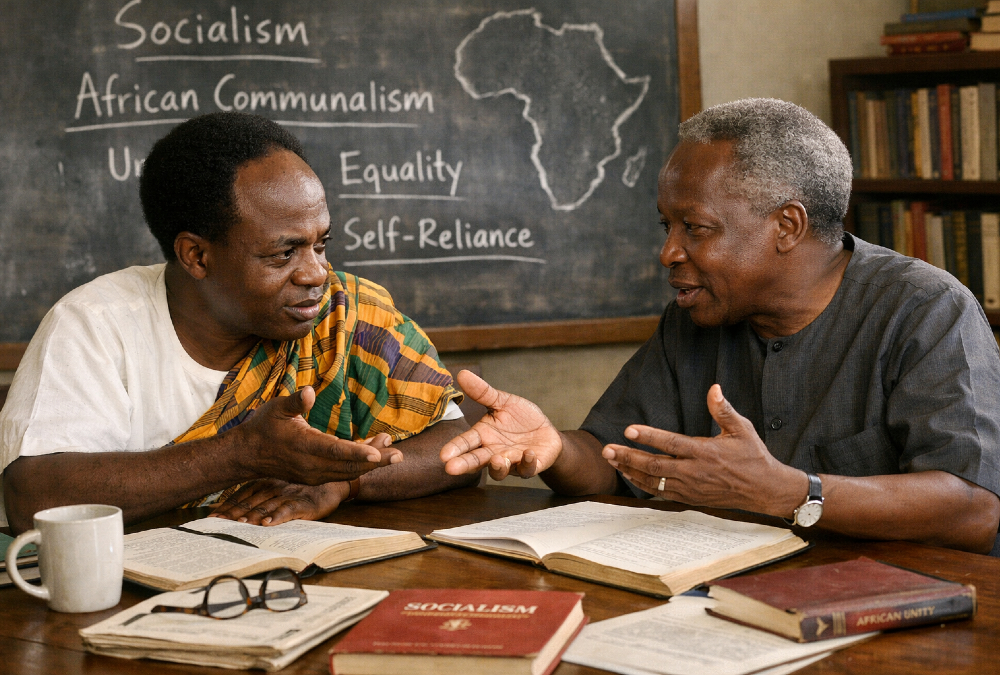
In the most recent Habari Network podcast, Habari director Emmanuel Musaazi asked our guest about how Communalism affected business and entrepreneurship in Africa. It brings up a point often overlooked when considering African economic success or failure: have foreign economic systems adapted to the traditional African economic and social systems?
The question of whether the international concept of democracy works or must be adapted in Africa has been examined, but not economic compatibility with foreign economic theories and practices.
African Communalism has a rich history. In the Pre-Colonial Era, many African societies were organized around communal systems, with shared land ownership and collective decision-making.
Examples include the Igbo people of Nigeria, the Yoruba people of Nigeria and Benin, and the Zulu people of South Africa.
Then there is the practice of ubuntu, a philosophy emphasizing interconnectedness and community, prevalent in southern Africa. Ujamaa is a Swahili concept meaning “familyhood” or “community”, promoted by Julius Nyerere in Tanzania.
Colonialism disrupted traditional communal systems, imposing European-style governance and economies. Many African societies resisted, maintaining communal practices alongside colonial structures.
In the Post-Colonial Era, some African leaders, like Nyerere and Kwame Nkrumah promoted Communalism as a foundation for national development.
Countries like Botswana and Ghana incorporated communal elements into their governance structures. Communal land ownership and management are still common in many African countries.
Community-based organizations and cooperatives are widespread, addressing issues like agriculture, healthcare and education. African Communalism has evolved over time, influencing governance, economies and social structures.
Its principles continue to shape African societies and inform development approaches.
The Introduction of Foreign Economic Systems
Marxism and Socialism were introduced to Africa through various channels.
Colonial Era: European colonial powers brought Marxist and socialist ideas to Africa, often through:
- Education: African students studied in European universities, where they were exposed to socialist and Marxist ideologies.
- Labor Movements: African workers, influenced by European labor movements, began organizing and adopting socialist principles.
- Anti-Colonial Struggles: Nationalist leaders, like Nkrumah and Nyerere, drew inspiration from socialist and Marxist ideologies to fight colonialism.
Cold War Era: The Cold War rivalry between the US and USSR led to:
- Soviet Influence: The USSR supported African liberation movements, introducing socialist ideas and providing military aid.
- Chinese Influence: China, under Mao, promoted its own brand of Marxism, gaining traction in countries like Tanzania and Zambia.
Key Events and Figures:
- Bandung Conference (1955): African and Asian leaders, including Nkrumah and Nyerere, discussed socialist and anti-colonial ideas.
- Ghana’s Independence (1957): Nkrumah’s socialist government became a model for other African nations.
- Tanzania’s Ujamaa (1964): Nyerere’s socialist experiment, inspired by Chinese and Soviet models, aimed to create a self-sufficient economy.
These influences shaped Africa’s post-colonial landscape, with various countries adopting socialist or Marxist ideologies. Whereas Communalism emphasizes community control, Marxism is a system where the state controls the means of production, and there’s no private property or social classes.
The idea is to create a classless society with equal distribution of resources, ostensibly as in the old Soviet Union.
Socialism is an economic system where the means of production are owned and regulated by the state or by the workers themselves. The goal is to reduce economic inequality and promote social welfare. Examples include Nordic countries like Sweden and Denmark.
Marxism advocates state ownership, Socialism often involves state regulation, and African Communalism focuses on community ownership. Marxism is a broad ideology, while Socialism is more of an economic system, and African Communalism offers a cultural and philosophical approach.
Marxism and Socialism have had varying degrees of success in Africa. While no African country has implemented a strict form of Marxism, several have adopted socialist ideologies, often blending them with traditional African values.
Successes include Ghana under Nkrumah, which implemented socialist policies focusing on industrialization and modernization. The country made significant strides in education and healthcare.
Tanzania under Nyerere’s Ujamaa policy aimed to create a self-sufficient economy, improving education and healthcare. Tanzania’s literacy rate increased significantly, and life expectancy rose.
Senegal under Léopold Sédar Senghor’s socialist government implemented policies promoting economic development, education, and cultural preservation.
However there have been challenges under Marxist and socialist regimes in Africa. Many socialist economies in Africa, even those achieving some level of success, have faced difficulties, leading to food shortages and economic stagnation.
Some socialist regimes became authoritarian, suppressing opposition and individual freedoms. By the 1980s, many African socialist countries adopted neoliberal reforms, shifting towards market-oriented economies.
Notable examples of these subsequent reforms are Angola’s MPLA, the Marxist-Leninist group that fought for independence and implemented socialist policies, and Mozambique’s FRELIMO, the socialist liberation movement that became the ruling party after independence.
The Capitalist Detour
Capitalism was introduced first to Africa through colonialism, where European powers imposed capitalist systems on African colonies, exploiting natural resources and labor. European traders and merchants established trade relationships with African kingdoms and empires.
European missionaries and explorers introduced Western economic ideas and values. In the Post-Colonial Era, many African countries adopted capitalist systems after gaining independence, often with Western influence.
The tenets of Capitalism make it entirely different from Marxism, Socialism and Communalism.
First of all, individuals and businesses own resources and means of production. Under a free market system, there is supposed to be a voluntary exchange of goods and services, with prices determined by supply and demand.
There is a profit motive where individuals and businesses aim to maximize profits. Businesses compete with each other, driving innovation and efficiency.
There is supposed to be limited government intervention in which government regulates markets to protect property rights and prevent monopolies.
Some notable examples of Capitalism in Africa include South Africa’s mining industry – a significant sector driven by private investment and competition. Kenya’s tech sector is a hub for innovation and entrepreneurship, with companies like Safaricom and Andela. Ghana’s gold mining sector is a major industry with private companies operating in the country.
Capitalism has indeed been successful in various African countries, driving economic growth and development. Let’s look at some examples:
- Mauritius: This island-nation is a shining example of economic success, with an average annual GDP growth of 5.4 percent between 1970 and 2010. Its business-friendly policies and adaptability to external shocks have made it a hub for economic diversification.
- Ethiopia: Ethiopia has made significant strides in infrastructure development, particularly in energy, and has become a major player in African manufacturing.
- Tanzania: With a focus on urban development and infrastructure, Tanzania has experienced rapid economic growth, averaging 6.5 percent in 2017.
- Benin: Benin’s rural development projects have improved livelihoods and created jobs, highlighting the potential for inclusive growth.
- Ivory Coast: With a GDP growth rate of 7.4 percent, Ivory Coast is another success story, driven by its excellent infrastructure and government initiatives.
Other countries, like Ghana, Kenya and South Africa, also are experiencing significant economic growth, driven by sectors like technology, agriculture and renewable energy. These success stories demonstrate Africa’s potential for economic growth and development, driven by Capitalism and innovative solutions.
Marxism, Socialism and Capitalism can clash with African Communalism in several ways.
Marxist centralized planning’s emphasis on state-owned means of production might conflict with African Communalism’s focus on community ownership and decision-making, and its centralized planning might disregard traditional African communal decision-making processes.
Socialism’s state regulation might limit community autonomy and self-governance in African communal contexts, and socialist economic planning might not account for traditional African communal economic practices. Capitalism’s emphasis on individualism and competition might clash with African Communalism’s focus on community and mutual support, and Capitalism’s private property rights might conflict with communal land ownership and resource management practices.
These ideologies can conflict, but their elements also can be adapted and blended to suit African contexts just as the configuration of democracy can be adjusted to fit specific African contexts. Some countries, like Botswana, have incorporated communal elements into their governance and economy.
To the extent that African governments and societies can adapt the beneficial elements of foreign economic systems to fit their social traditions, these outside influences can have a positive rather than a negative impact. The question is: will foreign proponents of the three outside economic influences at long last disavow interference and coercion to allow African societies to make the adaptations needed to create successful, harmonious and sustainable economic conditions?
Gregory Simpkins, a longtime specialist in African policy development, is the Principal of 21st Century Solutions. He consults with organizations on African policy issues generally, especially in relating to the U.S. Government. He further acts as a consultant to the African Merchants Association, where he advises the Association in its efforts to stimulate an increase in trade between several hundred African Diaspora small and medium enterprises and their African partners.
